


 Shkruar nga Pamfleti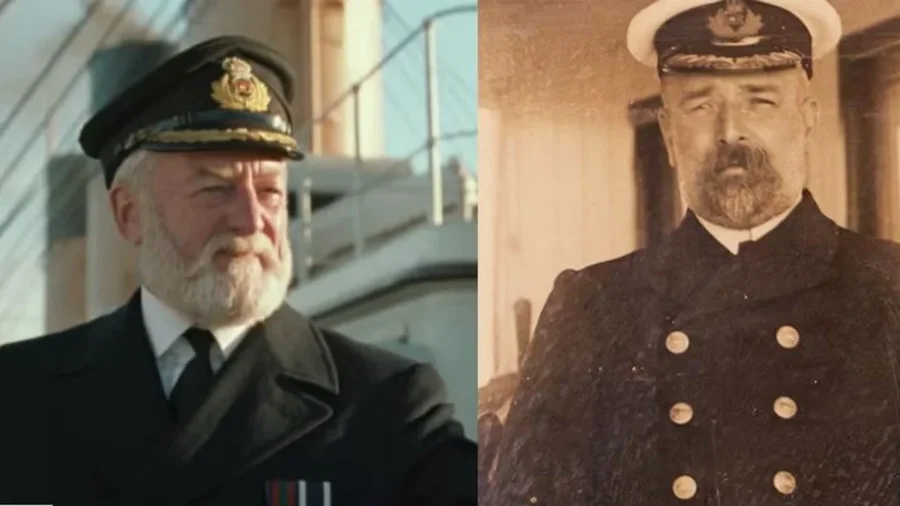
Millions of viewers watched the captain of the Titanic, Edward John Smith, die a hero's death. But is this the truth?
In James Cameron's 1997 blockbuster, the captain of the Titanic is at the helm as the ship sinks in the Atlantic Ocean when water bursts through the wheelhouse windows.
This is a very different story from the one told eight decades ago, on April 18, 1912 – three days after the sinking – when the Los Angeles Express announced on its front page: “Captain E.J. Smith killed himself.”
The next day, Britain's Daily Mirror announced on its cover: "Captain Smith kills himself."
As official inquiries into the maritime tragedy unfolded in New York and London, survivors claimed they too had heard rumors of his dishonorable behavior. And among the reports, some of them uncertain, were the captain's drinking habits, the Titanic's reckless speed, and the ignored warnings of ice ahead.
Sailors of the time were honored to travel on that ship. Could it be that the highest-paid captain in the world really ended his life in humiliation?
Now a new book claims to have cleared it all up. Author Dan E. Parkes is convinced that Smith did not kill himself, but drowned or froze in the icy waters, along with 1,495 others.
In his carefully researched account, “Titanic Legacy: The Captain, The Daughter and The Spy,” Parkes insists that the stains on Smith’s reputation are unjustified.
As evidence of the spread of strange stories, Parkes describes how three months after the sinking, a Baltimore man claimed that Smith had survived and was living in hiding in Maryland.
A few years later, Life magazine reported that a "wrecked" person in Ohio was also claiming to be the sailor declared dead.
Parkes also finds no evidence to show that Smith was pushing the Titanic too fast on its maiden voyage, ignoring warnings.
He denies reports of Smith's drinking and his feeling helpless as the ship sank.
While there were many “eyewitnesses… who reported an officer shooting and suicide,” Parkes argues that the person was unknown and therefore, it was impossible for him to be the unfortunate sailor.
Instead, Parkes suggests that traumatized passengers heard the shots, perhaps fired to control the panicked crowd, and assumed, without evidence, that it was Smith who was killing himself.
The survivors, angry and shocked by the turn of events, looked for someone to blame and found the captain, says Parkes.
Contrary to the suicide story, Robert Williams Daniel, a 27-year-old banker and first-class passenger, said he "saw Captain Smith" as the Titanic sank into the ocean.
He told the New York Herald at the time that he saw the captain drown in the water.
"He died like a hero," Daniel declared.
Frederick Dent Ray, a 33-year-old first-class saloon attendant, testified before a US inquiry that Smith's personal attendant, Arthur Paintin, was "the last person seen standing next to the captain".
A Connecticut millionaire, Frederick Hoyt, described how he went to his room, removed his outer clothing – believing he had a better chance of survival without those thick clothes – and then met with Smith.
He said he and Smith shared a stiff drink, to cope with the cold, before Hoyt jumped.
And Isaac Maynard, a 31-year-old cook, testified in New York that he “saw the captain standing on the bridge” as he himself was swept out to sea.
“One of the guys who was holding onto the boat tried to save him by reaching out his hand, but he refused and said, ‘Take care of yourselves, guys.’ I don’t know what happened to the captain, because I couldn’t see him at the time, but I assume he sank.”
Few of the survivors who claim to have seen Smith kill himself are credible, says Parkes, as they were in lifeboats that had been launched well before the final sinking.
Parkes cites other survivors who claimed that Smith went even further in his heroism, swimming to a lifeboat with a child held afloat and handing the child over to it, but refusing to board the boat himself.
Frederick Harris, a firefighter, told the British newspaper The Western Daily Mercury that "I saw the captain jump into the water and grab a child, who he put in one of the boats, which he had very little for. I did not see the captain after that."
Parkes argues that the heroic actions were entirely expected for a man so sought after by luxury-seeking travelers that he earned the nickname “Captain Millionaires.”
And, according to Parkes, Smith predicted his fate.
Concerned about the Titanic's stability, Ada Murdoch, who was the wife of the first officer, William Murdoch, warned Captain Smith about a "prophecy" in such a novel about the end of a great ship.
“Yes,” Smith is reported to have said, according to the Chicago Tribune, “if the biggest ship in the world sinks, I’ll go with it.”







Lini një Përgjigje