


 Shkruar nga Pamfleti
The Democratic Party, through a letter addressed to the Speaker of the Assembly, Niko Peleshi, requests representation in the October 16 session to be held at the Constitutional Court on the interpretation of the end of the mandate of the members of this Court.
The request signed by the head of the DP Parliamentary Group, Gazmend Bardhi, requests that the DP representative at this meeting be Marash Logu, who is also the legal advisor of the DP Parliamentary Group.
The DP has requested that Logu be accredited so that the session to review the terms of the Constitutional Court's mandates is inclusive and open.
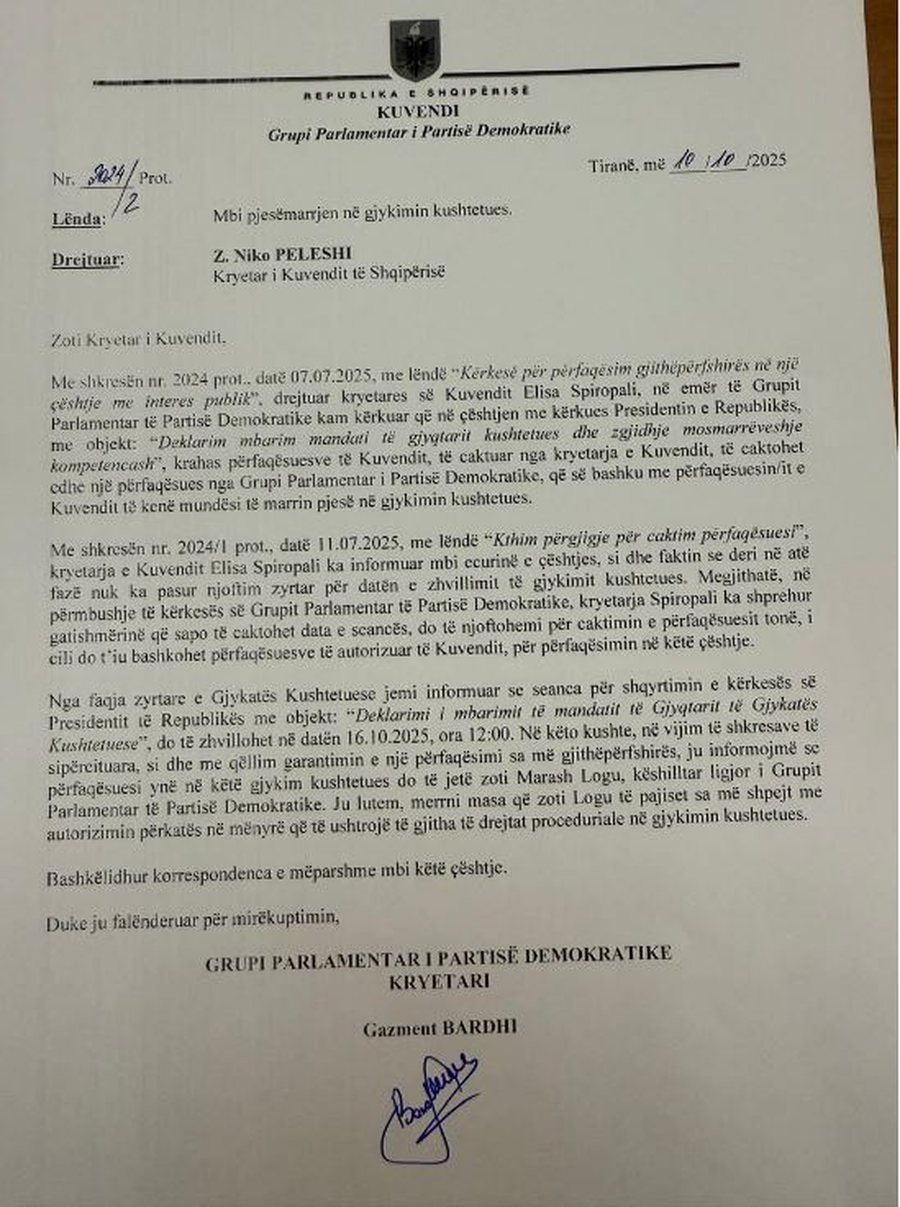
According to the letter signed by Bardhi, Logu should join the representatives authorized by the Assembly for this session.
The Constitutional Court was set in motion by President Bajram Begaj, who requested from this court an interpretation regarding the deadline for when a member's mandate ends. The debate arose over the mandate of Holta Zaçaj, who took office with a delay of almost 6 years from the moment the vacancy was created. Zaçaj claimed that her mandate was being interrupted, that is, without giving her the opportunity to exercise it full-time (9 years), while she was given the opportunity to exercise the 3-year mandate.
"The Law on the Constitutional Court establishes that the mandate of the Constitutional Judge begins on the date of taking the oath and ends, for the initial judges, as the case may be, eight or nine years later. In the conditions of the late appointment of the initial judges, the application of this provision nullifies the principle of partial renewal, both in 2025 and in 2028 or in 2031.
The partial renewal simultaneously includes three specific mandates. In order for the renewal intended by the Constitutional Court for 2025 to occur, the Court's reasoning for the renewal must also extend to the other two mandates that coincide with the renewal deadline.
The Constitutional Court's decision does not clarify this aspect, while the deadline for declaring the end of these mandates has expired without the Court taking any action, placing the appointing bodies in difficulty.
The Constitutional Court has had the obligation to create complete clarity about its decision-making, as it should be the first, most devoted and correct implementer of its decisions. In fact, the Court has preferred to transfer this responsibility to other institutions.
In the context of the Court's inaction, the President of the Republic has used the only opportunity recognized by law, the possibility of filing a request for a dispute of competence, to have the Constitutional Court resolve in a fair, comprehensive, constitutional and exhaustive manner the impasse created by the partial renewal mechanism.
The President of the Republic hopes that in this way the Constitutional Court will be able to fully and definitively clarify how the partial renewal of the Court should be, so that it is considered in accordance with the Constitution.
"The Constitutional Court must make this clarification in such a way that it is of value to all current constitutional judges, otherwise there will be no possibility of correcting the deformation of the renewal mechanism and any intervention to shorten certain mandates, only for one or a few judges, would be in clear violation of the Constitution," the request that the President addressed to the Constitutional Court stated.






Lini një Përgjigje