


 Shkruar nga Fred Abrahams
European hypocrisy in the Balkans: When Rama becomes the 'lover' of Brussels, but rules like an autocrat in Tirana...
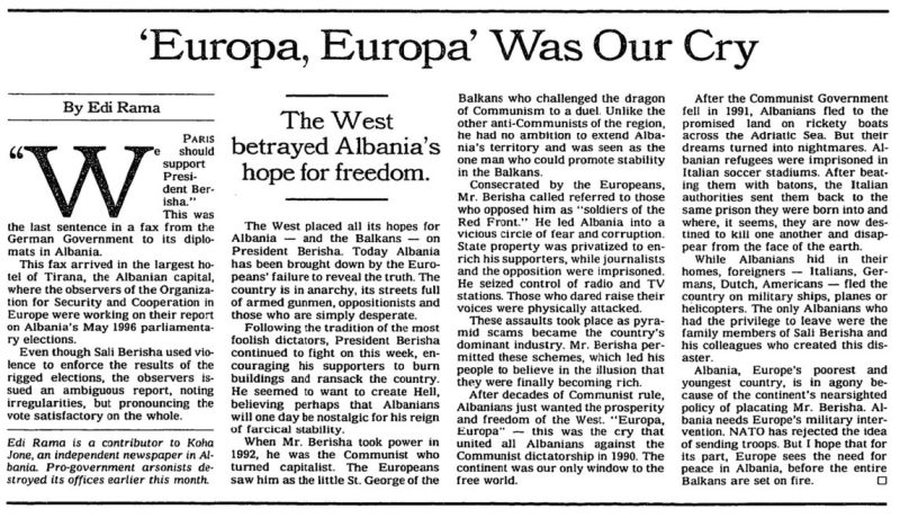
Twenty-eight years ago, Edi Rama, an Albanian artist in exile in Paris, wrote a scathing opinion piece in the New York Times, condemning Europe's blind support for Albania's authoritarian leader at the time, Sali Berisha.
As the country crumbled after the collapse of giant pyramid schemes, Rama accused Europe of choosing short-term stability through an autocracy, instead of investing in democracy and the rule of law.
“ Today, Albania is ruined by the failure of Europeans to see the truth ,” he wrote.
These words still ring strong today – except now, Rama is in power, having just secured his fourth consecutive term as prime minister, and last weekend he welcomed European leaders to Tirana, at the sixth summit of the European Political Community (EPC).
To be clear: The Albania of 2025 is a far cry from the chaos of 1997, under then-President Sali Berisha, the despot who brought the country to the brink of collapse. But one essential element of that era survives: the concentration of power in a single person, dominating the political, social, and economic life of the country .
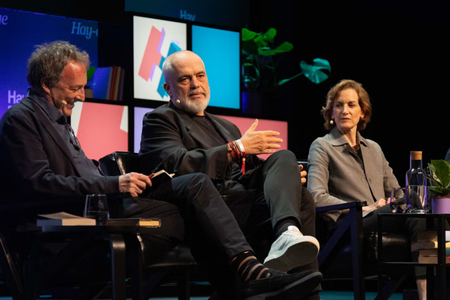
At first glance, today's Albania seems transformed. Rama, unapologetic about protocol and cosmopolitan in style, wears sneakers with suits, kneels on red carpets and shakes hands with world leaders. But after twelve years in power, his mastery lies in managing international relations while maintaining an iron grip on the country.
This control was strengthened on May 11, when Rama and his Socialist Party won a landslide victory over the Berisha-led opposition, campaigning on the promise of EU membership. The EPC summit then served as a triumphal parade.
Every handshake with Meloni, Merz and Macron in Tirana, faded the clear criticisms that international observers from the OSCE, the Council of Europe and the European Parliament raised about the elections: misuse of public resources, pressure on the administration and extensive control over the media.
Beyond the elections, every hug and congratulatory message legitimized the entrenched corruption and oligarchic politics that hides beneath the splendor of the tall towers surrounding "Skënderbej" Square, where - according to the official EPC website - "the history and modern identity of Albania come together."
The political dynamics in Albania retain the same characteristics as the last 35 years: elegance outside, control inside . On stage, the rule of law, democracy and European values appear. Behind the scenes, there are judges under pressure, media that is bought and tenders that are manipulated.
Since the fall of communism, Western governments have shown little interest in democracy in this small Balkan country – even though the conditions for democracy fill the pages of the EU membership application. What matters more is that Albania behaves “right” in the region – especially with regard to Kosovo and North Macedonia, as Rama does. And that it responds to calls when needed, such as by helping Italy circumvent European law by resettling migrants and asylum seekers in camps in Albania.
As Rama warned in 1997, European leaders are once again showing a “ failure to see the truth .” Or perhaps they see it clearly, but turn a “ deaf ear and a blind eye .” /Adapted from “Pamfleti” by “Euractiv”
*Fred Abrahams is the author of “Modern Albania: From Dictatorship to Democracy.” He covered the Southern Balkans for Human Rights Watch from 1993 to 2000.



Lini një Përgjigje