


 Shkruar nga Pamfleti
The Constitutional Court of Kosovo cannot review the draft statute for the establishment of the Association of Municipalities with a Serbian majority until the Government of Kosovo decrees it, Professor of Constitutional Law, Kadri Kryeziu, former judge of the Constitutional Court of Kosovo, tells Free Radio. .
About four months ago, the Prime Minister of Kosovo, Albin Kurti, accepted in principle a draft statute for the formation of this association, which was drawn up by the European Union. The president of Serbia, Aleksandar Vučić, accepted the same.
It should also be examined by the Constitutional Court of Kosovo, to prove its constitutionality, but the Government of Kosovo has not forwarded it yet.
The evaluation of the Constitutional Court should be the first step towards the possible harmonization of this statute, its final acceptance and the establishment of the Association.
The association will then provide the Serbs in Kosovo with greater rights in decision-making and management.
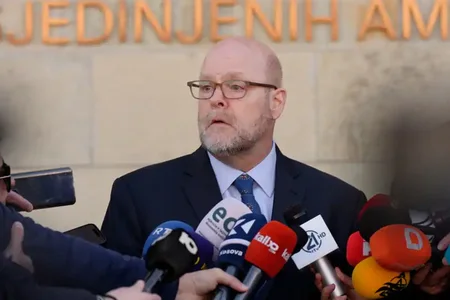
On February 29, the ambassador of the United States in Pristina, Jeffrey Hovenier, once again called on the Government of Kosovo to forward the draft statute to the Constitutional Court.
Radio Free Europe asked the Government of Kosovo why it has not forwarded it yet and when it will do so, but did not receive an answer.
The Speaker of the Assembly of Kosovo, Glauk Konjufca, said on Friday that the EU is not competent to propose to Kosovo a draft statute for the formation of the Association, but that he understands the request of the American ambassador to forward it to the Constitutional Court.
"Perhaps, Mr. Hovenier has said that Kosovo will propose a draft for the Association. This is another topic. I did not understand it the way you understood it", said Konjufca after the meeting of the Presidency of the Assembly of Kosovo.
Professor Kryeziu says that the dynamics of this process, in fact, depends on the Government and Prime Minister Kurti.
The Serbian political scientist, Ognjen Gogić, says that the text of the draft statute, initially, had to be agreed within the dialogue between Kosovo and Serbia for the normalization of relations.
About ten days after the international envoys delivered the draft statute to the parties, in October last year, the Prime Minister of Kosovo, Albin Kurti, said that the document was written carefully, in accordance with the spirit of the Constitution of Kosovo.
He also emphasized that the Constitutional Court of Kosovo will examine it.
But, at the end of December 2023, Kurti said that Kosovo should be the author of the statute and suggested that it should be written by itself, in cooperation with his Minister for Communities and Returns, Nenad Rashić, and the Minister of Local Government Administration , Elbert Krasniqi.
This statement was a reaction to a message from the EU's special envoy for the Kosovo-Serbia dialogue, Miroslav Lajçak, that the issue of the statute is an internal issue of Kosovo.
Otherwise, the draft statute that was submitted to Kosovo and Serbia was drawn up by the EU, after the parties previously accepted the Agreement for the normalization of relations, which was also proposed by the EU as a mediator of the dialogue.
Then, in January of this year, Kurti said that the Association of Serb-majority municipalities "is not the main priority" for the normalization of relations with Serbia and that the issue of the statute should not be separated from the agreement.
In a conversation with journalists from several media in Kosovo, including the REL team, on February 29, the American ambassador, Hovenier, said that he expects the Government of Kosovo to initiate the process of forming the Association of municipalities with a Serbian majority.
"The first step is to forward the statute, which we already have, to the Constitutional Court for review and confirmation", he said and expressed the hope that something like this would happen as soon as possible.
"The answer would be whether [the statute] is constitutional or not, whether it has executive powers or not... We think that this assessment can only be given by the [Constitutional] Court." This would create a different dynamic, as well as the commitment of Kosovo to fulfill its obligations", said Hovenier.
He sent this message to the Government of Kosovo at a time when relations between Pristina and Washington are not the best, because Kurti refuses to suspend the implementation of the regulation of the Central Bank of Kosovo that prohibits the use of the Serbian dinar in Kosovo.
The US and other Western countries expressed their concerns that this regulation could negatively affect the Serbian community in Kosovo, which receives dinars other than Serbia's budget.
The Professor of Constitutional Law, Kadri Kryeziu, says that the dynamics surrounding the evaluation of the statute for the Association depends only on the Government of Kosovo.
He adds that the formation of this association is "its national and international obligation".
"When I say national obligation, I mean it because of the fact that that agreement [for the Association] has passed the Assembly and is a law. All the laws that are approved in the Assembly, the Government must implement them, so that this is a legal state", says Kryeziu.
He emphasizes that the Constitutional Court of Kosovo cannot examine a document that is not an act or a decision.
"The draft statute must be passed to the Government, a decision made and then decreed by the Prime Minister. Then, as a valid document, it is presented to the Constitutional Court. The Constitutional Court has no authority and right to decide, if they are not approached with a request", explains Kryeziu, former judge of the Constitutional Court.
He says he has seen the draft statute and has noticed some "problematic" provisions, such as the mention of UN Security Council Resolution 1244, but adds that the Constitutional Court should evaluate it and make possible recommendations. for harmonization.
In 2015, the Constitutional Court of Kosovo gave its opinion on the Agreement on the principles on the basis of which the Association would be formed. At that time, this agreement was not rejected, but it was said that inconsistencies with the Constitution could be harmonized.
Political scientist Ognjen Gogiç says that the text of the statute had to be agreed upon by both parties, before it was sent for consideration to the Constitutional Court of Kosovo.
Gogic says that if this court issues new recommendations, Serbia can reject them.
"All parties are bypassing the foreseen procedure. Thus, everyone is enabled to relativize and find legal deficiencies. It is a senseless procedure to allow [relativization] to anyone," says Gogiq.
He adds that the Government of Kosovo does not have the will to start the process of forming the Association and that "the statute will be kept in the drawer as long as possible".
Gogiç also emphasizes that the Association cannot be formed without the consent of the Government of Kosovo, because there are some responsibilities that must be transferred to it.
The draft statute for the formation of the Association was drawn up by European officials and provides for the Serbs in Kosovo to have a certain level of self-management, as agreed with the Agreement for the normalization of relations.
In that document it is stated that the Association will not have executive powers and that it will not threaten the independence and integrity of Kosovo.
However, the document refers, among other things, to Resolution 1244 of the UN Security Council.
This draft statute also foresees the possibility of financial support of the Association from Serbia, as well as "an effective direct channel of communication between the Kosovo Serb community and the Government of Kosovo, through the Ministry of Local Government Administration".
The part of the draft statute that refers to the powers of the Association specifies that this body has the right to make decisions, regulations, instructions and statements.
It will also have full authority, at the local level, in the areas of economic development, spatial planning, health, education and the protection of cultural and religious identity.
When it comes to funding, it is foreseen that the Association will have its own budget, which it would manage "responsibly and transparently".
Also, it is specified that the Association must have an account in a bank licensed by the Central Bank of Kosovo./ REL




Lini një Përgjigje