


 Shkruar nga Pamfleti
A quarter of a century later, in the midst of a new war in Europe, Freer points out that he and his soldiers stationed in Kosovo felt they were part of something meaningful, something truly significant.
The original plan of NATO commanders was to deploy their forces to Pristina airport on June 11, 1999, while 250 Russian soldiers were already on their way to the airport. NATO decided to send its forces into the Kaçanik Gorge instead – had the Russians come across, who knows what might have happened. World War Three could have started, explains Adrian Freer, 25 years later, the brigade leader who was supposed to land at the airport.
Paratroopers of the 5th Airborne Brigade led by Brigadier Adrian Freer were originally scheduled to land at the airport near Pristina. However, NATO commanders changed their minds and sent them to secure Kosovo's southern entrance to the Kaçanik Gorge.
I will not start World War III for you
Who knows what might have happened if they weren't redirected to this location? Specifically, they note that 250 Russian soldiers were already on their way to the airport by land from Bosnia and Herzegovina (BiH), shortly before the arrival of 50,000 NATO troops from North Macedonia and Albania.
The deployment of NATO soldiers was to coincide with the withdrawal of Yugoslav and Serbian forces. However, nothing was guaranteed.
" The NATO forces decided that if the Yugoslav Army wanted to create difficulties, the Kaçanik Gorge could block it. Everything happened very quickly. There was very little delay to pass through the Kaçanik Gorge and then I was asked to arrive quickly at Pristina airport. The situation was extremely tense ," Freer recalled in an interview from his home in Scotland, 25 years later.
The story of the Russian march on Pristina and what followed became legendary after it was revealed a few months later that the United Kingdom (UK) general in charge of NATO forces in Kosovo, Michael Jackson, refused an order from the United States ( USA), NATO's supreme commander, Wesley Clark, to push the Russians back.
It soon became clear that there was no talk of Russian withdrawal "for some diplomatic reasons".
Zavarzin, who at the time was the Kremlin's military representative to NATO, was " very clear about his intent ," Freer recalled. The presence of the general gave considerable weight to the Russian operation.
" As you know, Russia and Serbia were hand in hand, especially since Russia came to help Serbia, if I may say so ," he said.
In retrospect, Freer notes that the UK's stance of avoiding direct confrontation with Russian forces was "absolutely correct".
" In the end, common sense prevailed. It would have been a disaster" , he concluded.
The Russians stayed at the airport for four years—they pulled out in July 2003. Five years later, Kosovo declared independence, backed by major Western powers but not Russia and Serbia.
Echoes in Ukraine
A quarter of a century later, in the midst of a new war in Europe, Freer points out that he and his soldiers stationed in Kosovo felt they were part of something meaningful, something truly significant.
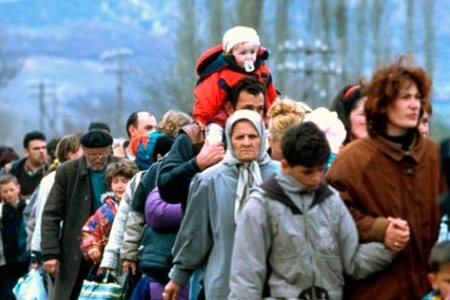
" There was definitely a terrible ethnic cleansing and people were traumatized. There is no doubt. We supported a humanitarian operation after the crimes. It is clearly similar to what is happening now in Ukraine, where civilians are very much on the front line and suffering ", he said, drawing parallels with Ukraine after the Russian invasion in February 2022.
Asked if he advocates more direct Western intervention in the Ukraine war, Freer says it would be "ungrateful" for him to try to predict NATO's next steps in the conflict.
" However, there is absolutely no doubt that without NATO's full support, especially in the training of Ukrainian soldiers and the provision of weapons and materials, Ukraine would not be able to carry out its current operations ," he said. N1./ Adapted "Pamphlet" from "SarajevoTimes"



Lini një Përgjigje