


 Shkruar nga Pamfleti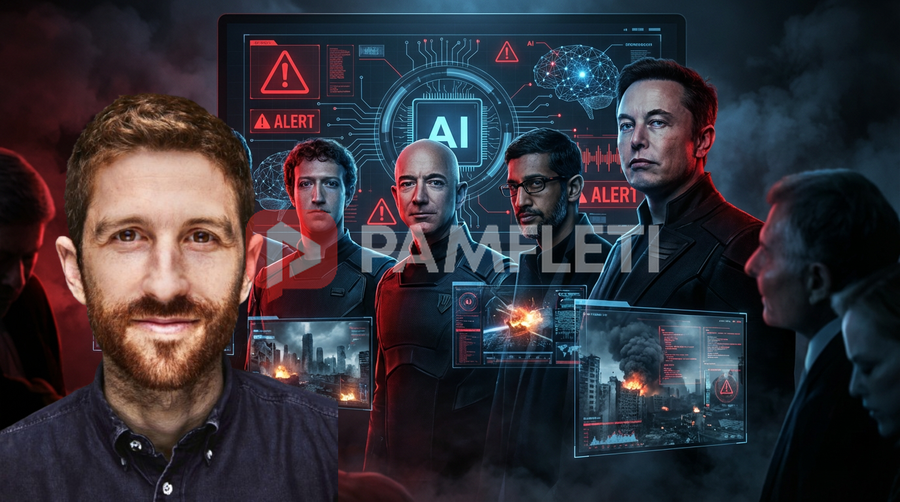
Tristan Harris, one of the most prominent critics of technology in the US and co-founder of the Center for Humane Technology , has been raising the alarm for years about the way big tech companies shape society's behavior and information. In his interview on the popular channel "Diary of a CEO", he shows a reality that the public does not see. According to Harris, there are two parallel worlds in the artificial intelligence industry. In one, companies like OpenAI, Google and Meta talk about abundance, curing diseases and a future where humans no longer need to work. In the other, the leaders who build this technology admit that they are part of a race that could lead to the extinction of humanity.
Harris describes private conversations with billionaires and top engineers who see the development of AI as a process that has gotten out of hand. One of them told him that even a five percent risk of global catastrophe should be considered unacceptable. However, many of those who make the most important decisions in this field believe that the risk is higher, but they cannot stop the race. The reason is the fear of losing. They believe that if they slow down, another competitor, in their opinion less responsible, will achieve the creation of general artificial intelligence first. This conviction pushes them to justify the extreme risk. The internal logic is simple. Better to build it themselves, than to have someone they consider more dangerous build it.
Harris gives another significant example. A co-founder of a major AI company told him that even if there was a twenty percent chance of humanity going extinct and an eighty percent chance of a technological utopia, he would accept that risk. Harris calls this a decision without moral legitimacy, because six people cannot make decisions on behalf of eight billion people. He describes this situation as a gambling game in which individuals with extraordinary influence gamble with the future of the species due to competitive pressure and personal selfishness.
In the interview in “Diary of a CEO” , Harris shows that some leaders appear to have a kind of fatalism. Some of them believe that the end is inevitable, so they prefer to be part of the moment when the course of events will culminate. This mindset is consistent with some public statements by Elon Musk , who has spoken openly about the possibility of human extinction due to AI. According to Harris, this atmosphere within Silicon Valley is not related to technological idealism, but to fear and uncertainty that are not shared with the public.
This story exposes the gap between the propaganda of the technology industry and the reality of internal decision-making. Companies offer citizens an optimistic vision, while behind the scenes a race is taking place that its participants themselves consider dangerous. The question that Harris raises is straightforward: How is it possible for a small group of individuals to make decisions that affect the fate of the world step by step without any real control mechanism from society? The article concludes that this race cannot be left to companies alone, because the danger is not limited to the technology, but to the way it is managed and the motives of those who control it. /Pamphlet







Lini një Përgjigje