


 Shkruar nga Jane Coombs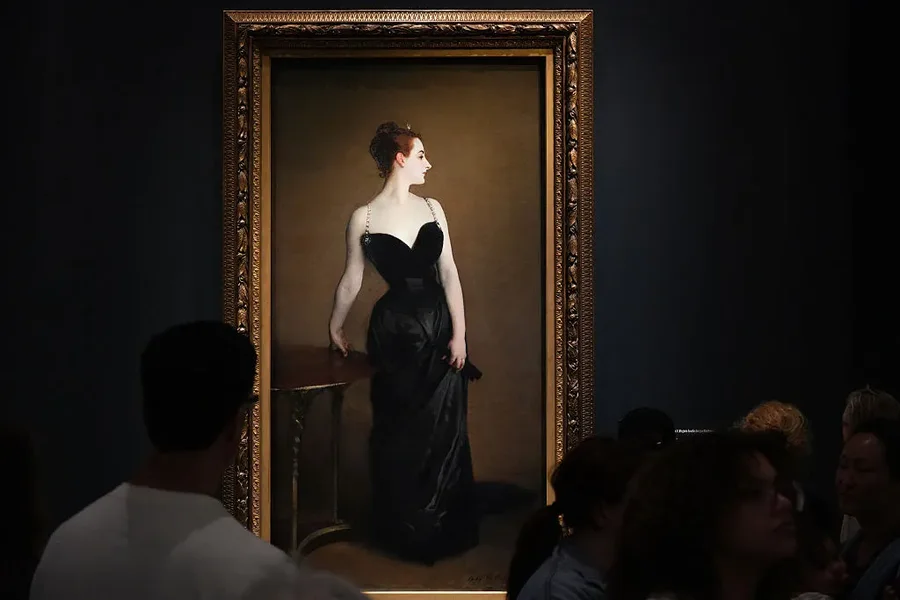
John Singer Sargent was destined for greatness and scandal.
Ah, to be a 19th-century Parisian! A unique creature who, as a journalist of the time wrote with excessive imagination, “emerged like Venus from the waters of the Seine, the supreme fruit of civilization.” A graceful arbiter of taste, she was seen at theaters, concerts, and exhibitions, or strolling along Haussmann’s airy boulevards. By the time of the Third Republic, aristocratic blood was no longer needed; it was enough to have thoughts about painting, poetry, and music. For a city recovering from the horrors of the Franco-Prussian War and the Paris Commune—which left thousands dead and monuments destroyed—she represented a brighter future.
Artists flocked to paint the Parisian (as well as foreigners who dreamed of becoming like her), and she, in turn, welcomed the opportunity to commission portraits that would enhance her status. By the late 1860s, portraiture was gaining respect in France as a serious genre. The boldest painters freely combined neoclassical conventions with elements of avant-garde realism (and later, impressionism), but this was a delicate game for both artist and client: a boring portrait remained just that, but if you took too many risks, you could come across as vulgar or attention-seeking—the worst possible mistake.
Enter John Singer Sargent, the painter whom Henry James described as “cultured to the tips of his fingers.” Who better to capture the charms of the Parisian woman than he? A cosmopolitan par excellence, born in Florence to American parents and raised throughout Europe, Sargent, aged 18, moved to Paris in 1874 to train in the studio of the portraitist Carolus-Duran and then at the prestigious École des Beaux-Arts. A draftsman and colorist extraordinaire, well-read, fluent in four languages, a gifted pianist and above all très discret – discreet to the max – he managed to entertain and impress his female subjects without disturbing their husbands.
But Sargent was no court painter. He sought beauty in the strange, the exotic, and the extreme—his childhood friend Vernon Lee noted his penchant for “the unusual and the extraordinary”—rather than the approval of patrons. Before he secured his status as a modern classical master, he was destined to face scandal.
The exhibition “Sargent and Paris” at the Metropolitan Museum (later to move to the Musée d’Orsay), accompanied by a book of essays, tells the astonishing story of his rapid rise to the top of French art and his sensational departure just ten years later, when he moved to London after the scandal of the portrait of Madame X at the 1884 Salon – a harshly criticized portrait of socialite Virginie Gautreau, in a revealing black dress and an embellished belt that slid off her shoulder.
The exhibition features around 100 works from the first decade of his career, including landscapes and travel scenes, proving that the “strange intentions and unusual processing” that one art critic saw in Madame X should not have come as a surprise at all.
See the oil sketch (circa 1879) of an orchestra rehearsing in the Cirque d'Hiver indoor amphitheater. The conductor, Jules-Étienne Pasdeloup, was known for his bold programs that promoted modern composers such as Gabriel Fauré. Sargent's experimental painting is equally bold, with unusual framing and a unique perspective from the upper rows. With quick brushstrokes, he transforms the musicians, instruments, and scores into almost abstract forms, absorbed by the arches of the amphitheater. In the foreground, three clowns dressed in strange costumes appear, one with a white face and a red line across his lips.
“Strange elaborations” also feature in his travel paintings: the head and neck of his favorite model in Capri, Rosina Ferrara, is shown in profile with a determined gaze, like a medallion figure or an ethnographic illustration. She appears again in Among the Olive Trees – Capri (1879), standing with her back to the viewer and her head turned to the right, her arms wrapped around olive branches. In The Spanish Dance (c. 1879–82), a powerful night scene, two dancers turn back with their arms raised and their faces covered, while the third bends over, extending her arm toward the ground.
Early portraits are equally bold. In his 1879 portrait of the redhead Marie Buloz Pailleron, he places her in a windswept park, blending landscape and portrait, with free brushstrokes and light Impressionist colors. Equally radical is Dr. Pozzi at Home (1881), where the renowned surgeon and collector Samuel Jean de Pozzi is depicted not in a professional setting but at home, in a bright red robe amid equally red curtains and carpets, a composition reminiscent of Catholic cardinals (or Jonathan Yeo’s portrait of King Charles, 2024).
Dr. Pozzi përflitej të kishte qenë i dashuri i vetë Virginie Gautreau-së, e lindur Avegno. Vajzë e prindërve francezë kreolë nga New Orleans, me nënë nga familje të pasura pronare plantacionesh dhe baba gjeneral konfederate që vdiq në Luftën Civile Amerikane, ajo u soll në Paris në vitin 1867, në moshën tetë vjeç, nga e ëma që synonte ta fuste në shoqërinë e lartë. Plani funksionoi disi: në vitin 1878, në moshën 19-vjeçare, Virginie u martua me biznesmenin shumë më të madh në moshë, Pierre Gautreau, që ishte pasuruar nga importi i plehut guano nga Peruja. Por ajo kurrë nuk arriti të shkëputej nga origjina e saj dhe të pranohej si parisiene autentike.
Gazetat kronikonin jetën e saj aktive mondane dhe pamjen e kultivuar, duke e quajtur “bukuri profesionale”, por gjithashtu edhe “amerikane”. Sipas kritikut të artit Theodore Child, ajo “kishte përsosur deri në ekstrem artin e grimimit, të shtresimit të pudrës dhe të ekstravagancës në veshje e krehje”. Përpjekjet e saj për vetë-stilizim ngjallnin si admirim ashtu edhe tallje; piktorja emigrante ruse Marie Bashkirtseff shkruante në ditar se ajo dukej “e tmerrshme ditën sepse përdor shumë grim… por natën është me të vërtetë shumë e bukur”.
Sargent u magjeps nga ajo. Ai realizoi më shumë studime për Gautreau-në sesa për ndonjë portret tjetër. Skicat me laps kapin profilin e saj të pazakontë, me hundën e gjatë që ngrihej lart dhe vetullat e rreshtuara artificialisht. Në letra, Sargent shprehte kënaqësinë dhe frustrimin për përpjekjen për të fiksuar “bukurinë e papikturueshme” të saj, përfshirë atë ngjyrë të çuditshme “livando ose klorat-potasi” të lëkurës së saj të grimuar.
Të dy ishin të entuziazmuar nga piktura përfundimtare – Gautreau e quajti “një kryevepër”. Por askush nuk priste “sherrin e madh” që shpërtheu më pas. Edhe pse u ekspozua me titullin **Madame *** për të ruajtur anonimitetin, profili dhe flokët e saj të kuq u identifikuan menjëherë nga vizitorët e Salonit, dhe ajo u përqesh për vanitetin e saj. Jo vetëm që u akuzua se dukej artificiale dhe e zbërdhulur, por edhe e pahijshme, sikur fustani i saj ishte gati të binte. (Pas skandalit, Sargent e ripikturoi rripin në vendin e duhur.) Pozicioni i saj i shtrembër, ndërkohë, dukej sikur imitonte në mënyrë provokuese sirenat e gdhendura në këmbët e tavolinës pranë.
Skandali largoi përkohësisht klientët e Sargent-it dhe ndoshta përshpejtoi vendimin e tij për t’u zhvendosur në Londër. Por ata u kthyen shpejt. Sargent, nga ana e tij, qëndroi gjithmonë pas Madame X, parisienes së tij amerikane, tashmë një nga xhevahirët e Koleksionit të Met-it. Kur ia shiti veprën muzeut në vitin 1916, ai deklaroi në një letër: “Mendoj se është gjëja më e mirë që kam bërë ndonjëherë.”
Dhe çfarë ndodhi me Gautreau-në?
Pas tronditjes së parë, ajo dhe e ëma shkuan në studion e Sargent “me lot në sy”, duket se e mori veten shpejt. Disa javë pas hapjes së Salonit, u pa në teatër me një fustan “të mbajtur në supe nga byzylykë me diamante”.
*Note : John Singer Sargent was an American immigrant artist, considered "the leading portrait painter of his generation" for his evocations of Edwardian luxury. He created approximately 900 oil paintings and more than 2,000 watercolors, as well as countless charcoal sketches and drawings.








Lini një Përgjigje