


 Shkruar nga Pamfleti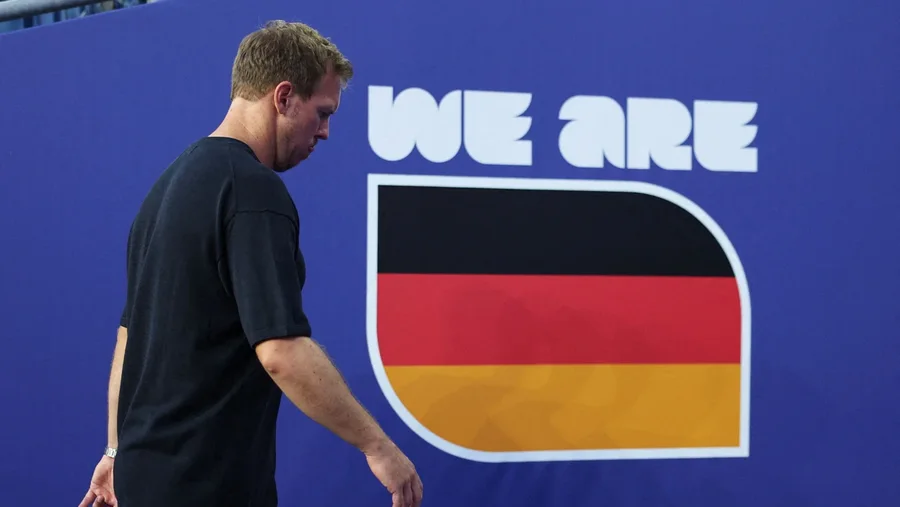
According to an analysis by the German newspaper WELT, German national team coach Julian Nagelsmann bears significant responsibility for Germany's early elimination, while the leaders of the German Football Association continue to support him...
Germany national team coach Julian Nagelsmann has said he wants to remain in charge even after Germany's early elimination from the World Cup, if the German Football Association (DFB) continues to trust him.
During the press conference held at the Foxborough Stadium, DFB sporting director Andreas Rettig was present and, according to the German newspaper WELT, his approving reaction was interpreted as support for Nagelsmann's extension. Sporting director Rudi Völler has also publicly expressed his position in favor of the coach.
In its analysis, WELT questions whether the DFB should continue with the same approach that proved unsuccessful after the 2018 and 2022 World Cups, when the federation kept coaches Joachim Löw and Hansi Flick in office despite disappointing results.
According to the author, Nagelsmann is not solely responsible for Germany's third consecutive early elimination from a major tournament. He, like his predecessors, has come to terms with the fact that German football no longer enjoys the dominance it once had and that a few high-quality players are not enough to build an elite team.
However, the analysis argues that the coach's responsibility was to compensate for these shortcomings through clear decisions and team management. According to WELT, this is precisely where Nagelsmann failed, as he overestimated both the team's potential and his ability to adapt to different opponents.
The article points out that, apart from the match against Curaçao, Germany did not find any formation or game plan that worked convincingly against stronger rivals.
Injuries to players significantly affected the team's performance, but he believes that in such a situation the team needed pragmatic decisions and stability. Instead, according to the analysis, players often remained unclear about their roles and the direction of the team.
WELT also notes that Nagelsmann's management style, based on emotional communication and a close relationship with the players, had paid off during the European Championship held in Germany. However, according to the newspaper, the same approach no longer worked at this World Cup and may have contributed to the team's failure.
The trust capital that Nagelsmann had built among federation leaders and players may have been consumed, leaving open the debate as to whether he is still the right man to lead the German national team until Euro 2028.



Lini një Përgjigje