


 Shkruar nga Pamfleti
Dinner with king crab in Tierra del Fuego, then the cruise departed: there was already a carrier of the virus on board, but it took 30 days to detect the infection.
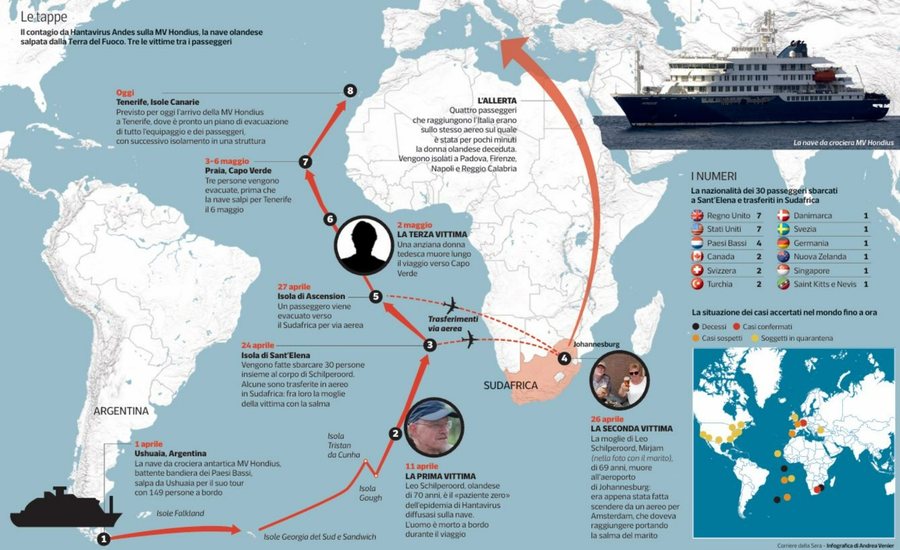
The "Atlantic Odyssey" of the MV Hondius ship has ended, arriving this morning in the port of Granadilla de Tenerife, in the Canary Islands, under strict sanitary safety measures. The journey was organized by the Dutch company Oceanwide Expeditions, which specializes in expeditions to extreme areas of the planet, from the Arctic to the Antarctic.
What was presented as a luxury cruise, with prices ranging from 16,000 to 25,000 euros per person, turned into an international health emergency: three people lost their lives, two of them on board, at least five others were found to be infected with a rare variant of hantavirus, and dozens of other passengers are considered possible contacts with a risk of transmission.
How did it all start?

The incident is believed to have started in Ushuaia, on the southern tip of Patagonia. Before the cruise departed, most of the crew, 61 in total, had dinner together at a local restaurant. 88 passengers from 23 different countries were to board later.
Initial suspicions center on an elderly Dutch couple, the first victims of the virus. According to local media, they had visited a garbage dump near Ushuaia to observe birds of prey. The area is also home to so-called “long-tailed rats,” considered the main carriers of the Andean variant of hantavirus, the only one of the 38 known variants that can be transmitted from person to person.
Remembering the 2019 outbreak
Argentina also experienced a serious outbreak of hantavirus in 2019, in the village of Epuyen. Back then, one person infected five others during a birthday party that lasted just 90 minutes. The final tally was 34 cases and 11 deaths, with a mortality rate of 32 percent.
The MV Hondius set sail on April 1st on an itinerary that included the Sandwich Islands, Tristan da Cunha, Saint Helena, Ascension and Cape Verde. The passengers had chosen this trip to observe rare species of marine birds and mammals.
Five days after departure, a 70-year-old Dutch passenger began to show symptoms: fever, headache, and mild diarrhea. Initially, it was thought to be seasonal flu, but his condition quickly deteriorated due to respiratory problems. He died a few days later.
His body remained on board until April 24, when the ship docked on the island of St. Helena, in the middle of the Atlantic. His 69-year-old wife was also disembarked there, along with 28 other passengers who returned to their countries independently.
The wife of the first victim traveled to South Africa, where she attempted to board a KLM flight to Amsterdam. She was stopped before departure due to her serious health condition and later died in hospital.
WHO searching for contacts
On April 27, another British passenger was hospitalized in South Africa, while a German passenger lost her life on board the following day.
It was only on May 2 that authorities in Johannesburg confirmed that it was the Andean variant of hantavirus, considered the most dangerous to humans. By that time, many passengers had already traveled to various countries, including Switzerland, Canada, Singapore, and the United States.
The World Health Organization has launched international tracing of contacts and their movements.
Meanwhile, the passengers who remained on board were isolated in their cabins until arrival in the Canary Islands.
Landing operation in Tenerife
The ship's last stop was Cape Verde, where three infected people, including the ship's doctor, disembarked. They were immediately transported to the Netherlands for treatment.
The ship then continued to Tenerife, after the WHO asked Spain to organize the final disembarkation operation. The passengers, considered “high-risk contacts”, although asymptomatic, will be transferred under strict sanitary-military surveillance to Tenerife South airport to return to their countries./ Adapted from Corrire della Sera







Lini një Përgjigje