


 Shkruar nga Pamfleti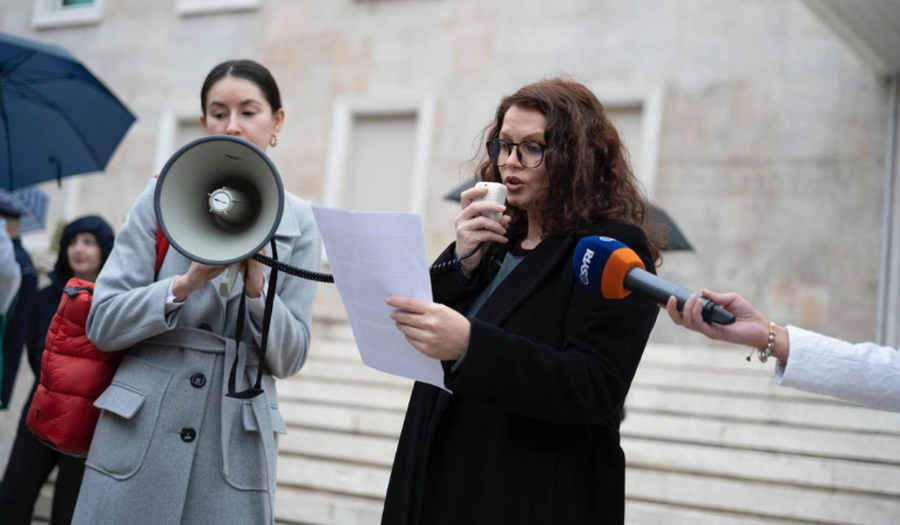
A group of journalists protested on Wednesday in Tirana pointing out the dramatic shrinking of freedom of expression and the right to information in Albania, while significantly, their protest went unreported by the vast majority of the traditional media, which is currently shrinking. on few televisions and hardly any newspapers.
Journalist Aurora Velaj emphasized in her speech the long history of anti-media and anti-freedom of Prime Minister Rama, listing the many legal initiatives aimed at suppressing freedom of expression as well as the controversial practices of concentrating government communication in a single office, known as the Agency for Media and Information or the much-criticized practice of preparing ready-made propaganda materials by press offices, which are then broadcast as "independent news" by television.
According to Velaj, journalists, in order to inform citizens according to the minimum standards of correct and qualitative reporting of events, must first overcome censorship and the pressure exerted within the newsrooms not to violate the government's interests, and then must face the closed doors of institutions, which are not allowed to answer questions except with authorization from the Media and Information Agency.
Journalist Ola Xama, who recently faced a smear campaign by the pro-government media, showed how in the daily work of journalists, the common practice of taking the opinion of one side in a news story is followed, in cases where the side aims to be a government official, with a second phone call from the media owner ordering the killing of the news. Xama ironically suggested to the prime minister that, as part of his legal initiatives, draft a law through which the topics of news or debate shows are determined by the Media and Information Agency so that journalists no longer get tired of dealt with news that is censored by media that have close economic interests with the government.
The protest was triggered by the handshake that Prime Minister Edi Rama gave to journalist Ambrozia Meta, while the latter was asking questions about the affair of former President Donald Trump's son-in-law with the construction project in Sazan and in the protected area of Zvrnec, a an affair that, according to the New York Times, looks like a corrupt bargain in which American diplomacy can be exchanged for plots of public land or other material goods paid for by taxpayers in countries such as Albania or Serbia, in the event that Trump is re-elected president in the US elections next November.
Rama claimed that touching the journalist with his hands was a friendly act without any malice. The vast majority of media freedom activists, in Albania or around the world, saw the action as a gender-based violence, in which the obligation to answer concrete and serious questions of high public interest is replaced by touching with the hands of the journalist asking the questions.
The Albanian government seems to control, in the smallest way imaginable, the vast majority of the normal flow of information in a democratic society, starting with the control of access to official documents and continuing with the preparation of propaganda "news" or the use of pressure economic over media owners who have vital interests in public procurement or are declared "strategic investors", a status granted by Rama that often brings free land, tax exemptions and taxpayer-subsidized public services, such as lines water supply, electricity infrastructure, roads or sewers, services which, for the taxpayers who subsidize them, are often absent or of poor quality.
A journalist who spoke on the condition of anonymity explained how the media works under Rama's government, quoting the television owner who tried to emphasize to journalists the critical importance of following the government's line with the words: "a the tender given by Rama is enough to pay your salaries for a whole year"./BIRN


Lini një Përgjigje