


 Shkruar nga Pamfleti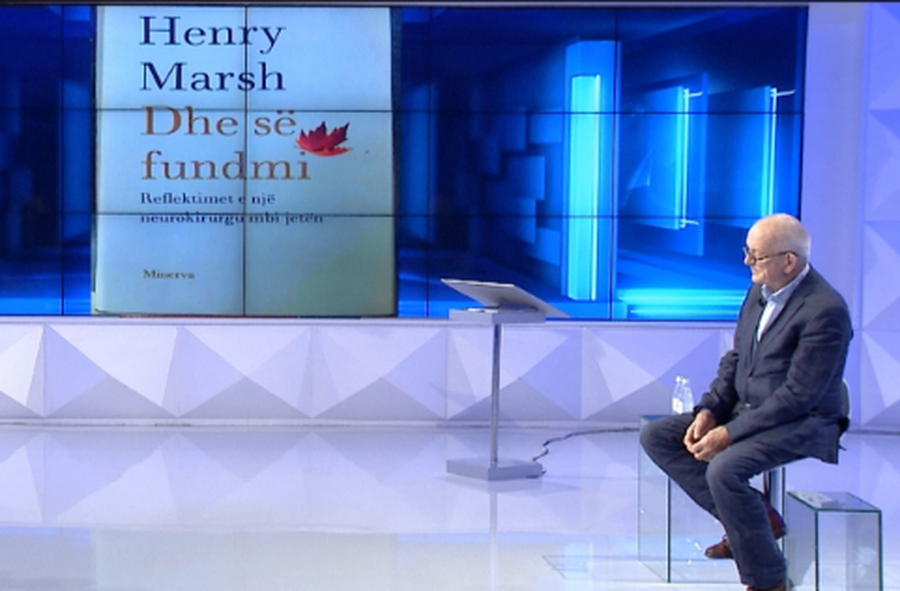
In an interview for "Opinion", the well-known neurosurgeon Henry Marsh talks about the "significant" moment of his life, the day he was diagnosed with severe cancer.
73 years old and after a long career as a doctor, he confesses that he had an MRI out of curiosity to see what his brain looked like. Further, it is expressed why he was shocked by what he saw.
- It is very interesting the relationship that people have with life and death. In the book you wrote about a Ukrainian sniper for whom death is a normal part of his daily life, to kill people. What is this person's approach?
Henry Marsh: I don't know. He claims to be completely detached.
- It was work.
Henry Marsh: It was work. Killing Russians was part of his day job. I am not sure. I wonder if he's still alive since he might be dead, I wonder if he developed post-traumatic stress disorder after the war. Doctors can stay very separate. One of the most difficult aspects of being a doctor is finding the balance between kindness and compassion and the scientific clinical divide. You have to find the balance. You shouldn't be too cold, but you shouldn't be too sore. The more you try to have compassion for your patients, the more your job hurts when things go wrong, and many of your patients will die no matter how good you are, while some of the patients will die because you did one mistake and you have to live with it. The only way to live with this is to keep a lid on it and avoid the reality of what your patients are dealing with.
- It is very interesting when at the beginning of your book you talk about the magnetic resonance through which you can see the signs and changes in the brain. In your book, write that you voluntarily did an MRI...
Henry Marsh: Yes, I chose to have an MRI out of curiosity...
-But you were afraid to look at the resonance after it was done. Why?
Henry Marsh: I wanted to write another book. This was before I was diagnosed with cancer, before the pandemic, before the Russian attack on Ukraine. I thought I want to write a book about the brain, but not a science book. I wanted to write about how I understand the brain from a neurosurgeon's point of view and what it means to me as a human being, as an individual. I thought my brain scan would look amazing. I'm smart, I'm successful. So I thought it was funny.
-The older you get the more you think you are active and well.
Henry Marsh: My brain scanner was terrible. It was the scanner…
-Why?
Henry Marsh: It was the brain scanner of a 70-year-old man. And the brain was smaller…
-Did you have the opportunity to look at the signs of aging?
Henry Marsh: Yes, without question.
-Too easy?
Henry Marsh: Very easily. Just as our hair turns gray and our skin wrinkles, our brains shrink as we age. I was shocked. One more time. You are very young but when you reach my age you will look at pictures and ask: do I really look that old? We are constantly rejecting the situation. It was the same when I saw the script of my brain.
-Doctor, what is the difference between age and the energy you have inside you. Because I remember old people telling me when I was little. It is extraordinary. I don't know this person in front of my mirror. This is not me. This is not how I feel inside.
Henry Marsh: We all have within us an idealized idea of who we are.
- But actually...
Henry Marsh: And I had this idea of a version of what my brain was supposed to look like. But it wasn't like that. It seemed to me like a joke against myself.
-Then you write in your book that humanity, doctors, scientists do not know more things than what we knew in the 17th century about the brain. What does this mean?
Henry Marsh: In many ways yes. The great mystery of human life, for me and as many neuroscientists would say, is that the brain follows the laws of physics. It's a very hard thought to grasp, but thoughts and feelings are physical events in our brains. So when we die, our brain dies and the existing alignment. But the laws of physics tell us nothing about how physical matter creates pain and love and sight. They don't tell us anything.
- We don't know...
Henry Marsh: We just don't know. And so far we know that some scientists…
-Even with the development of science, we don't know more than we knew a few centuries ago...
Henry Marsh: About the big questions.
-Yes of course.
Henry Marsh: About the really big questions. Some scientists are seriously suggesting that insects can feel pain. We don't know how many brain cells are needed to create pain.
- It is extraordinary and I did not know what you said that the brain is like bricks in the wall, but you said that hundreds of thousands...
Henry Marsh: 85 billion nerves!
-85 billion...
Henry Marsh: And all you are thinking or feeling right now is electrical activity.
-In 83 billion...
Henry Marsh: In 85 billion cells.
-In 85 billion cells.
Henry Marsh: Yes.
- You also said that there are hundreds of thousands of kilometers...
Henry Marsh: Network. Yes.
- Which are related to each other. It's so complicated.
Henry Marsh: It's extraordinary! Yes.
-And how can a doctor orient himself in such a complex world?
Henry Marsh: No, it doesn't. Brain surgery is very simple, unrefined, crude compared to the complexity of our brains.







Lini një Përgjigje