


 Shkruar nga Pamfleti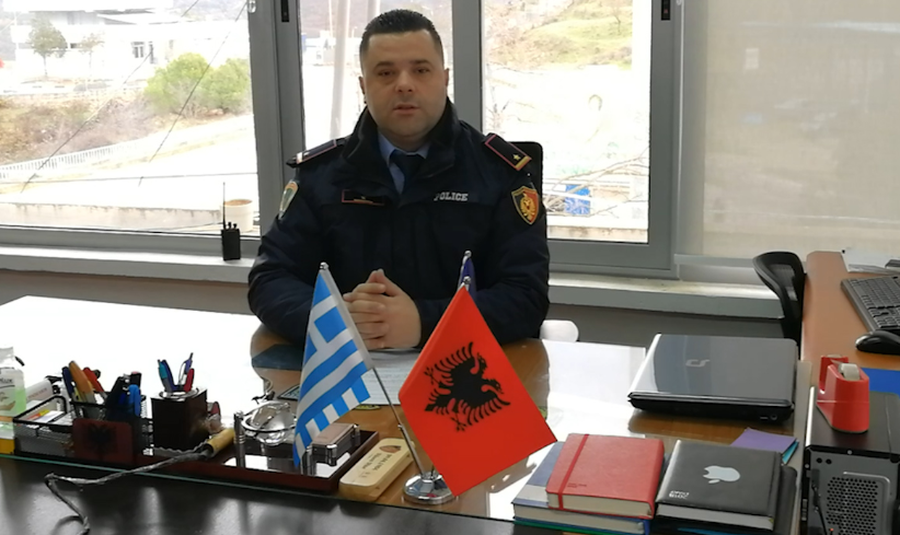
In a normal country, a man who is mentioned in several serious criminal episodes from the massive cultivation of cannabis, collaboration with traffickers and corruption within police structures would end up in court, in isolation and out of any public function. But this is not the case of Vilson Dine.
This is the case of Albania, a country where crime is not punished, but catapulted. In the office, in diplomacy, in strategic assignments, and through the diplomatic passport even abroad.
Rumored for years as one of the darkest figures in the security system, Vilson Dine, former head of the Police Supervision Agency (AMP) in Vlora, has recently been appointed liaison officer for the State Police in Greece.
An appointment that, ironically or not, gives an important role to a man who has been mentioned in numerous reports as being involved in drug trafficking, an activity that has Greece as one of the main transit corridors.
Instead of answering for his suspicious activities, Wilson Dine gives his hand to the state and heads to Athens, as the official representative for international cooperation against organized crime. Irony? No more. This is an insult to state protocol.
Dine is not an unknown name for law enforcement agencies – on the contrary, it is a name that has long been circulating in internal files, wiretaps, investigations launched and then "magically" archived. According to internal sources, during a period in Gjirokastra, Dine is suspected of having been the organizer of the planting and trafficking of over 6 hectares of cannabis, destined for the Italian market. He was not just a policeman who "didn't notice", but one of those who guaranteed the security of the plots and the tranquility of the network.
His career does not end here. With such a past, in Albania they do not exclude you from promotion. Dine would later rise to one of the most sensitive positions, head of the AMP in Vlora, that is, the institution that theoretically controls corrupt police officials.
The result? An AMP that becomes a protective umbrella for the same officials who were supposed to be investigated. Dine, according to sources, not only failed to curb corruption, but helped spread it, by sharing information with criminal groups, avoiding certain investigations and guaranteeing protection for the “chosen ones.”
Sources from within AMP describe him as a "silent operator of the system," who instead of punishing lawbreakers, placed them on a list of preferred collaborators.
In a country where hope for justice has been replaced by whispers of "political protection," career paths no longer pass through honesty or professionalism but through criminal connections and mutual cover-ups.
And Vilson Dine's path has never passed through SPAK, but now passes through the Ministry of Interior, the Ministry of Foreign Affairs and ends with a post in Athens. As a representative of the Albanian state in a country where the largest files against Albanian drug trafficking groups are being built. What a painful irony for official Albania: it sends to Greece precisely the one who should have been under investigation for collaboration with Greek drug traffickers.
This is not just an isolated case. This is the symbol of the state's transformation into a clientelist system, where suspects are rewarded and the honest are ignored. Dine is not just a problematic figure; he is the reflection of a successful model, where criminal experiences are valued as "field experience," and crime is institutionalized.
What message does this case send to young police officers who face pressure, corruption, and injustice? What motivation does an honest officer have when he sees that "cannabis expertise" leads to international cooperation, while integrity leaves him in the red?
And then we ask why drugs are not stopped, justice is not working, and trust in the state has disappeared. Because when traffickers disguise themselves as diplomats, when suspects become state representatives, and when international cooperation is built on faces that belong to crime scenes, we no longer have a functioning state, but a system captured by name and surname.
And in this grotesque reality, Vilson Dine is not only the symbol of reward for crime, but also the purest representative of the Albanian state in the international arena. A disgrace who walks with a diplomatic passport and smiles in front of international cameras. / Infront-al.com/




Lini një Përgjigje