


 Shkruar nga Pamfleti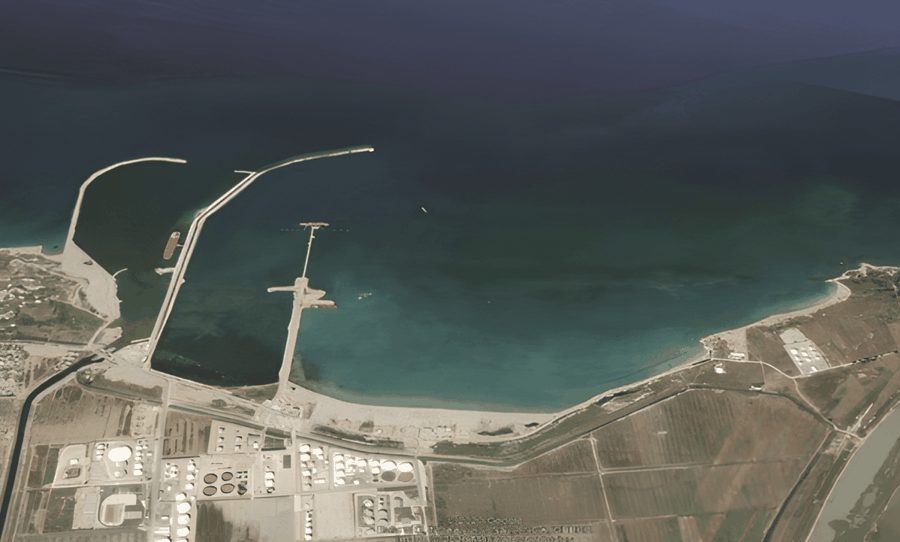
Port projects in Albania are taking on an increasingly strong geopolitical dimension, linked to Corridor VIII, Western strategic interest in the Adriatic, and the country's role as a regional logistics hub...
The debate over Albania's ports is now moving beyond the confines of a technical infrastructure investment. Porto Romano and the transformation of the Port of Durres are emerging as key projects linked to Corridor VIII, the Western Balkans' logistics chains, and the West's growing interest in critical infrastructure in the Adriatic.
Albania’s port strategy is increasingly taking on a clear geopolitical dimension, as the government of Prime Minister Edi Rama aims to position the country as a developing hub for transport and logistics in the Western Balkans. At the heart of this strategy is the new port at Porto Romano, a project that the Albanian government sees as directly linking it to Corridor VIII and with the ambition of transforming the country into a critical connection point between the Adriatic, the Balkans and the Central European networks.
Edi Rama publicly returned to the issue after the cancellation of the approximately 400 million euro tender for the construction of the new port, after the only remaining company in the race withdrew before submitting its final financial offer. Despite this development, the Albanian prime minister stressed that the project has not been abandoned and that the government is ready to move forward with a faster and more aggressive alternative plan to ensure the start of construction.
In his argument, Edi Rama presented Porto Romano not simply as a new commercial port, but as part of a broader strategic infrastructure chain that includes land connections and “dry ports” in Pristina and Skopje. Through this approach, the government seeks to place the project within a broader logic of increasing Albania’s regional role, shifting the center of gravity from a purely national investment to a connecting corridor that extends beyond the country’s borders.
Of particular importance is the Albanian Prime Minister's reference to the international and allied framework surrounding the project. Edi Rama argued that neither the United States nor the European Union have expressed concerns and that, on the contrary, the plan prepared by the Royal Haskoning company has already passed the necessary technical verifications and is awaiting a political assessment due to its geopolitical value. This formulation has political significance, as it suggests that the Albanian government intends to position the project not only in the sphere of economic development, but also in that of strategic infrastructure harmonized with the security priorities of the West.
On the other hand, the public debate in Albania is not limited to the government narrative. Journalist Artan Hoxha has warned that shifting the center of gravity from the current Port of Durres to new development schemes could weaken one of the country’s most important strategic nodes. According to his critique, Durres is not just an existing port facility, but a regional asset that connects the Balkan hinterland to the main maritime trade routes.
The main issue in this debate is not only related to the technical suitability of the new project, but also to whether the new port investment architecture will strengthen or weaken Albania's overall maritime and transshipment capacity. The criticisms raised emphasize that an unbalanced transition from Durrës to Porto Romano could lead not to an improvement, but to a fragmentation of the strategic role of the country's ports.
At this point, the issue takes on even greater significance when linked to recent diplomatic and business developments in Tirana. The visit of the United States Ambassador to Greece, Kimberly Guilfoyle, to Tirana, accompanied by the CEO of the company AKTOR, writes Ibna , has reinforced the perception that large infrastructure projects in Albania are being seen not only as investment opportunities, but also as elements of a broader framework of Western strategic presence in the region.
In this context, Albanian ports are gradually evolving into infrastructure of dual importance: on the one hand they serve as instruments for economic development, trade and regional connectivity; on the other hand they represent critical strategic assets linked to NATO interests, control of maritime networks and the balance of influence in the Adriatic. This explains why the debate about Porto Romano and Durrës is now going beyond the domestic Albanian political arena and is taking on a broader Balkan and Euro-Atlantic significance.
The broader trend is clear: Albania is seeking to turn its port infrastructure into a geo-economic advantage. However, the success of this strategy will not be determined solely by the speed of implementation or the ability to secure financing. It will also depend on whether new projects can combine commercial viability, political acceptance by Western partners, and effective integration into an increasingly competitive regional transport network.
The battle for Albania's ports is not just about where the next major terminal will be built. It is about control of entry points, transit corridors and the strategic projection of influence in one of the most sensitive geopolitical spaces in Southeast Europe. /Pamphlet/






Lini një Përgjigje