


 Shkruar nga Pamfleti
Of the 210 billion euros, 185 billion euros are actually held by Brussels. The rest is divided among other member states, mainly Germany and France. Italy holds a minimal share of around 3 billion euros.
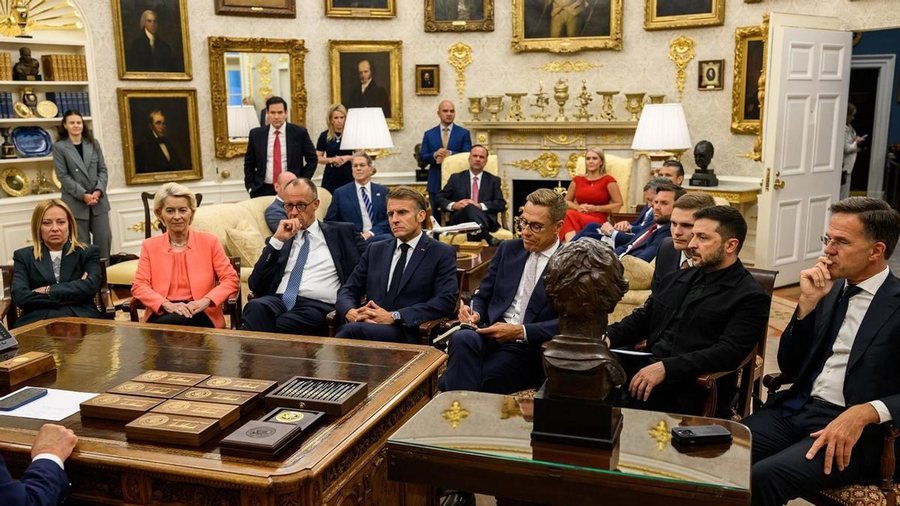
Brussels has no intention of withdrawing from Moscow's assets. And despite new doubts raised last week by Italy, the heads of the Commission and the European Council are agreeing on a line that will nevertheless lead to the approval of the option of transforming Putin's assets into a loan to support Kiev economically and militarily. And to do so at the European Council next Thursday and Friday.
In recent hours, some irritation with Rome has also increased. The restriction of this option at the last Coreper meeting (the committee that brings together the 27 Permanent Representatives) surprised the Berlaymont Palace and irritated the French and German governments. They will express their displeasure in Berlin during the summit of the "willing", this time expanded to include Giorgia Meloni.
Therefore, the policy is to follow the chosen path at all costs. Because at the moment, it is the only one that is able to resist Russian pressure and prevent Putin from seeing the lack of decision-making as the last weakness of the European Union. And therefore, the possibility of hitting Ukraine. A fear that is felt especially by Germany, France and Great Britain. It should be noted that the German government in particular is pushing this solution to avoid the need to finance Kiev with public money from individual countries. A rather high expense. Even for Italy.
At the Berlymont Palace, they are currently considering possible strategies to address Belgium's concerns in particular. The idea is to exempt countries holding Russian assets from legal liability.
Of the 210 billion euros, 185 billion euros are actually held by Brussels. The rest is shared among other member states, mainly Germany and France. Italy holds a minimal share of around 3 billion euros. Among the options being considered is the creation of a guarantee system with a partly virtual fund to be created together with the G7 allies. And the funds made available would not count as far as the EU is concerned in calculating the deficit.
Precisely for these reasons, the presidents of the Commission and the Council are examining all possible procedures for approving the use of the assets. The European Council, in fact, could formalize the decision even without a final document. It could be approved by the 26 - as has already happened in the recent past or through the conclusions of the President of the European Council, Antonio Costa. What is ruled out is that this path is not followed. Then, based on the option indicated, the subsequent legislative requirements will be assessed. According to the legal office of the EU executive, the wording currently envisaged for the "repair loan" allows for qualified majority voting. And even if Italy, Belgium, Hungary and Bulgaria were to vote "no", the quorum would still be reached. But anyone who expressly votes against would certainly be supporting the "fifth columns" that support Moscow, as has happened with Hungary over the last three years./ La Repubblica






Lini një Përgjigje