


 Shkruar nga Pamfleti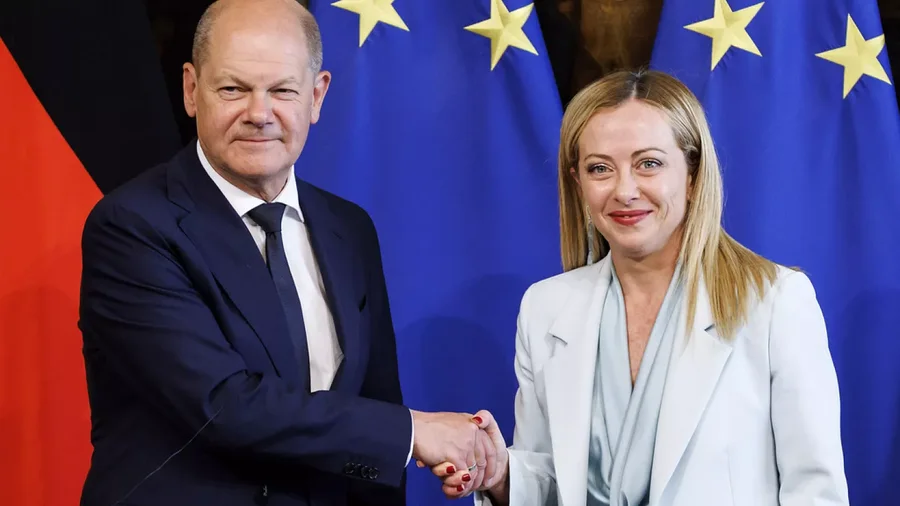
While Germany's economy has stagnated, Italy's is experiencing a burst of development. But this has little to do with the economic policy of ultra-right Prime Minister Giorgia Meloni.
For 25 years, Mauro Congedo and his brother have been finding small buildings of architectural beauty in Salento, a peninsula at the most south-eastern point of Italy, so to speak at the heel of the Italian boot, in the Puglia region, and renovating them.
The flats and houses that Congedo restores in this remote region also find buyers from Germany or England. "It works well again", says the 50-year-old architect in a telephone conversation.
During the Corona pandemic, business was completely suspended. But what is happening now after Corona in this sector is "madness". And time stands still a little, because he lengthens the 'a'. But only on the surface: Congedo is not too happy about Italy's economic spree.
From problem child to engine of development
The previous governments of Rome have had the habit, especially before the pandemic, of announcing bad economic forecasts by reaching important positions in the debt ranking, and now the country has turned into an engine of development in Europe. In the last quarter, the Italian economy had a 0.6 percent growth, while the German economy had a 0.3 percent economic decline in the same time period.
But even outside this period, the figures of the third most developed economy in Europe speak for themselves. "Since 2019, the Italian economy has grown by 3.8 percent," says Jörg Krämer, chief economist of Commerzbank, in a conversation with Deutsche Wellen. This economic growth is twice the economic growth of France and five times higher than the economic growth of Germany.
Whereas in Germany, the forecasts are cloudy. For example, the Organization for Economic Cooperation and Development (OECD) predicts economic growth of 0.3 percent. Leading German experts even think that economic growth will be 0.1 in the following year. And according to the OECD, Italy will have economic growth of 0.7 percent.
The stock market also benefits from the optimistic atmosphere. Thus the main Italian index FTSE MIB, where the 40 largest companies are listed, had a 28 percent increase last year, more than all other European stock market indices. Italy in development, a success story.
Confidence in the Meloni government is growing again
Economists had initially reacted with restraint when Giorgia Meloni took office in the fall of 2022. The ultra-right prime minister went into the election campaign with her "Brothers of Italy" party with a nationalistic "Made in Italy" economic course. inciting hatred towards migrants and not properly distancing from Russia. The weekly "Stern" called her after the election "the most dangerous woman in Europe". But from the point of view of economic policy, Meloni continued to stay on the course of her predecessor, Mario Draghi. This is bearing fruit for Italy, especially in the interest rate market. Thus, the percentage of debt interest that Italy receives is again at the level it was when Meloni took office.
During a press conference, held at the beginning of the year, Meloni tried to attribute the economic growth to himself. Meloni, who has now secured the post, said that especially the lack of political stability in the past has caused the economy not to develop.
But how much does economic development have to do with Meloni's successes? "A little," says Jörg Krämer from Commerzbank.
"The great development is explained by Italy's liberal fiscal policy". Which means that the economic development of Italy is mainly based on taking on new debts. The new debts of the Italian state before Corona accounted for 1.5 percent of the country's gross domestic product, while in recent years they grew rapidly, reaching in the first half of 2023 to 8.3 percent of the country's gross domestic product.
Even the mountain with state debts is growing. Thus, the EU Commission predicted in January that state debts will reach 140 percent of the country's gross domestic product this year, and will continue to grow even more next year. For comparison: in Germany the so-called debt ratio is at the level of 66 percent, while in France it is almost at the level of 100 percent.
The giant construction program boosts the economy
Since the end of 2020, the Italian state finances the adoption of various restructuring measures. Some restructuring measures help by 50 percent, others by even more. But especially the so-called Superbonis 110, which is given for restructuring measures in the energy field, is much preferred: Whoever wants to renew the energy in his apartment or house, he gets back from the state all the costs plus an additional ten percent, having tax breaks that last several years.
"It can be imagined that investments in construction have increased a lot. This effect explains two thirds of the economic development we are observing", says the economist and expert on Italy Krämer.
Architect Mauro Congedo is not too enthusiastic about the superbonus. Because everything has become very expensive. Because the prices have not only increased due to inflation, but the expenses for materials and personnel have also increased due to the superbonus. "When the state pays for everything, then people don't think about how much the bill will be," says Congedo.
Besides, no one deals with price control. Construction firms from Naples, Bari or the provincial capital, Lecce, had asked him several times to correct the expenditure figures.
“They want me to get double. But I don't. Because it looks like I'm stealing," says Congedo.
In general, he thinks well of the bonus given for renovations in the energy field of buildings. Owners must share in the costs and not leave everything to the state to pay. Congedo does not have any special opinion about the Prime Minister, Giorgia Meloni. The only good thing about it is that it ended the superbonus.
Happy money from Brussels
In fact, the ultra-right prime minister has limited the Superbonus that was introduced by the Five Star Movement. In 2023, the state participated with 70 percent of construction costs, and this year 65 percent of renovation costs.
However, the tax benefits from the superbonus will significantly reduce the state's income next year. This suits the government of Rome, because billions will come from Brussels. Italy receives much more money than other countries from the European Corona Reconstruction Fund.
Until 2026, Italy will be given 200 billion euros in the form of grants and loans.
"At least until that moment, the Italian state must reduce its large budget deficits. When he needs to start saving, then surely this miracle of economic development will also come to an end, because years have not been used to make structural reforms," says Jörg Krämer.
Even Mauro Congedo is worried that the superbonus will follow him for a long time.
"The prices are very high and we have gone into debt a lot." The work will not end one by one: He is currently working on eight projects simultaneously./DW




Lini një Përgjigje