


 Shkruar nga Mark Hollingsworth & Thibault Krause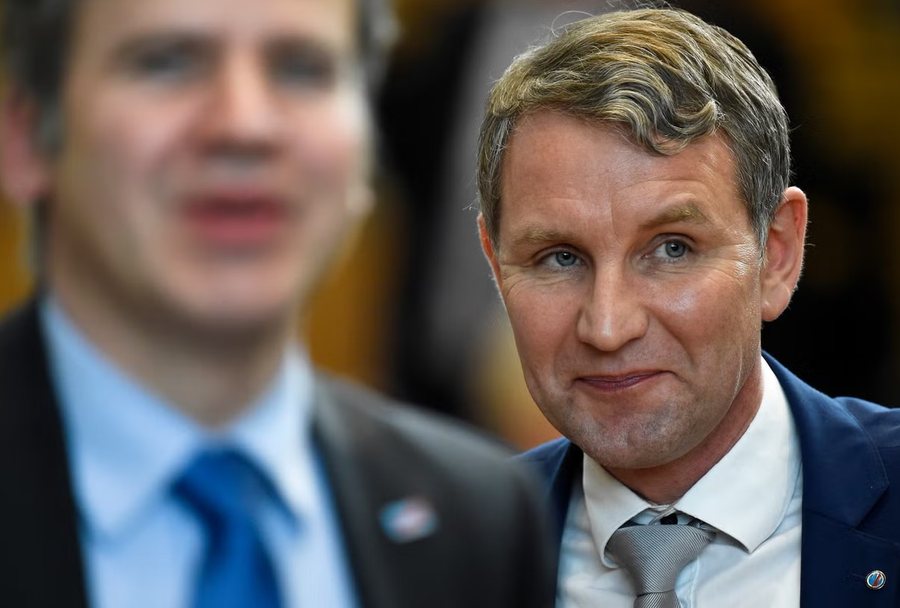
Germany's proportional electoral system means that cooperation with other parties is required to pass any kind of law. All traditional parties have declared that they will never cooperate in a coalition with the AfD. While this prevents the AfD from securing national power, it does not prevent it from having influence.
As a secret place to plot Germany's political future, Hotel Landhaus Adlon was neither the most diplomatic nor the most sought-after choice. Overlooking Lake Lehnitz in Potsdam, near Berlin, the hotel is just a 20-minute drive from the site of the infamous Wannsee Conference in 1942, where Reinhard Heydrich and other top Nazi officials discussed the "Jewish question" that ultimately led to The Holocaust.
The participants - leading members of the far-right AfD (Alternative for Germany) party - had failed to grasp the chilling parallels. That meeting last November was organized by two businessmen and attended by Roland Hartwig, aide to AfD leader Ulrich Siegmund, a regional parliamentary leader, two Austrian neo-Nazi activists and even two members of the Christian Democratic Party.
Forced re-emigration was at the top of the agenda. They discussed deporting not only refugees or asylum seekers, but also those who are not considered "true ethnic Germans," including well-integrated second- or third-generation German citizens.
The revelation of the details of that meeting rocked German politics and hundreds of thousands of people protested across the country. Even the Catholic Church declared that Christians should not vote for the AfD, because of their extreme nationalist views, which are very close to the infamous schemes of ethnic cleansing.
Usually, far-right parties do not have a significant support in Germany. So great is the sensitivity to any links to far-right factions that two weeks ago Adidas moved swiftly to block Germany's football shirts, which feature the number 44 at this year's European Championships in the country. due to concerns that it resembles the Nazi "SS" symbol. The style of the number "4", when the figures are side by side, resembles the symbol designed by the SS in the 1930s.
And yet in recent months, polls have shown growing support for the AfD, which could influence the political direction of Germany, and this could have important consequences for the EU and the war in Ukraine. AfD is no longer a radical but a peripheral opposition group.
Founded as a conservative anti-EU party, the AfD has drifted to the far right and is now classified as a "suspected danger" to the German Constitution. The party is led by former businesswoman Alice Weidel and former painter Tino Chrupalla. But its stronghold is in the Thuringia region, where the AfD's leader is Björn Höcke, a 52-year-old former history teacher.
A tough and charismatic populist, Höcke will be the next governor of Thuringia this fall. He has been officially described as an extremist and fascist by a local court and has been put under constitutional supervision. But while Höcke seems like an outlier, the meeting in Potsdam suggests he is not alone.
Because he currently leads a powerful faction within the AfD, and far-right policies now dictate the party. As the AfD has growing support, could the unthinkable happen? Can this party rise to power? The AfD currently receives 18 percent of approval in national polls, second only to the conservative Christian Democratic Union (CDU).
In the European Parliament elections in June, the AfD is expected to double its number of votes. In East Germany, where three local elections are held this fall, this party is expected to win a majority of the vote for the first time, possibly forming its first regional government if it finds another party to enter into a coalition with.
This could happen in an unholy alliance with the left-wing pro-Putin Sahra Wagenknecht-founded BSW party, which grew up in East Germany but agrees with the far-right to fight against NATO- s. However, even a strong AfD is unlikely to form a national government.
Germany's proportional electoral system means that cooperation with other parties is required to pass any kind of law. All traditional parties have declared that they will never cooperate in a coalition with the AfD. While this prevents the AfD from securing national power, it does not prevent it from having influence.
In fact, the growing popularity could cause political chaos. Growing support for the AfD makes it more difficult for other parties to form stable coalitions and cohesive governments that require reaching the 50+1 percent threshold.
The current administration is one such case. For the first time in Germany's history, there are 3 parties in power, causing an unprecedented division of government. If the AfD strengthens, then coalition governments comprising multiple parties from different political factions will become even more likely, blurring their ideological loyalties and political differences.
And this could turn into a vicious circle, where the traditional parties are forced to work together reluctantly, and this could lead to less stability, making the AfD the only possible alternative. But why does the AfD have so much support in Germany? Most of the reasons are predictable: increased immigration, economic insecurity and perceived cultural threats to traditional ways of life. But one factor is more unique to Germany: disillusionment with the politics of the traditional big parties.
Olaf Scholz's centre-left coalition is deeply unpopular and the AfD is skilfully exploiting this discontent to present itself as an alternative to the orthodoxy of the Greens and the left of the Woke movement. The extreme right portrays itself as a champion of "ordinary people" against elites.
Populists like Höcke, with his nationalist and inflammatory rhetoric, are liked by segments of the population who feel left out and are disillusioned with the status quo. And an underperforming economy, and especially high energy prices due to Russian gas shortages and the abandonment of nuclear power, only reinforces the trend against traditional centrist parties.
If the AfD manages to secure a large national influence, it promises to withdraw the country from the EU, abandon Ukraine, lift sanctions against Russia, support negotiations with Putin and welcome a second term for Trump . It's no wonder why this party is so hostile to the EU and prefers dictators like Putin. But the AfD's pro-Russian stance will soon be tested after its foreign policy spokesman, Petr Bystron, was revealed to have accepted a €25,000 payment from the pro-Russian media network, Voice of Europe, to promoted the Kremlin line on the war in Ukraine.
Bystron, one of AfD's main candidates in the European Parliament elections, reacted by saying that he "has not accepted any amount of money to defend pro-Russian approaches". The scary scenario is that if Germans were to vote today, the ruling coalition would get just 35 percent of the vote, far short of the required majority.
Can the AfD be the largest party in every pair of national elections? It is very unlikely to happen. Most Germans do not support the extreme right and remain satisfied with the consensus of the post-war center political parties, which has brought them development and security. But the status quo is under threat, and while the AfD may not lead the central government, it is certain that they could soon have a real impact. /Adapted Pamphlet, taken from "The Independent"





Lini një Përgjigje