


 Shkruar nga Jamie Dettmer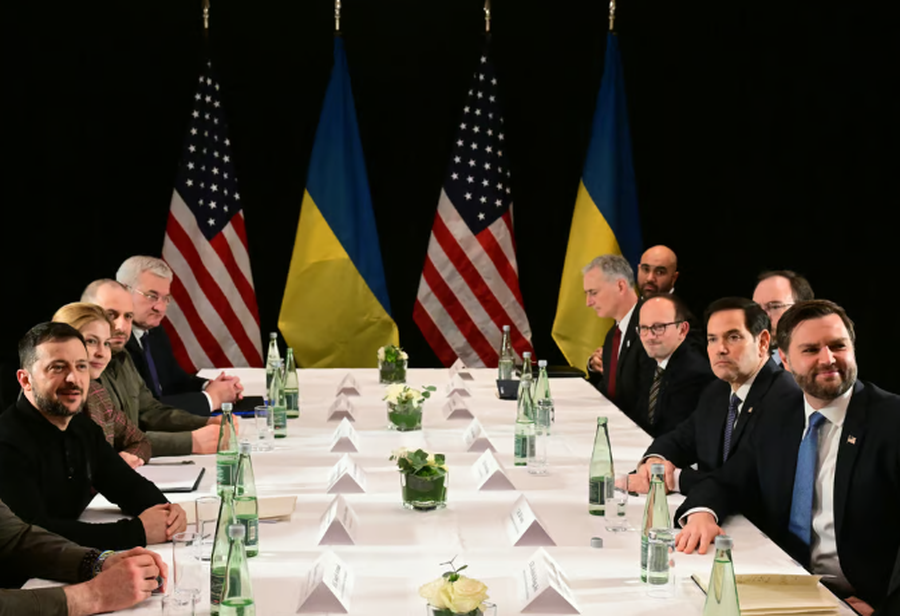
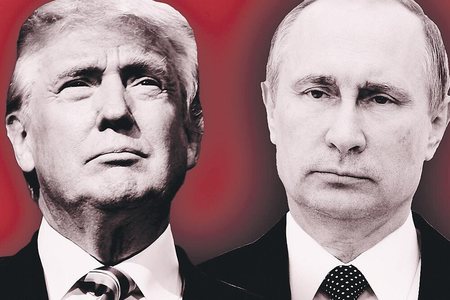
"Now we have an alliance between a Russian president who wants to destroy Europe and an American president who also wants to destroy Europe. The transatlantic alliance is over."
US President Donald Trump is a longtime fan of Winston Churchill. But what would Britain's iconic wartime leader make of the Munich Security Conference in 2025?
“You have been given the choice between war and dishonor. You have chosen dishonor and there will be war .” These were the words Churchill roared as then-prime minister Neville Chamberlain left this Bavarian town 87 years ago, clutching a piece of paper that turned out to be meaningless.
Would this be Churchill's reaction to Trump's attempt to end the war in Ukraine, on terms that Kiev and its European allies fear will be favorable to Moscow and will only mean another bigger war down the road?
The word "appeasement" is on European lips here, and for the more historically sensitive - like Britain's former Defense Secretary Ben Wallace - the echoes of Munich circa 1938 seem a clear reference point.
As they gathered for the summit, European officials were still reeling from the readout of Trump’s 90-minute phone call with Russian President Vladimir Putin, as well as from U.S. Defense Secretary Peter Hegseth’s midweek comments in Brussels. For former Lithuanian Foreign Minister Gabrielius Landsbergis, the most overlooked and chilling line to come from Hegseth was his warning that “realities” will prevent the U.S. from being the guarantor of Europe’s security.
In other words, there is no turning back to the US.
Like others, Landsbergis senses the end of an era. " This could very well mark the coming of NATO's twilight. Especially when you combine that with what I think Washington will announce soon - the withdrawal of 20,000 American troops from Europe ," he said.
While the Lithuanian spoke to POLITICO in Munich, Hegseth was in Warsaw, announcing a troop withdrawal and warning already bewildered Europeans that "now is the time to invest because you can't assume America's presence will last forever."
As it has been in the US, the Trump administration's relentless and rapid-fire announcements of shock and awe have been overwhelming and disorienting in Europe as well.
And American lawmakers attending the summit have tried to offer some reassurance to an anxious Europe, though not much.
Among them was Senator Roger Wicker, chairman of the powerful Senate Armed Services Panel, who told POLITICO that Hegseth made a “rookie mistake” in Brussels: “I don’t know who wrote the speech — but it could have been written by Tucker Carlson. Carlson is a fool ,” he said, reassuring that there are plenty of serious people around Trump who he pays attention to.
Wicker also noted that Hegseth had already backed down from some of his harsher remarks, but admitted that he had not yet done so when it comes to Europe losing the US security guarantee – which undermines NATO's Article 5 that commits alliance members to collective defense.
And it's that line, more than any other, that's getting Europeans' teeth into it – along with tough lines like: " Make no mistake, President Trump will not let anyone turn Uncle Sam into 'Uncle Piglet '."
“ Trump’s direct approach to Putin, combined with Defense Secretary Hegseth informing allies in Brussels that the US is tentatively agreeing to some of Russia’s core demands before talks begin, is a double whammy – not just for Ukraine, but for the future of Europe. The admission that the aggressor can keep the territory it has seized in exchange for a plea for peace – the parallels to 1938 might only be clearer if Trump had taken note and said that Putin had assured him that he had no further territorial ambitions in Europe ,” noted Chatham House’s Keir Giles.
Meanwhile, Vice President JD Vance's speech in Munich, focused on criticizing democratic practice in Europe, is doing nothing to ease European concerns, nor those of pro-NATO Americans.
She was met with rocks, occasional applause, and a few polite nods when he began to talk about migration as a threat to European civilization.
"Consider the audacity of someone who ran with a man who inspired a riot against our Congress in 2020, to come to Europe and say, 'You guys have a democracy problem ,'" said academic and former US diplomat Michael McFaul.
"And we have a constitutional crisis going on right now with executive overreach and the health of American democracy ," he added.
Vance also ignored the elephant in the room — the war in Ukraine. Three years ago, the Russian invasion of Ukraine seemed to make NATO more relevant than it had been — the search for a reason for existence in a post-Cold War world had vanished. But it was hard here, on the first day of the summit, to shake the feeling that we were witnessing the beginnings of a divide. Of course, summits during Trump’s first term also had a “US vs. Europe” feel, but his former national security team would tone things down.
And for Europe, the US remains the exceptional nation, indispensable to call upon in times of trouble. Who else does it have to turn to now? Perhaps itself.
Former German diplomat Wolfgang Ischinger told POLITICO that “perhaps Europe needed to be tasered,” to be shocked into being more forward-looking and self-reliant.
His position is that European leaders are partly to blame for the situation they are now complaining about. They had ample warnings about what a second term in office for the US president might bring, and yet they moved too slowly to increase their defence spending and share of the transatlantic burden.
Landsbergis' successor, Kęstutis Budrys, agrees that Europe has been late. " We are really late. We need to hurry up and show that we have real defense and that we are ready and capable and trained to fight ," he told POLITICO.
But Budrys hopes this is not a "Munich moment" like 87 years ago. "The fact that we mention 1938 shows that we have an awareness and it is a sign that we are seeking to avoid it. Yes, there is a risk that some elements could be repeated, but we can also see how to avoid it. And that will require all allies to share the seriousness of the situation we are facing, if they want to preserve NATO ," he said.
But others wonder if it is too late and fear that the Trump administration is not a friend but an enemy. A senior EU diplomat, who was granted anonymity to speak candidly, said: “ We now have an alliance between a Russian president who wants to destroy Europe and an American president who also wants to destroy Europe. The transatlantic alliance is over .”/ Adapted from “Pamphlet” by “Politico”


Lini një Përgjigje