


 Shkruar nga Lydia Khalil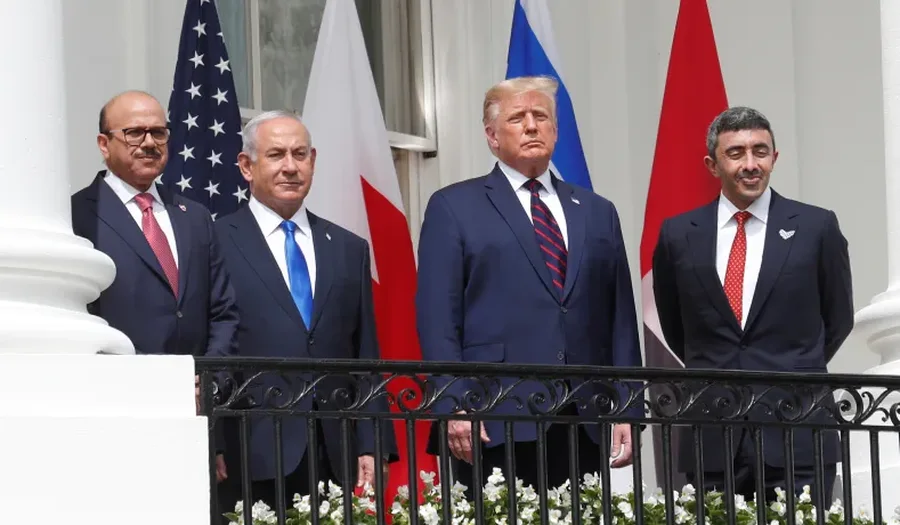
Trump will have no sympathy for the Palestinian movement and is unlikely to put further pressure on Israel to prosecute this war.
A recent New York Times editorial weighing Donald Trump's suitability for a second presidential term aptly noted how, rather than being driven by a compelling vision of America's future, Trump's desire to returned to power is above all motivated by three things: "to use the levers of government to advance his interests, to satisfy his impulses, and to punish precisely those he thinks have wronged him ".
By fitting this prism, we can also begin to sketch a second Trump administration approach to the Middle East.
- Impulses
Trump's overarching thrust toward the region can be summed up as follows: look strong, but don't do too much. For a region known for its complexity and difficulty, this is not necessarily a bad approach. It could save the United States from further disastrous and misguided follies, such as the invasion of Iraq in 2003. In many ways, this approach would also represent a continuation of America's “hegemonic withdrawal” from the region—a dynamic that predates Trump.
However, "looking strong" is not the same as exercising regional leadership. Nor does a less involved US mean more stability in the Middle East. Far from ushering in a period of benign neglect, a re-elected Donald Trump is more likely to widen a vacuum in the Middle East that begs to be filled. The region is already subject to the alternative models of Iran, Russia and China, among others.
That would sharpen the calculations of every US ally, including Saudi Arabia, the United Arab Emirates, Jordan, Egypt and Israel. These players have already hedged against a US withdrawal and are preparing for the possibility that US adversaries will have freer rein under a second Trump presidency. This could continue positive developments, such as deepening China-brokered detente between Iran and Saudi Arabia, or it could intensify intra-regional competition, especially if the US-Saudi security agreement is reached.
More problems can arise when Trump's impulse to appear strong leads to incoherent and dangerous policies, such as his first administration's decision to withdraw from the Iran nuclear deal, which has only served to accelerate Iran's production of enriched uranium to weapons-grade levels. Similarly, the US assassination of General Soleimani, commander of the Iranian Quds Force, in Baghdad in 2020 was an ill-advised decision that set off a round of escalating violence. The same impulsiveness is likely to continue to guide any future regional approach of the Trump administration, for example, when dealing with the problem of Houthi attacks on ships in the Red Sea and the Gulf of Aden.
While Trump's impulsiveness and unpredictability offer little comfort to the US's regional allies, his actions are not entirely helpful to adversaries either. Trump's capricious tendencies may also make it more dangerous for Tehran and its regional proxies to agitate against US interests in the region.
- Personal interests
With Trump back in office, the national interest would almost certainly be defined in much narrower terms. US Middle East policy will be pursued primarily to serve the president's self-interests, rather than the United States as a nation or the broader interests of a wide network of allies. This could mean that US policy drivers towards a key strategic partner like Saudi Arabia will be governed more by the Trump Organization's real estate development plans in Jeddah. Or, given his penchant for flattery, decisions will be influenced by Trump's personal relationships with regional leaders who do their best to boost his ego.
It is also in Trump's interest that it be seen as a deal. Trump's first term brought the Abraham Accords. Whether this diplomatic breakthrough was due to Trump's talents as a dealmaker or those of his son-in-law-turned-broker Jared Kushner, or simply a formalization of the discreetly growing ties between Israel and the UAE in previous years, remains to be seen. for debate. But a second Trump administration would be keen to cover up this legacy and shut down the next phase of the Abraham Accords, which aims for normalization between Israel and Saudi Arabia, a goal that was also doggedly pursued by the Biden administration.
However, Trump's deal is likely to stall in the most difficult regional conflict of all. The Israel-Hamas war has no upside for Trump, and even considering his inflated self-esteem, Trump seems self-aware enough not to pretend he can solve the Israeli-Palestinian conflict. While Trump has been a strong supporter of Israel in the past, he has repeatedly stated that the war in Gaza must end quickly and has recently been lukewarm at best toward Israeli Prime Minister Benjamin Netanyahu. However, Trump will have no sympathy for the Palestinian movement and is unlikely to put further pressure on Israel to prosecute this war.
- Punishment
Finally, beyond Trump's direct interests and impulses, what will affect the US state in the Middle East is his desire for broader retribution against the so-called deep state, otherwise known as the functioning bureaucracy of the US government. .
Much has been made of Project 2025, a publication published by the Heritage Foundation that claims to offer a blueprint for a second Trump term. In reality, it is little more than a grab bag of old, and sometimes contradictory, libertarian and conservative positions. Some of what is laid out in these documents aligns with his stated goals: cutting funding to government agencies, eroding their authority, and ensuring that there are no functioning executive agencies to moderate his agenda.
A re-elected Trump is also likely to make significant cuts to the US foreign aid budget, which would have serious implications for countries such as Jordan, Egypt, Syria, Lebanon and Yemen. A cut in funding to UNRWA, the UN humanitarian and development agency operating in Gaza and the West Bank, appears almost certain.
A potential purge of the US federal government also means that, outside of Trump's circle of advisers and loyalists, there may be very little institutional expertise left on US foreign policy in the Middle East. This time, there would be far fewer "adults in the room"./ Adapted "Pamphlet" from " TheInterpreter "



Lini një Përgjigje