


 Shkruar nga Shlomo Ben-Ami*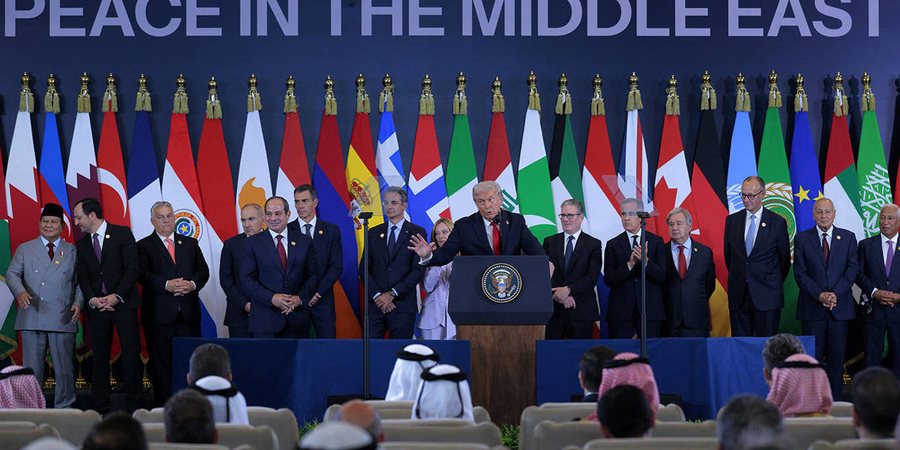
With his 20-point peace plan for Gaza, US President Donald Trump is relying on economic integration and infrastructure connectivity to foster long-term stability in the Middle East. While there are many obstacles to overcome, Trump could have the necessary influence, especially on Israeli Prime Minister Benjamin Netanyahu…
US President Donald Trump is probably not even aware of John Maynard Keynes’s 1919 book, “The Economic Consequences of Peace,” which warned that the harsh demands imposed on Germany after World War I, with their “unjust and unworkable economic basis,” would destabilize all of Europe. But Trump’s 20-point peace plan for Gaza reflects one of Keynes’s most important insights, embodied in the warning that “the dangers of the future lie not in borders and sovereignties, but in food, coal, and transportation.”
Gaza has never been at the center of discussions about the Israeli-Palestinian conflict. But Trump sees the enclave as the Archimedean point from which he can not only expand his family's business empire, a key motivation behind much of his foreign policy, but also consolidate US alliances in the Middle East and advance a major international infrastructure program capable of countering China's Belt and Road Initiative (BRI).
These ambitions long predate the war in Gaza. In 2017, during his first presidency, Trump reached an agreement with Japan to provide “high-quality infrastructure investment options in the Indo-Pacific region” and created a partnership aimed at promoting universal access to affordable and reliable energy in Southeast Asia, South Asia, and sub-Saharan Africa. “In a globalized world,” then-Secretary of Defense James Mattis declared, “there are many belts and many roads, and no nation should put itself in a position to dictate ‘One Belt, One Road.’”
Former US President Joe Biden took charge of infrastructure in 2022, when he founded the I2U2 Group with India, Israel and the United Arab Emirates to focus on “joint investments and new initiatives in water, energy, transportation, space, health, food security and technology.” The following year, the Biden administration, along with France, Germany, India, Italy, Saudi Arabia, the United Arab Emirates and the European Union, committed to developing a new India-Middle East-Europe Economic Corridor (IMEC), aimed at stimulating economic growth and development through enhanced connectivity and integration.
IMEC builds on the 2018 “Railways for Regional Peace” project, which would connect Israel, the United Arab Emirates, Jordan and Saudi Arabia via high-speed rail. It adds a sea route from India to the Persian Gulf and pipelines to export gas, mainly green hydrogen, from India and the Gulf countries to Europe. As European Commission President Ursula von der Leyen put it, IMEC is more than “just a railway or a cable”; it is a “green and digital bridge across continents and civilizations.”
But realizing IMEC’s vision will not be an easy task. For starters, Saudi Arabia and the United Arab Emirates are strategic trading partners of China and part of the BRI. The UAE also joined the China-led BRICS grouping in 2024, and Saudi Arabia has been considering membership since it was invited to join in 2023. Trump must now convince them to distance themselves from China’s infrastructure plans in the Middle East and instead commit to the US-backed strategy.
More fundamentally, progress on the relationship requires a stable Middle East, and that presupposes a peaceful and rebuilt Gaza. So unlike the interwar administration of US President Woodrow Wilson, which succumbed to isolationist pressures at home and retreated from peacebuilding in Europe, ultimately leading to another great conflagration, Trump is willing to face criticism from his MAGA base for focusing too much on foreign affairs. He has used American power to push recalcitrant regional actors toward a peace deal that reflects the wisdom of Keynes.
Trump's peace plan includes not only a permanent ceasefire, the deployment of a temporary International Stabilization Force (with a United Nations mandate), and the disarmament of Hamas, but also the establishment of a Palestinian transitional civil administration and the reconstruction and economic development of Gaza. It states that Israel will not occupy or annex Gaza and that no Palestinians will be forced to leave the enclave.
While Trump’s plan does not set out a path to Palestinian statehood, it does recognize statehood as “the aspiration of the Palestinian people.” Once Gaza is “redeveloped” and the Palestinian Authority is reformed, “the conditions may finally be in place for a credible path” toward that goal. Convincing Israel’s far-right government to approve, even in principle, a plan that includes any mention of Palestinian statehood is a notable achievement.
But this is just the beginning. The plan is more of a blueprint than a plan, and the lack of clarity on how its various phases will play out leaves plenty of room for different interpretations by the parties. Hamas has already said it will not give up its weapons, and both Hamas and Israel are likely to resist many other elements of the plan. The ceasefire remains fragile. Moreover, Trump’s regional alliance is divided by deep ideological and strategic divisions: the Qatar-Turkey axis is too friendly to Hamas and the Muslim Brotherhood to the Saudi-UAE-Israeli bloc. It also remains to be seen how Egypt would cope with a Turkish role in Gaza.
However, Trump has prepared the ground for a new peace in the Middle East, based on economic integration and infrastructure connectivity. An expansion of the Abraham Accords, Israel’s bilateral agreements establishing diplomatic relations with four Arab countries (Bahrain, Morocco, Sudan and the United Arab Emirates), may now be on the horizon.
To improve the chances of success, Trump has taken a number of steps to increase his administration’s influence over regional actors, including signing an arms deal with Saudi Arabia and a security pact with Qatar, and indicating that he might lift a ban on F-35 sales to Turkey. For Egypt, the prospect of securing major contracts in the reconstruction of Gaza is very attractive. Trump has even brought Syria into America’s orbit, as Turkish and American companies prepare for the reconstruction bonanza.
Perhaps most importantly, Trump has made it clear that Israeli Prime Minister Benjamin Netanyahu needs him, even going so far as to send a letter to the Israeli president demanding a full pardon for Netanyahu in his ongoing corruption trial. Internationally isolated, completely dependent on American military and political support, and facing a citizenry eager to end Israel’s longest war, Netanyahu has little choice but to bow to Trump’s will. Whether Trump’s softened vision of Palestinian statehood matches that of the Arab side is another matter. /Adapted from Project-Syndicate/
*Shlomo Ben-Ami, a former Israeli foreign minister, is vice president of the Toledo International Peace Center



Lini një Përgjigje