


 Shkruar nga Pamfleti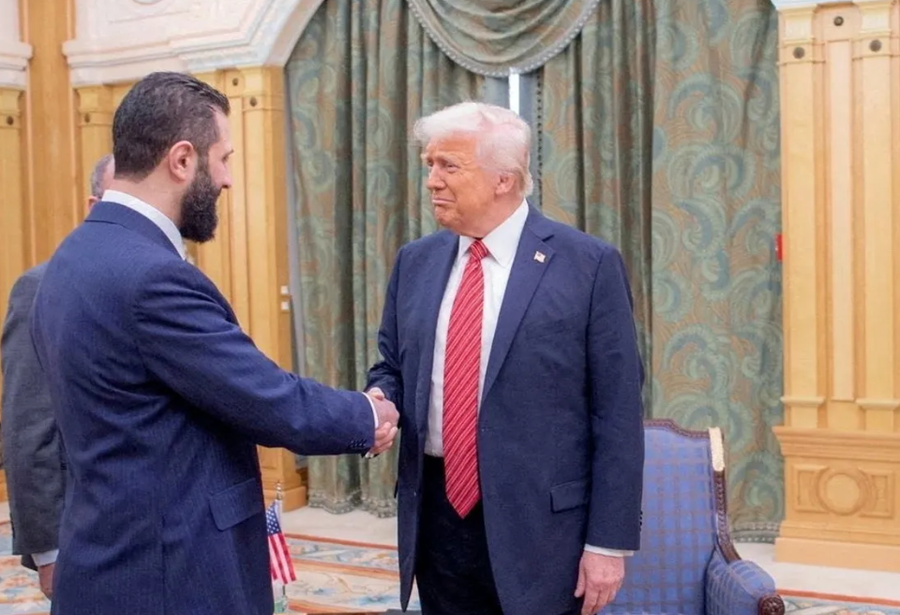
After more than a decade of isolation, Damascus receives the first signal of economic recovery and opening up to the West...
Syrian leader Ahmed al-Sharaa made a historic visit to the United States, where he was welcomed at the White House by President Donald Trump, marking an unexpected turn in relations between the two countries after more than a decade of diplomatic isolation.
This was the first time a Syrian leader had set foot in Washington since the country's independence, and was considered by international observers as a high-caliber political act, with a direct impact on the balance of power in the Middle East.
In a one-on-one meeting in the Oval Office, President Trump and al-Sharaa discussed ways to rebuild Syria’s economy and the possibility of involving American businesses in the post-civil war reconstruction process. A few hours after the meeting ended, the U.S. Treasury Department announced a 180-day suspension of sanctions known as the “Caesar Act,” allowing for the first time U.S. civilian goods, technology, and software to be exported to Syria without the need for special licenses. According to the U.S. administration, this is a “step to allow Syria to rebuild and prosper,” in line with President Trump’s new strategy to give the country “a second chance at greatness.”
However, the sanctions have not been completely lifted. Bans on individuals and groups accused of war crimes, drug trafficking and human rights abuses remain in place, including Bashar al-Assad and his inner circle. Transactions involving Russia and Iran also remain prohibited, reflecting Washington's tough line on the Syrian regime's former allies.
On the other hand, Damascus has welcomed the decision as a "bold political step", but President al-Sharaa has called for the sanctions to be lifted permanently, describing the six-month suspension as "a symbolic step, but not sufficient". He has called for the US Congress to pass new legislation that would completely end the economic sanctions, allowing Syria to attract investment and revive the vital energy, agriculture and construction sectors.
This diplomatic development represents a significant shift in the US approach to the Middle East, signaling Washington's attempt to balance Russian and Iranian influence in the region by reaching out to Damascus. For Syria, this is a major step towards emerging from international isolation, after 14 years of war, economic devastation and crippling sanctions that have paralyzed any form of domestic development.
The suspension of sanctions does not yet guarantee immediate changes, but it paves the way for a new diplomatic and economic process where Syria can be included as a factor of stability in the region, while the Trump administration tries to restore the US role as the main negotiator in Middle East conflicts. /Pamphlet





Lini një Përgjigje