


 Shkruar nga Pamfleti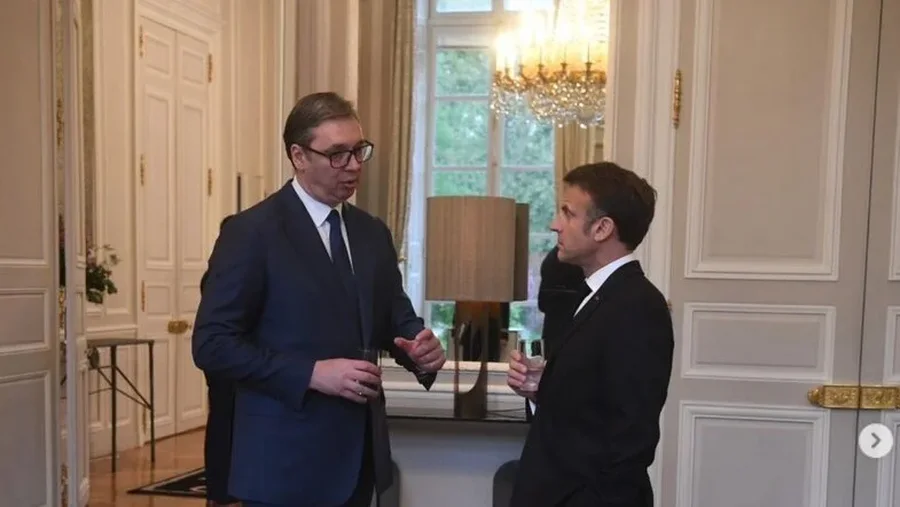
Radio Free Europe in its Serbian version through an interview with several international experts has analyzed the behavior of Serbian President Aleksandar Vucic who is managing to sit in two chairs two years after the Russian aggression against Ukraine - one Western and the other Russian and Chinese.
According to the chairman of the International Advisory Board of the Belgrade Center for Security Policy, Srđan Cvijič and Nikola Burazer, editor-in-chief of the European Western Balkans portal, Vučič is managing not to be swayed by Western partners for moves such as the inclusion of Vulin in the government and in the post senior vice president.
Since the beginning of the Russian aggression against Ukraine, Serbia has managed to avoid imposing sanctions on the Russian Federation. It also manages not to be punished by its Western partners for moves such as the inclusion of Vulin in the government and in the high post of vice president. I would compare Vucic to Mark Dren from Emir Kusturica's film Underground. Dreni is a war profiteer for whom a small army of people works in the slums of Belgrade producing weapons for the needs of the war, and when the war ends, he keeps those people convinced for 20 years that the war is still going on. that they will continue to work for it. President Vučić behaves in a similar way, he said.
While Burazer emphasizes that the Serbian president is only interested in hiding from the public eye the cooperation with Western partners in exchange for money.
I think that in the past the European Union showed a high degree of tolerance towards very visible, undemocratic tendencies in Serbia. There has been a calculation that Serbia under the rule of Aleksandar Vučić is a reliable partner when it comes to the stabilization of the region - whether for the solution of the Kosovo issue or for Bosnia-Herzegovina and Montenegro. This situation has changed a lot, because Serbia is appearing more and more as a factor of instability, so the long-standing policy of the European Union has turned out to be unsuccessful.
But the West really doesn't have many alternatives, because if it takes a tougher stance towards Serbia, it risks pushing Serbia even further away from the European Union and the West. Vucic threatens that if the West gets tougher on him because of the state of democracy in Serbia or not imposing sanctions against Russia, he will turn even more to China and Russia and become much more uncooperative when it comes to for Kosovo and Bosnia and Herzegovina. I think that the threat is not that credible, but in the West they consider that it is better to continue with the policy of appeasement than to act very harshly towards Serbia,' he said.
Has it not been clear to Brussels for a long time that Vučić is only interested in Western money and that he is not at all interested in Serbia joining the European Union? Because if it were not so, the media of the regime would not have been campaigning against the West for years and at the same time it would be raising China and Russia to the sky. It is no coincidence that a large number of citizens consider Russia and China to be Serbia's greatest friends.
Nikola Burazer: It is not so easy to understand and explain the behavior of Brussels when it comes to Serbia. It is simply impossible for Brussels not to see that with the rhetoric that European integration is Serbia's strategic goal, there has been a continuous anti-Western and anti-European campaign for more than ten years. Perhaps the real answer to this question is that they just don't care. For them, the most important thing is that Serbia behaves in a way that is in the interest of the European Union. Because if they do not see Serbia as a future member of the European Union, if for them it is only a neighboring country that is important for the stability of the region and therefore of the European Union, then maintaining stability in the region is much more. more important to them than democracy in Serbia.
The European Union has planned a fund of six billion euros for the Western Balkans, and a significant part of this amount should go to Serbia, as the largest country in the Western Balkans. Will Vucic get a gift again despite having hit the West so hard lately?
Srđan Cvijić: If I'm not mistaken, about two billion can be dedicated to Serbia. I think there will be some conditions, although we have to take into account the fear that exists in Brussels that if Serbia is not rewarded, it could go in an undesirable direction. However, despite Aleksandar Vučić's pro-Russian and pro-Chinese voter base, the vast majority of citizens expect economic prosperity, so turning their backs completely on the West and losing money coming from the European Union would have political consequences for the regime .


Lini një Përgjigje