


 Shkruar nga Pamfleti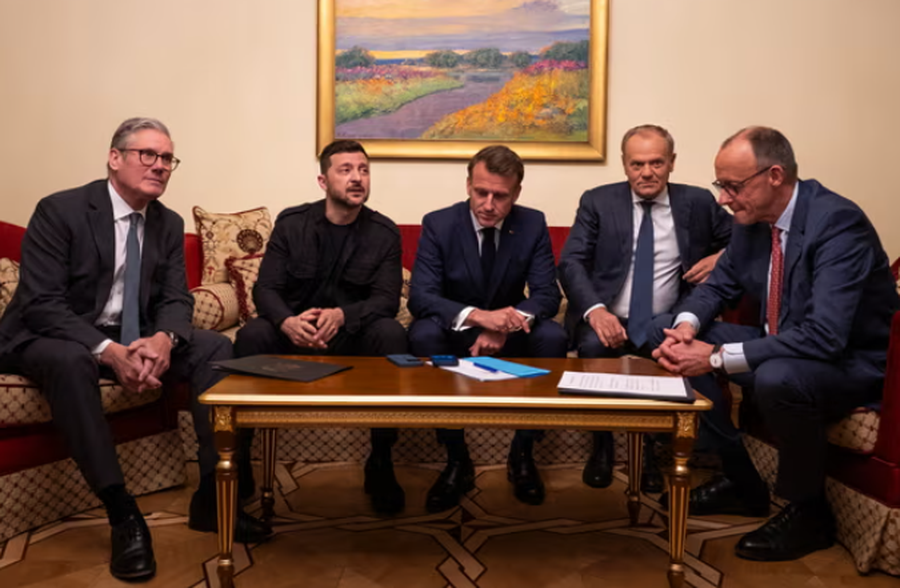
Donald Trump's social media post insisting that Ukraine should immediately begin peace talks with Russia has thwarted and perhaps jeopardized Europe's carefully crafted plans to persuade the US to impose sanctions on Moscow for rejecting the US president's proposal for a 30-day ceasefire, European diplomats said.
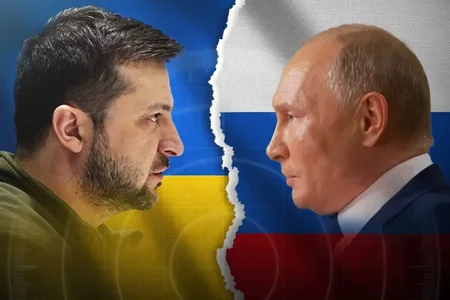
Volodymyr Zelensky had no choice but to accept Vladimir Putin's invitation for talks in Istanbul on Thursday for fear of offending Trump, diplomats said. Putin made the offer in an effort not to antagonize the U.S. president and to deflect mounting European pressure on Trump to impose tougher sanctions. Western diplomats say they have no reason to believe Trump acted in collusion with the Russian leader.
The leaders of Britain, France, Germany and Poland went together for the first time in Kiev over the weekend to underline the call for a 30-day ceasefire that, according to them, should begin on Monday.
The purpose of the visit by Keir Starmer, Emmanuel Macron, Friedrich Merz and Donald Tusk was to pressure Trump to admit that Putin was stalling and that the US had no other political option but to impose harsh economic sanctions on Russia.
Republican Senator Lindsey Graham has prepared a sanctions package that has broad support in Congress.
Foreign ministers were also in Lviv on Friday in a bid to put pressure on Russia, saying there were plans to try Russian leaders for the crime of aggression before a special court. The UK had announced further sanctions on the Russian shadow fleet.
Partly because of Trump's intervention, the UK has now postponed further measures that were due to be announced on Monday, but the EU is pressing ahead with its plans for another package of sanctions later this month. A German government spokesman said on Monday that the EU would start working on sanctions if there was no ceasefire by the end of the day.
However, the game changer would be additional US sanctions, not only because of the economic impact, but also because of the political symbolism in Trump's admission that Putin has been the main obstacle to a solution.
On Sunday, Trump issued a statement on his website Truth Social blaming both Russia and Ukraine for failing to implement his ceasefire plan. He said Ukraine should agree to meet with Russia immediately. "At least they will be able to determine whether or not a deal is possible," Trump wrote.
European leaders are waiting to see whether Putin will travel to Istanbul himself to hold talks with Zelensky, a leader he does not recognize as legitimate.
At the previous round of talks in Turkey in 2022, Russian Foreign Minister Sergei Lavrov led the Russian delegation. Putin's participation could be a sign that he understands he is under real pressure from Trump.
Kremlin spokesman Dmitry Peskov on Monday did not directly answer questions about the talks with Zelensky, saying instead that the Kremlin was "focused on a serious search for ways to achieve a long-term peaceful solution."
Peskov also criticized what he called the EU's "ultimatum" on Ukraine in a conference call with reporters. "The language of ultimatums is unacceptable for Russia, it is not appropriate. You cannot speak to Russia in such language," he said.
On Monday, Trump announced that Putin would attend and that he himself might attend. "You could have a good outcome from the meeting on Thursday in Turkey... and I believe both leaders will be there. I was thinking about flying. I don't know where I'm going to be on Thursday, I have so many meetings... There's a possibility there, I think, if I think things can happen."
A key demand, supported by Europe, will be for Putin to stop prejudging the 30-day ceasefire.
US Secretary of State Marco Rubio will also be in Turkey on Thursday for an informal summit on NATO's overall defence spending, but European ministers are set to discuss their view that Russia's conditions for a peace deal effectively include the break-up of Ukraine.
If Putin is seen to be delaying a ceasefire, or if talks fail in Istanbul, the goal will be to go back to Trump and urge him to acknowledge that Putin is not interested in a just peace, but only in Ukraine's capitulation.
European foreign ministers, meeting in London, publicly tried to downplay the importance of Trump's intervention, continuing to say that there can be no real negotiations without a complete ceasefire.
The new German foreign minister, Johann Wadephul, said on Monday that “it has been clearly articulated that, first, there is a ceasefire. Ukraine is ready for that. Germany now expects Russia to agree to a ceasefire and then be prepared to negotiate.”
Italian Foreign Minister Antonio Tajani said: "What we are seeing from Moscow is not promising. He is trying to gain time and perhaps occupy more Ukrainian territories."
Kaja Kallas, the EU's foreign policy chief, said that "in order to start peace talks, there must be a ceasefire. We must put pressure on Russia because it is playing a game." /Adapted from The Guardian/


Lini një Përgjigje