


 Shkruar nga Ian Garner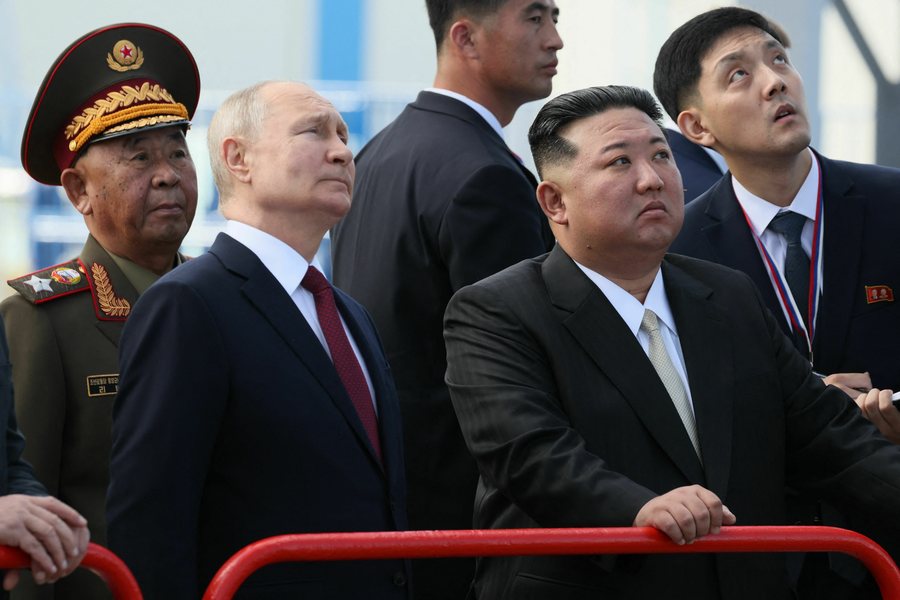
The truth is that Vladimir Putin is very dependent on Kim Jong Un, and the help he is getting from him is basically a sign of weakness, not strength.
A wave of terror is haunting Europe. At least this is the impression coming from Kiev. Nor Andriy Yermak, the head of the Ukrainian president's office, said recently, a "new axis of evil" is forming around the world, creating a military alliance that is "challenging democracies and world order."
His fear may be understandable to some extent. North Korea is planning to send about 10,000 troops to Ukraine to bolster Russian military operations on the battlefield. Meanwhile, Pyongyang supplies Moscow with half of the artillery shells it uses on the front.
However, if this June's agreement between these countries is undoubtedly worrying, especially when it comes to China's aggressive behavior in the Pacific, the West is facing less of an axis of evil and more of an alliance of convenience.
The truth is that Vladimir Putin is very dependent on Kim Jong Un, and the help he is getting from him is basically a sign of weakness, not strength. The sudden appearance of North Koreans in their country alarmed Kiev. And given how the conflict is going, Yermak's dramatic language is more than understandable.
Over the past few months, the Russians have made major advances across Ukraine, sometimes advancing up to 1 kilometer per day, and threatening strategically important cities such as Pokrovsk. Meanwhile, overall the recent alliance between Moscow and Pyongyang reflects the existence of an old friendship.
Both of these countries have generally had warm relations since Putin came to power 25 years ago. Pyongyang was the destination of one of President Kim's first state visits abroad, when he hailed the Soviet military's special role in "liberating" North Korea from Japanese occupation in 1945.
However, in the mid-2000s Moscow strongly criticized North Korea's erratic and dangerous behavior on the international stage, as Putin hoped to strengthen his reputation on the international stage by playing the role of mediator in the Korean Peninsula dispute.
During the early years of the Cold War, the North Korean regime relied on the aid of the Soviet Union. It then spent several decades suppressing its population, and evading Soviet retaliation. The Kim dynasty was not always treated as a junior partner, and was praised or criticized as it suited Moscow.
But since launching a full-scale invasion of Ukraine in 2022, Putin has been desperate to find partners wherever he can. Now, the Russian president is making open efforts to rewrite history and describe Russia and Korea as old and equal partners.
The security partnership signed this year, and North Korea's increasing supply of soldiers and missiles, seem to indicate that equality is being embraced by both sides. Yet despite the pageantry of state dinners and the finesse of official statements, Putin is clearly desperate for Kim Jong Un's support.
Despite Russia's recent victories around cities like Pokrovsk, this is largely due to its geopolitical weakness. Russia is currently facing a major recruitment crisis, fueled largely by the heavy losses it has suffered at the front.
Every month, 30,000 men enter the army, and the same number are wounded, disabled and return home or killed on the battlefield. Despite the large bonuses offered to contract soldiers who choose to enlist, which by some estimates currently account for 1.5 percent of budget spending, the Russian state is still forced to look to the world for mercenaries to support its war.
A division of inexperienced North Korean recruits, not even their officers speaking Russian, would be annihilated very quickly if thrown onto the battlefield like cannon fodder. And if Russia's support for North Korea indicates a military problem, it also relies on Pyongyang economically.
Although the Kim regime can produce the projectiles in large numbers, and reportedly sends around 5 million to its Russian allies, most of them appear to be of poor quality. The fact that Putin is accepting them anyway shows that he has no one else to turn to for help.
Although Russia is now spending about 40 percent of its defense budget and renovating its munitions factories, it remains completely dependent on external partners such as North Korea. Despite boasting an economy roughly 10 times the size of North Korea's, Russia seems incapable of waging an independent war against Ukraine, let alone launching an attack on NATO as part of a plot to evil to dismantle the current global order.
Pyongyang, for its part, can only offer not very significant support to its partner, help that they are giving anyway mainly to earn money, receive aid for scientific research and other material goods.
Despite all the ominous signs, the so-called "axis of evil" should probably not worry Western leaders all that much. On the contrary, the June alliance is showing Moscow's increasingly weak position on the world stage. Putin, who is quick to accept whatever help in soldiers and weapons is offered to him, has reduced himself to a beggar.
And once the North Koreans reach a better deal, especially with China, they will have little incentive to remain loyal to Moscow. If China solicits or buys Pyongyang's support for an invasion of Taiwan, Putin's war will be momentarily forgotten. Moscow may have some small benefits from its North Korean ally.
But 10,000 troops - no matter how undesirable their presence in Ukraine - will not change the course of the war. However, if the world at large is a little afraid of Putin and Kim's friendship, could the West see a golden opportunity it should seize? If Kim Jong Un can be enticed to stop providing missiles and soldiers to Moscow, whether from China or a Western coalition, could an exhausted Russia be forced to withdraw from Ukraine? Of course, such an action alone will not bring victory in this war.
Resupplying the exhausted Ukrainian army is also very important. But it is certain that reducing Russia's arms supply would hamper Putin's ability to hold the current front line, or to prepare for another attack against Ukraine. Torn by ideological differences and conflicting medium-term objectives, the "new axis of evil" is anything but./ Adapted "Pamphlet" by "Ian Garner"
*Note: Ian Garner, assistant/professor of totalitarian studies at the Pilecki Institute in Warsaw. His latest book is titled "Generation Z: Russia's Fascist Youth".


Lini një Përgjigje