


 Shkruar nga Matthew Fabbri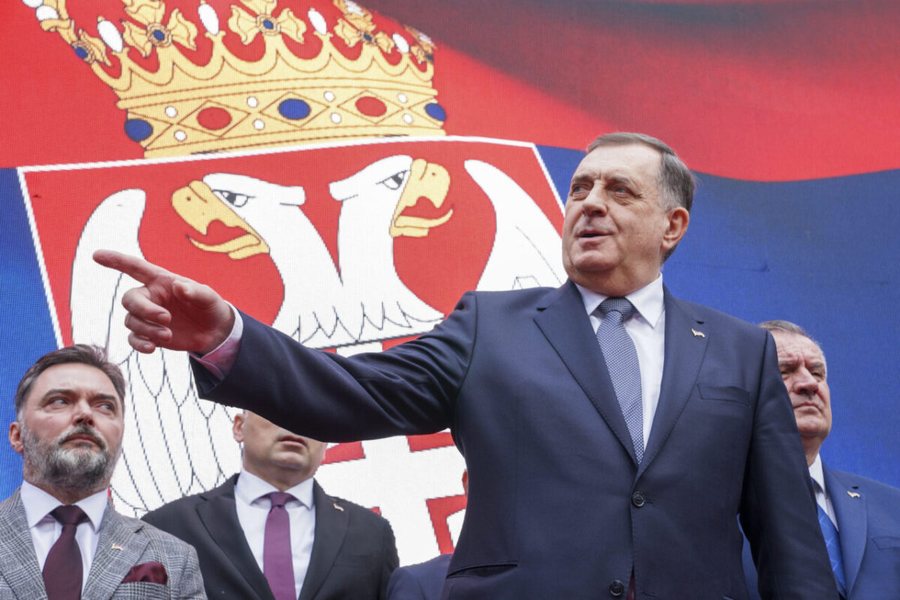
The Bosnian Serb leader and the president of Republika Srpska continues to defy the Dayton Accords, with the support of Putin and Orban. Serbia is using the crisis to distract from domestic protests, while the West is confident in the stance it must take.
The President of Republika Srpska, Milorad Dodik, has received an arrest warrant from the court of Bosnia and Herzegovina. The charge is that of attacking the constitutional order, and comes after a series of laws by the RS parliament, which significantly limit the ability of federal bodies in Sarajevo to act.
The arrest warrant, which came after Dodik refused to go to the prosecutor's office several weeks ago, also includes Prime Minister Radovan Višković and National Assembly Speaker Nenad Stevandic. Republika Srpska is one of two autonomous entities in Bosnia, populated mainly by Serbs.
It occupies approximately 49 percent of the territory of Bosnia and Herzegovina, and is home to 33 percent of the population. Republika Srpska enjoys a large degree of administrative autonomy: it has its own parliament, a people's council, president, government, police, and national symbols.
Relations between RS and Bosnia and Herzegovina are regulated by the Dayton Agreement, which defined the country's new institutional structure after the dissolution of Yugoslavia, providing for the creation of two entities (the second being the Croat-Muslim one) within a national and unitary framework.
Over the past 20 years, Dodik has almost always been at the helm of the Republic, and his political activity, especially recently, has focused on the secession of the RS from the central state. We asked Giorgio Fruscione, a researcher at the ISPI (Institute for International Political Studies), who has been dealing with the Balkans for years, to briefly explain how this point was reached: “The arrest warrant comes at the height of a strong clash that has been ongoing since at least 2021, between the Bosnian Serb leader and the central government.
Institutions prevent secession, but the fact is that Dodik's policies are disregarding the authority of these institutions. It is a clash that plays into the hands of the Bosnian Serb leader, whose nationalism has served his power for years.
"Dodik has also opposed the central institutions in Sarajevo, from which he has tried to remove some of the few exclusive powers in favor of the Serb-majority entity of Bosnia," the expert emphasizes.
Although the Bosnian institutional system has officially demonstrated that it has "antibodies" to counter the separatist aims of one of its entities, in reality the situation remains very fragile and paradoxically Dodik's judicial problems may strengthen his position.
Sipas Frusciones, boshllëku institucional i viteve të fundit mund të zgjatet më tej, edhe nëse ekziston rreziku që këtë herë pasojat të jenë më serioze: “Në 30 vjet, Bosnja ka funksionuar pak si një shtet koheziv, duke garantuar autonomi të gjerë për dy entitetet, që nga ana e tyre kanë qeveri dhe administrata krejtësisht të ndryshme. Pasoja më e mundshme është se shteti qendror do të pushojë së funksionuari në 49 për qind të territorit, dhe rikthimi nga një skenar i tillë do të ishte e vështirë”.
Në nivelin ndërkombëtar, presidenti serb i Bosnjës ka marrëdhënie shumë të ngushta me presidentin rus Vladimir Putin dhe atë serb Aleksandar Vuçiç. Qëkur Rusia pushtoi Ukrainën, për Vuçiç është bërë e papërshtatshme që ai të shihet shumë pranë Moskës, ndaj Dodik është bërë i dërguari i serbëve në Kremlin.
Sigurisht, Republika Srpska mund të mbështetet edhe tek udhëheqësi i Hungarisë Viktor Orbán. Ndërkohë, vendet e mëdha evropiane reaguan ndaj urdhër-arrestit duke mbajtur anën e Bosnje Hercegovinës dhe duke iu referuar Marrëveshjes e Dejtonit.
Po ashtu, Evropa ka forcuar misionin EUFOR në Bosnje, duke dërguar trupa shtesë. Megjithatë, kjo situatë rrezikon të kthehet në një problem tjetër për Brukselin, i cili mund të përballet me tensione të reja vetëm pak kilometra larg kufirit. Sidomos nëse qëndrimi i Uashingtonit, do të afrohet akoma më shumë me atë të Moskës.
Për momentin, administrata amerikane, ka dënuar nëpërmjet Sekretarit të Shtetit, Marco Rubio sjelljen “e rrezikshme dhe destabilizuese” të Dodik. Në realitet, interesi i SHBA-së në rajon është shumë i vogël, dhe kjo nuk do të ndihmojë në stabilizimin e marrëdhënieve në Ballkan.
“Amerika e Trumpit do të fokusohet pak në rajon - vazhdon Fruscione - dhe mënyra e veprimit e presidentit amerikan, pritet të normalizojë anarkinë në marrëdhënie, duke mos respektuar ligjin ndërkombëtar, që në fakt e garanton mbijetesën e Bosnjes.
Dodik shpreson që Shtetet e Bashkuara të heqin disa sanksione kundër tij dhe të mos pengojnë lëvizjet e tij, duke përqafuar statuskuonë e re të Bosnjës. Aspirata maksimale, do të ishte rreshtimi në një linjë me Rusinë në lidhje me refuzimin e Përfaqësuesit të Lartë, pra garantuesit të Marrëveshjes së Dejtonit.
Në atë moment presidenti i RS-së do të kishte një aleat në Moskë dhe një tjetër në Uashington. Ai do të përpiqet të përfitojë nga destabiliteti në Bosnje Hercegovinë është serbi Vuçiç, që ka shprehur tashmë mbështetjen e tij për Dodik.
Për muaj të tërë, mijëra njerëz kanë dalë në rrugët e Beogradit (të dielën e kaluar ishin mbi 100 mijë) për të protestuar kundër korrupsionit qeveritar, dhe çështja boshnjake mund të kthehet në një mundësi të madhe për ta shpërqendruar opinionin publik nga presionet e brendshme.
Si palë nënshkruese e Marrëveshjes së Dejtonit, Serbia duhet të jetë një nga vendet garantuese të integritetit territorial të Bosnjës. Por për momentin, stabiliteti i rajonit nuk është ndër prioritetet e Vuçiç.
"At the local level, Serbia is fueling divisions for domestic political purposes. Dodik and Vučić are close allies in that regional context that the authorities in Belgrade call the "Serbian world", an updated version of Greater Serbia and inspired by Putin's Russian world," Fruscione emphasizes.
Moscow plays an indirect role in this situation, and is already poised to reap the benefits of the great instability, which is hindering the Balkan country's Euro-Atlantic integration process.
The Russian autocrat likes the idea of new tensions that could distract Europeans. For this reason, he will continue to support Dodik in his attempt to destabilize the region. Supported by his loyal allies in Belgrade and Budapest. /Adapted from "Pamphlet", from "Linkiesta"




Lini një Përgjigje