


 Shkruar nga Pamfleti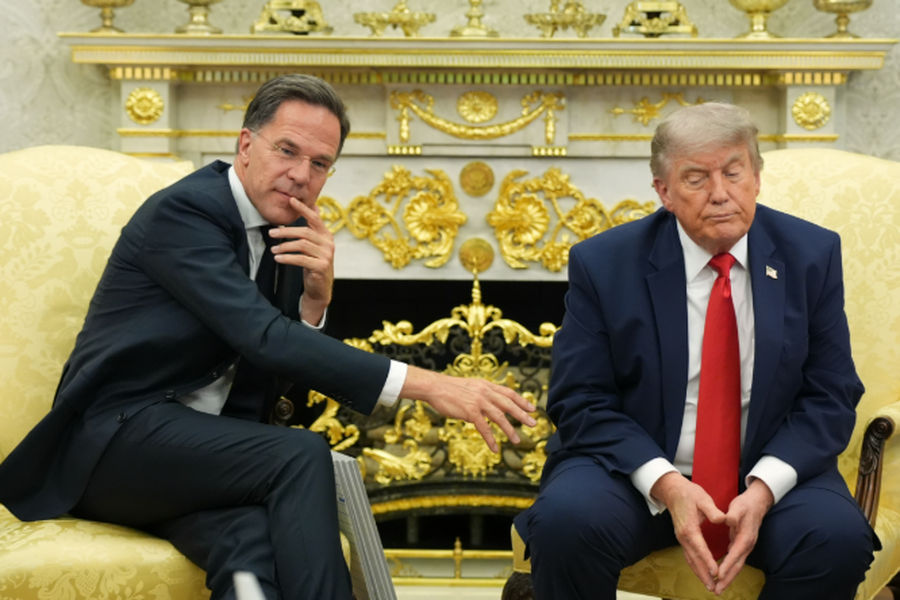
US President Donald Trump and NATO Secretary General Mark Rutte held a meeting at the White House this week, where the discussions focused on the military spending of member countries, the war in Ukraine, relations with Turkey and global security challenges.
The meeting took place at a time when the US administration continues to demand that European allies take more responsibility for their defense, while NATO strives to maintain unity in the face of numerous international crises.
To argue that member states have responded to Washington's demands, Mark Rutte brought data on increased defense investment.
"This is what I call the 'Trump trillion'. Since 2017, Europeans and Canadians have added over $1.2 trillion in defense spending," Rutte said.
According to him, the pressure exerted by the US administration has influenced many European governments to change their approach to defense financing and significantly increase military budgets.
However, Trump made it clear that he is not convinced that allies have done enough.
"The main question is: are they paying 5 percent? For the most part, no. We have thousands of troops in Europe, we spend billions of dollars on their security, and what I ask for is loyalty," the US president declared.
Trump criticized several European countries, saying that they continue to fail to fulfill the commitments they have made within NATO and that the burden of defense continues to fall primarily on the United States.
The US president also touched on the military operation against Iran, emphasizing that the US did not need military support from allies, but would have expected a stronger political stance in favor of Washington.
"We didn't need help. We solved it ourselves in the first week. But it would have been nice to hear some of them say, 'we want to help.' They didn't," Trump said.
On the other hand, Rutte acknowledged that there have been disagreements between allied countries, but underlined that transatlantic cooperation remains essential for common security.
"Between four and five thousand American aircraft took off from bases in Europe," said Mark Rutte, noting the logistical support that European allies have provided to American operations.
A significant part of the discussion was also devoted to Turkey. Trump spoke positively about President Recep Tayyip Erdogan, describing him as a partner with whom he has had good cooperation.
"Erdogan is a strong and respected leader. Every time I've asked him for something, he's done it," Trump said.
The US president hinted that his administration may take steps to improve military relations with Ankara.
"We will most likely do something that will make him very happy," he declared.
These comments have been interpreted as a positive signal for Turkey's request to return to the F-35 fighter jet program, from which it was excluded after purchasing the Russian S-400 air defense system.
A little later, US Vice President JD Vance confirmed that the administration in Washington is considering the possibility of Turkey's return to the F-35 program. According to Reuters sources, alternatives are being analyzed that could lead to an agreement with Ankara, although there are still reservations in Congress on this issue.
During his conversation with reporters, Trump also touched on the war in Ukraine. Unlike his critical statements towards Kiev in recent months, this time he used more positive tones about President Volodymyr Zelensky and the resistance of the Ukrainian army.
"He's doing pretty well. No matter how you look at it, he's holding out. There are a lot of casualties on both sides, but you have to admit he's shown courage. He has good equipment, but most of all he has good fighters," Trump said.
The US president's statements come at a time when the war in Ukraine continues without a clear prospect of an end and remains the biggest security challenge for NATO on its eastern flank.
At the same time, the alliance is also following developments in the Middle East with concern. The ceasefire between Israel and Iran is still considered fragile after recent weeks of military escalation, which also involved the United States. In parallel, tensions in Lebanon between Israel and Hezbollah continue to keep the risk of conflict in the region high.
In this context, the upcoming NATO summit, to be held on July 7 and 8 in Ankara, is expected to focus not only on increasing defense spending and support for Ukraine, but also on new security challenges related to the situation in the Middle East.
The meeting is expected to be an important test of the alliance's unity, while Donald Trump's presence and positions are expected to have a direct impact on debates about the future of NATO and the role that European countries will have to take in their defense.




Lini një Përgjigje