


 Shkruar nga Pamfleti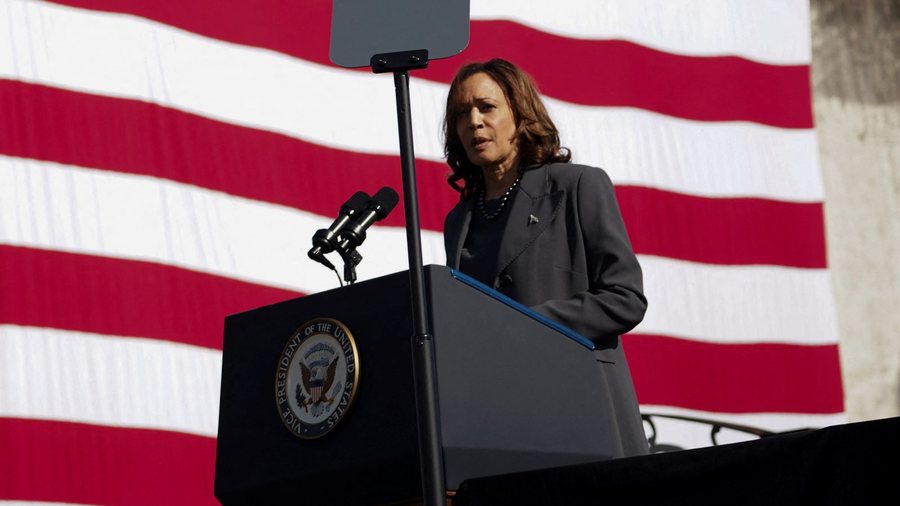
In public statements after her recent meeting with Israeli Prime Minister Benjamin Netanyahu, Harris reiterated the Biden administration's position that Israel has the right to defend itself, but added that how it does so is also very important.
Now that US Vice President Kamala Harris is almost certain to be the Democratic nominee for this year's presidential race, one of the main questions being raised both in Washington and in the capitals of many countries is how she will to be Harris's foreign policy doctrine, should she win in November.
In addition to reviewing her past performance and statements, Foreign Policy spoke with dozens of U.S. and former U.S. officials, congressional staffers, experts and former aides to Harris to learn more about her approach to key regions and politics. outer.
China
Her direct experience with China is relatively limited compared to Biden. Harris has held only a brief meeting with Chinese leader President Xi Jingping at the Asia-Pacific Economic Cooperation summit in Bangkok in 2022. As No. 2, he has sought to bolster US alliances in the Indo-Pacific region.
He also traveled 3 times to Southeast Asia, visiting Singapore, Vietnam, Thailand, the Philippines and Indonesia. The position he has taken on China in the 2020 campaign is consistent with White House policy over the past 4 years. It has accused Beijing of stealing American products, intellectual property, and demanded accountability.
But he stressed that the United States should cooperate with China on key issues such as climate change. Meanwhile, she and 55 other senators supported the Hong Kong Human Rights and Democracy Act, which imposed sanctions on Chinese officials for violating human rights during protests against the extradition bill.
Shortly after, she co-sponsored a law imposing sanctions on human rights abuses in Xinjiang. So overall, experts agree that her approach to China policy is unlikely to differ significantly from Biden's.
India, South Asia and the Indo-Pacific
According to experts, Harris' India policy is unlikely to change much from Biden's. The US-India relationship has had reliable bipartisan support for decades, including the Trump presidency, and remains very important on both sides.
Harris has a more personal connection to India than any other US presidential candidate. Her mother, Shyamala Gopalan, immigrated to the United States from India. But politically, this is unlikely to play a major role. Because when she was a senator, Harris was tougher on India than Biden, criticizing Modi's violation of human rights. But if she becomes president, the approach may be moderated.
Trade policy
Harris has never acted with a commercial mindset, either in the Senate or as vice president. But overall, she has championed a vision of trade that is worker-centric and environmentally friendly. Harris has repeatedly criticized the Trump presidency's tariffs, labeling them as additional taxes on American businesses and consumers.
In relation to trade agreements, it is a little more difficult to understand. She voted against the original North American Free Trade Agreement (NAFTA), an idea of Reagan-era Republicans that is widely criticized today. But he was also against former President Barack Obama's Trans-Pacific Partnership, which was criticized by both sides and canceled in the first week of Trump's presidency.
The Russia-Ukraine war and NATO
Joe Biden has sent Harris to represent him at many of the biggest international conferences, including the Munich Security Conference and the Ukraine peace summit. In the latter, she called for a "just and lasting peace".
The Kremlin has so far remained largely silent on Harris' candidacy. Presidential spokesman Dmitry Peskov cited the vice president's "unfriendly rhetoric" but added that Russia could not yet officially assess her candidacy. However, the Russian state media immediately launched attacks. " Kamala with a nuclear button is more dangerous than a monkey with a grenade!" - said Andrei Sidorov, dean of global politics at Moscow State University, during the weekly program of Russian state television.
The Israeli-Palestinian conflict
A close analysis of her Senate votes and public speeches shows that Harris is unlikely to bring about any significant change in the US approach to the war in Gaza or to the Israeli-Palestinian conflict in general. "Given what she has said, we will have a continuum," says David Makovsky, a former senior adviser to the US special envoy for Israeli-Palestinian negotiations.
Her husband, Doug Emhoff, is Jewish, and has played an important role in the Biden administration's fight against anti-Semitism. Since the October 7, 2023 Hamas attacks, Harris has largely supported the policy of the Biden administration, which has asserted Israel's right to defend itself.
It has gradually increased its criticism of the extreme and indiscriminate nature of Israel's military campaign, and pressed for a ceasefire agreement that would also secure the release of hostages. In public statements after her recent meeting with Israeli Prime Minister Benjamin Netanyahu, Harris reiterated the Biden administration's position that Israel has the right to defend itself, but added that how it does so is also very important.
Africa
During the 2022 summit between the US and African leaders in Washington, Biden pledged to visit the continent next year. This did not happen. African leaders have long complained that they have been neglected by Washington. Harris has been the most senior administration official to visit Africa, visiting Ghana, Tanzania and Zambia over the years. But overall, it is likely to continue Biden's approach to Africa: cabinet-level visits, talk of promoting democracy and the rule of law, while significantly expanding the influence of Russia and China.
immigration
Republicans have labeled Harris the "border empress" of the Biden administration, and have attacked her for her failures to normalize the situation. But immigration experts point out that her mandate was much more limited. In reality, Harris was tasked with negotiating with 3 Central American countries - Honduras, Guatemala and El Salvador - to help them address the "root causes" of migration such as economic hardship, violence and political oppression.
As part of this effort, Harris announced the award of more than $5.2 billion to the private sector in the three countries. Illegal crossings fell to a three-year low in June of this year, after Biden signed a controversial executive order barring immigrants from seeking asylum during high-flow periods.
As a Californian, a former attorney general, and a child of immigrants, Harris's own background has shaped her perspective on this issue, and is sure to continue to do so if she is elected president./ Adapt "Pamphlet" from "Foreign Policy"






Lini një Përgjigje