


 Shkruar nga Federico Giuliani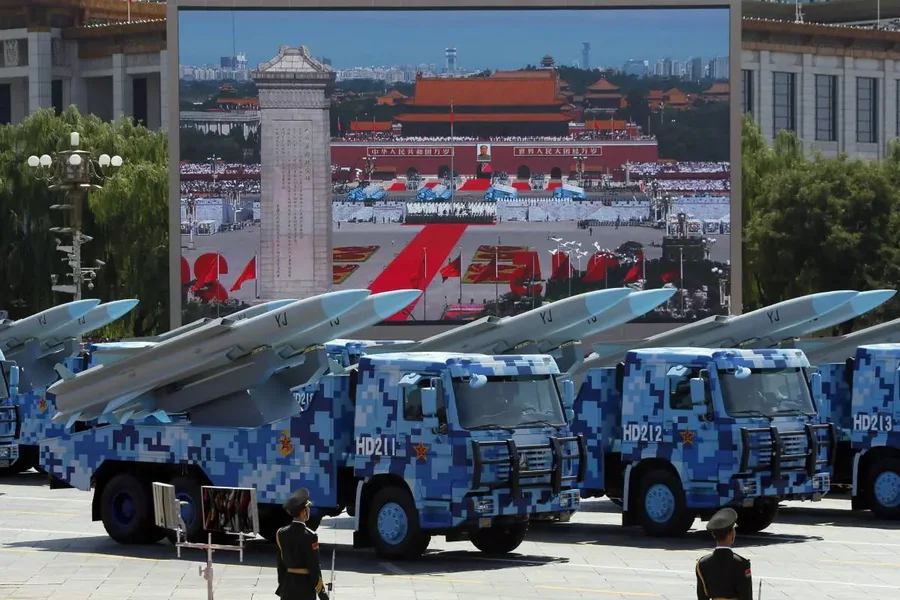
China is accelerating its military modernization with new weapons and technologies, raising questions about the ability of US intelligence to effectively monitor and assess these rapid developments...
China continues to modernize its military, constantly unveiling new weapons, vehicles, and military equipment. In recent months, for example, Beijing has shown off all sorts of autonomous combat drones, tailless J-XDS and J-36 tactical fighter jets, stealth fighter jets, and even its new aircraft carrier.
Of course, we do not know the status of these programs, nor how much of them are real and how much are simply designed to confuse rivals. In this context, and in the midst of so many other global crises, analysts have begun to raise a fundamental question: is the US intelligence apparatus capable of monitoring so many technological changes simultaneously? Do US intelligence agencies have the skills to manage the situation, both now and in the future?
Tracking American intelligence
As The War Zone explained, not since the Cold War have so many military advances and weapons programs emerged from a rival of the United States. Therefore, it is fair to ask whether the US intelligence community is truly capable of processing and monitoring this growing wave of developments and providing sufficient analysis to the White House, the Pentagon, and Congress.
According to Timothy Heath, a senior researcher at the Rand Corporation, US intelligence capabilities "are quite sophisticated and can collect significant data on systems once they are deployed."
However, given the secretive nature of China's weapons programs, Washington risks being surprised by the emergence of new weapons systems. Another distinction must be made: warships are difficult to hide and are built in only a few countries, while things get much more complicated for missiles and high-tech systems.
Another possibility that shouldn't be overlooked: Beijing might be happy to flood the U.S. intelligence community with a large amount of systems and munitions to review. However, if China is presenting more advanced military capabilities than it actually possesses, it wouldn't be the first country to do so.
"We should neither exaggerate nor minimize what we are seeing from China. We should try to understand the current capabilities of each system and then understand that these capabilities can change rapidly," explained Brad Bowman, senior director at the Center on Military and Political Power at the Foundation for Defense of Democracies (FDD).
US Capabilities
The United States has several intelligence agencies with deep expertise in weapons systems. “Ultimately, we’re only talking about a handful of really new systems, so the scale of the challenge is probably manageable, even if it will require significant time and attention at DIA and elsewhere,” added Zack Cooper, a senior fellow at the American Enterprise Institute. Christopher Miller, the former acting defense secretary from November 2020 to January 2021 during the first Trump administration, also recalled his experiences while in office: “I don’t think there was ever any concern about the ability to track and analyze Chinese weapons programs. It was a pretty standard data collection requirement.”
Other experts believe it is unclear how much of China's new systems are real and how much are prototypes, but above all it is difficult to speak about their effectiveness.
Of course, the US should not underestimate China, given that the Dragon can produce (and quickly) massive weaponry and can concentrate its combat power in a specific theater close to its own backyard. This presents an additional challenge for Washington. /Adapted from Il Giornale/








Lini një Përgjigje