


 Shkruar nga Pamfleti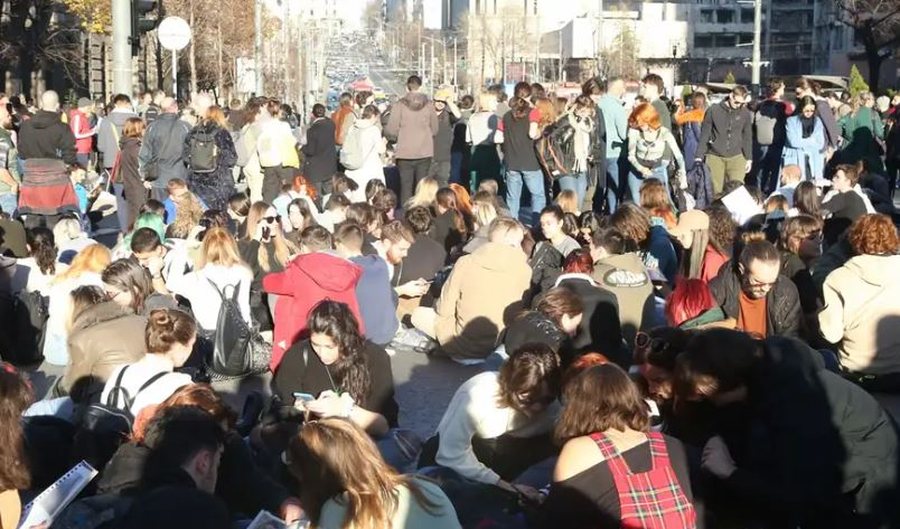
Suspicions of election manipulation in Serbia have caused a new wave of protests and led the country to a new political crisis. Apart from the fact that the elections showed that Serbia is politically in a "counting place", where despite all efforts the same winner emerges again, more than ever they emphasized the complete paralysis of the institutions.
It's virtually no secret that the police were ordered not to respond to calls for irregularities at certain polling stations, but the administration's crackdown continued even after election day. The prosecution established within a few minutes that there were no criminal offenses during the elections, the election commissions rejected the objections of the opposition, while the Ministry of State Administration and Local Self-Government claims that the list of voters was open and public and that these were democratic and legitimate elections, and a "flawless" election list.
There have been protests in Serbia in the past years as well, but they, despite the large number from time to time, have mostly failed. The last round of protests in Belgrade lasted only a few days and for now the basic impression is that the protest may not be at the level of the opposition's expectations, while the innovation is the greater involvement of students.
The long history of unsuccessful protests discourages citizens and political activists, but as political analyst Dragomir Angjelkovic points out to DW, "Aleksandar Vučić is primarily concerned about mass protests that he will not be able to control, which does not mean that the opposition and students cannot threaten the stability of Vučić with a combination of different movements".
"The refusal of the opposition to enter both the Belgrade and the republican assemblies and the declaration of illegitimate elections - would strip Vučić of his legitimacy and bring the situation to an open dictatorship." "The opposition has mechanisms to oppose it, but it must be ready for marathon work and set clear demands on how the next elections should be conducted," Angjelkovic believes.
Regarding the demands, our interlocutor adds that "it is very bad that the opposition mentions the republican elections, hoping for a solution for Belgrade. The election was either stolen or it wasn't. If they were stolen, we can only imagine how they were stolen inside Serbia, if there were so many irregularities in Belgrade. They could not be discovered outside Belgrade, because they have no reliable observers there."
If we look at the history of the protests so far, we see that three factors play a decisive role if the protests will bring results, Professor Zoran Stojiljkovic of the Faculty of Political Sciences told DW: "These are the unity of the opposition, the energy of the protests and the influence of the factors of external". Only the synergy of these factors gives results. As for these elections, the opposition made several strategic mistakes, the last of which was shifting the emphasis and broadening the demands. A small plus was the reaction of international observers, which was very critical", says Stojiljkovic.
An additional factor is the reaction of the authorities and what can be expected further, continues Stojiljkovic and assesses that "it is quite certain that the elections in Belgrade will be repeated, but that the republican elections can only be canceled in those countries where there are necessary reasons" .
Avoiding the same mistakes
In recent years, the government's tactic has been to let the protests die down on their own. It seems that Aleksandar Vucic still believes that the protests will one day die down on their own. The possible reaction of the police is reserved only for cases where the authorities see no other way out, as was the case with the incidents in front of the Belgrade Assembly.
This will happen again if the opposition repeats the same mistakes, warns Dragomir Angjelkovic and says that "last time the opposition went to protests, but did not leave the institutions. Now she should do the opposite, she should not enter the parliament but should protest. You cannot challenge the legitimacy of the system and be part of it", says the political analyst.
The situation is such that something must be done, otherwise it makes no sense to participate in the next elections, Zoran Stojiljkovic emphasizes. He adds that "before the new elections, at least three to six months would have to pass, in order to have equal conditions in the media and in the elections. Some kind of pressure on the street is quite important", says the professor from Belgrade.
Zoran Stojiljkovic admits that he was also surprised by "the reaction of the police in front of the Belgrade Assembly. But if the international support is also strengthened, then the opposition must also prove that it is ready for resistance", said Stojiljkovic. DW.
Aleksandar Vucic has also implicated the Russian secret services in the whole incident surrounding the protest. According to him, the services have warned that the opposition is preparing violent demonstrations. The government's narrative is that the opposition in Belgrade is preparing a new kind of "Maidan" and that it will gain power by violence.
"The President of Serbia is manipulating the negative mood of public opinion towards the West", says Dragomir Angjelkovic and adds: "He basically fulfills everything the West asks of him regarding Kosovo". The West has no intention of overthrowing it. While Russia has a much greater interest in not having sanctions from Serbia, than it is interested in Serbia protecting Kosovo. If Serbia capitulates on the Kosovo issue, this would be useful for Russia as well. She will insist that the same parameters be applied in Ukraine. So, for Russia, everything that Belgrade does is useful, so they, together with Vucic, participate in the deception that this is related to Maidan", Angjelkovic assesses.
How to reconcile the different options?
If it wants the protest to be successful, the opposition must make its demands serious and insist on their realization, adds Angjelkovic. "She must insist on not repeating the previous situations when the opposition had some demands, while then giving up all the demands related to the election conditions". An additional confusion that confuses the opinion is that opposition parties and students appear as organizers of the protest. As for Saturday, December 30, protests have been announced by ProGlas.
Professor Stojiljkovic believes that citizens really want to know who is inviting them to protests. But he also remembers the protests of 1996/97, "when we had opposition gatherings and student marches and where everyone gave their contribution". "Of course it causes confusion among the citizens", notes Dragomir Angjelković and adds that "many citizens give up the protest, because they think they are being organized by this or that political option that is not close to them".
"Therefore, it is the opposition's mistake, that it did not create the widest possible grouping that would define the demands of how Serbia can be democratized." But there is still no real agreement, because some are privatizing the protests, while others are contesting them due to some of their geopolitical disagreements, which are in the foreground", concludes Angjelkovic./DW


Lini një Përgjigje