


 Shkruar nga James Angelos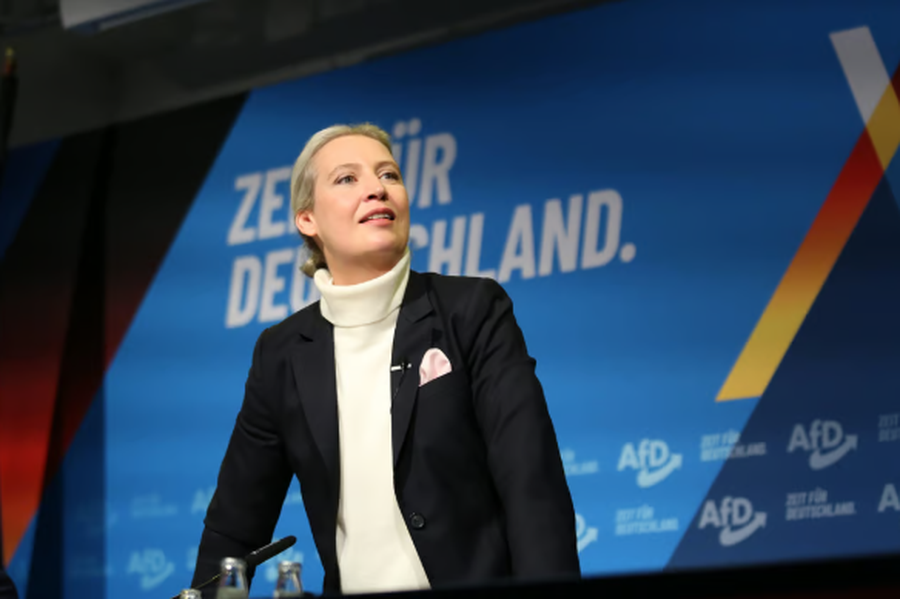
During her speech at the AfD convention, Weidel vowed to close Germany's borders and enact "large-scale repatriations" once in power.
Germany's nationalist far-right is increasingly looking to ideological allies abroad to give it the legitimacy it craves at home. This was evident at a convention of the far-right Alternative for Germany (AfD) on Saturday when Alice Weidel, the party's chancellor candidate, thanked billionaire tech mogul Elon Musk for streaming the event on his X account, where it was viewed by millions of people around the world, giving the party a much bigger stage than it's used to.
"I'd like to thank Elon Musk, who is live-streaming this caucus so everyone can see what we're politicking about. Everyone should see it ," Weidel said during her speech to enthusiastic cheers. Switching to English, she added: " Freedom of speech!"
The AfD has been boosted by Musk's endorsement ahead of national elections on February 23. Not only is he promoting the party on his own platform, but AfD leaders see Musk, a close adviser to US President-elect Donald Trump, as a key link to the next US administration.
In a show of their desire to forge closer ties, AfD delegates approved a motion on Saturday to build closer relations between Germany and the U.S., and in particular with the incoming Trump administration. Marc Jongen, an AfD member of the European Parliament, described the motion as a “thank you” to Musk.
The AfD, a Russia-friendly party that wants closer relations with the Kremlin, is not known for harboring a strong pro-American faction. On the contrary, many AfD politicians resent what they see as US dominance of post-war Germany. In a recent interview with the bimonthly American Conservative magazine, Weidel said Germans are a "defeated people" and suggested Germany is a "slave" to the US.
But for AfD leaders, Trump could redefine America's role in the world and become a close ally.
Weidel suggested as much during her speech at the convention, implying that an AfD-led government would be uniquely placed to pursue strong ties with both the Kremlin and the Trump administration, making Germany a bridge between Putin and Trump.
" AfD is the only party that has all communication channels open to East and West ," she said.
AfD supporters abroad
The Trump administration has not clearly thrown its support behind the AfD, but Musk's advocacy for the party has at least sparked some interest in high places. Earlier this month, Vice President-elect JD Vance reposted on X an English-language translation of Musk's opinion piece in German newspaper Welt am Sonntag, in which he called the party "the last glimmer of hope" for the country.
" I am not supporting a party in the German elections, as it is not my country and we hope to have good relations with all Germans. But this is an interesting part ," wrote Vance.
Many German leaders, including conservatives, have warned that the AfD propagates Nazi ideology; Meanwhile, Germany's federal domestic intelligence agency has classified it as a suspected right-wing extremist organization. Party leader in the eastern German state of Thuringia, Björn Höcke, has been found guilty of using a banned slogan used by Adolf Hitler's SA stormtroopers; a German court once ruled that Höcke could rightly be called a fascist.
The party's defense by someone of Vance's stature serves to undermine warnings from German officials, potentially legitimizing the AfD among voters. It also raises questions about the future relationship between the Trump administration and the incoming German government, which, according to current polls, is likely to be led by conservative chancellor candidate Friedrich Merz.
Merz's conservatives, like other German parliamentary parties, have vowed not to govern with the AfD. But party leaders are playing the long game, hoping to build enough popularity over time that other parties will find it impossible to oust them.
It is still far from clear that Musk's support for the AfD will help him in this regard, although polls show the party has become more popular in recent weeks. The AfD is in second place behind Germany's conservatives in the polls, with support of around 21 percent.
There are other sources of foreign support much closer to home that could also benefit the AfD.
One of the biggest boosts for the party could come from Austria, where the successes of Herbert Kickl and his far-right Freedom Party (FPÖ) have emboldened German far-right leaders, who see Austria as a guide how they too can one day take power.
AfD leaders see the FPÖ as a "sister party" and feel that if their Austrian brother takes power, it could further destigmatize the AfD in the eyes of German voters.
Embracing extremism
Just a year ago, things did not look so rosy for the AfD. Last January, angry Germans took to the streets in large numbers to protest against the radical right after an investigative report by Correctiv revealed that AfD politicians had been present at a meeting of right-wing extremists in which a "master plan" to deport immigrants en masse for "unassimilated citizens" was discussed. Those present euphemistically called the conspiracy "emigration".
The sustained protest movement, which drew millions to cities across the country, appeared to hurt the AfD - leading many Germans to question whether the demonstrators had halted the party's rise. Even France's far-right leader Marine Le Pen distanced herself from the AfD, if only in an attempt to portray her party as more palatable to French voters.
However, a year later, the AfD has largely recovered and is approaching the record vote numbers it enjoyed before the protest movement. During that time, Trump was elected on a platform that included a promise to carry out mass deportations.
In an illustration of how extremist ideas can quickly become normalized with a little rhetorical resonance from the party's friends across the Atlantic, the AfD's national leaders, who once avoided uttering the word "immigration" in light of the controversy, are now embracing fully due.
During her speech at the AfD convention, Weidel vowed to close Germany's borders and enact "large-scale repatriations" once she is in power./ Adapted Pamphlet from Politico



Lini një Përgjigje