


 Shkruar nga Pamfleti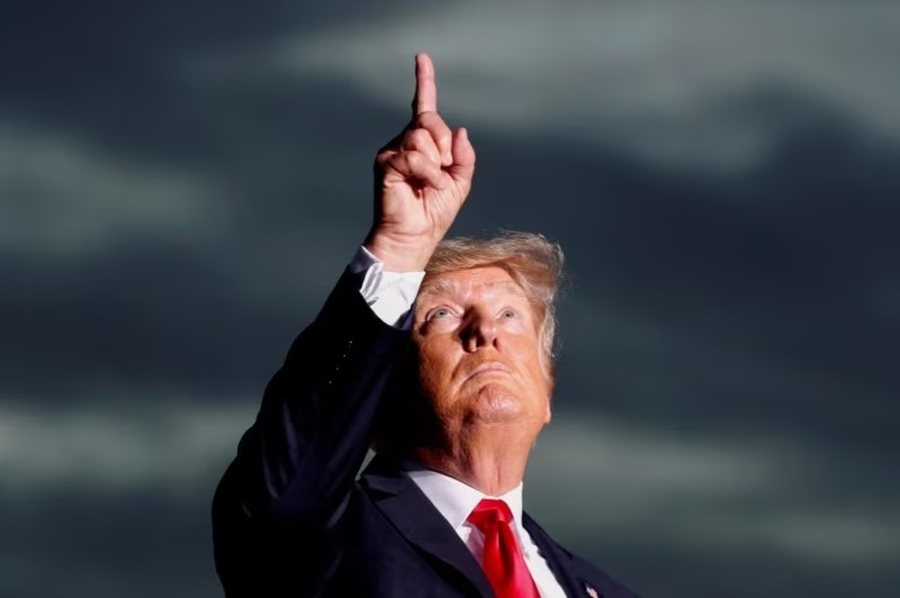
The larger reality is that a second Trump term will likely spell the end of the West as an organizing idea on the world stage.
No one can say Donald Trump didn't warn them. In an incredibly detailed interview with Time magazine this week, the Republican nominee sent shivers down the spines of liberals by explaining what he would do if he were to retake the presidency.
This included rounding up millions of illegal immigrants, deploying the military to disperse protests on America's streets, imposing loyalty tests on federal civil servants, allowing Republican states to monitor women's pregnancies, and eliminating the House Office of Pandemic Preparedness. White. He repeatedly refused to rule out violence if he lost in November.
America's media is understandably focused on the radical import of Trump's domestic agenda. But some of his clearest language was directed at Europe. There was nothing new in his plans to treat NATO as a dues-paying club – countries that miss the 2 percent of GDP defense spending target won't be able to count on America coming to them in help. Nor was it a surprise that he would escalate the transatlantic trade war of his first term.
What stood out, however, was the repeated emphasis he placed on both. "[The EU] is brutal to us on trade. We went through it, the cars, they don't want our agriculture. They don't want anything from us. It's like a one-way street. It's the same with NATO. They treat us a lot bad. They don't pay their bills," Trump said.
One European response is to hope Trump loses in November. That would be a rash bet. In 2020, Biden beat him by more than 4 percentage points in the popular vote. The average polls in the last three months show that Trump has an advantage of 1.5 percentage points. More ominously, he leads, albeit narrowly, in each of the seven swing states. It is too early to take such polls seriously. But if the US elections were held today, Trump would win.
A second response, which many American business leaders are getting, is to say that Trump wasn't so bad the first time. There would be winners and losers, but life would go on. Earlier this year, Jamie Dimon, JPMorgan's chief executive, said Trump and Biden each had their strengths. "My company will survive and thrive in both," he said.
Many in Europe would be inclined to echo Dimon's self-assurance. That too would be foolish.
The difference between 2024 and 2016, when Trump last won the presidency, is that this time he has a plan. From Europe's perspective, it would look like Fortress America. What's more, he can now draw on a roster of true believers to make it happen. In his first term, he appointed establishment figures such as Rex Tillerson as secretary of state and Jim Mattis as secretary of defense.
This time he would choose proven Europe skeptics, such as Elbridge Colby, who runs the Marathon Initiative think tank, and outspoken Europhobes, such as Richard Grenell, Trump's former ambassador to Germany.
"The advantage I have now is that I know everyone. I know the good, the bad, the stupid, the smart. . . "When I first got to Washington, I knew very few people," Trump said.
It is unclear what Europe can do to defend itself against Trump 2.0. A small minority of European leaders, notably Viktor Orbán's Hungary, would welcome his return. So does Vladimir Putin of Russia. If, as expected, the European far-right does well in next month's European parliamentary elections, Trump would have a larger group of supporters in Brussels than before. He may also be able to count on the support of Giorgia Meloni, the right-wing prime minister of Italy, who, to the surprise of some, has cooperated with Biden on Ukraine.
Among Europe's main parties, another strategy is taming the tiger. The United Kingdom's Labor Party, which is almost certain to win Britain's next general election, has highlighted key figures in Trump's world. Britain's shadow foreign secretary, David Lammy, will visit Washington next week for the sixth time since becoming shadow foreign secretary. He has developed relationships with Colby, JD Vance, the Republican senator and Ukrainian skeptic, Robert O'Brien, Trump's last national security adviser, and Mike Pompeo, Trump's last secretary of state.
Since Trump has a particular animosity towards the EU, Britain, regardless of its government, could also be a beneficiary. In the pro-Trump Heritage Foundation's 887-page document Project 2025, the de facto blueprint for a Trump presidency, Britain is singled out as the only country with which a Trumpian US would seek to do more trade.
None of these tactics are foolproof. The larger reality is that a second Trump term will likely spell the end of the West as an organizing idea on the world stage.
This would be great news for Putin and terrible for Ukraine. It could also open a nuclear Pandora's box. If NATO could no longer rely on America's umbrella, countries such as Germany and even Poland might consider launching nuclear arsenals. It's no small irony, but Trump probably wouldn't have a problem with that. /Adapted "Pamphlet" from " Financial Times"




Lini një Përgjigje