


 Shkruar nga Pamfleti
He sees the European Union as something strange and rather decadent – the concepts of consensus and co-dominance are foreign to him.
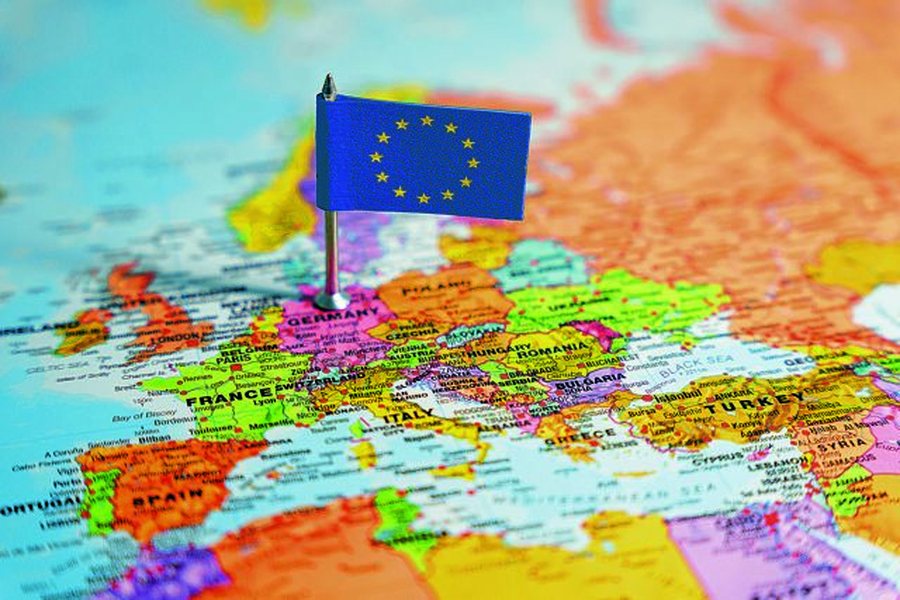
It is far from clear whether Europe will be able to respond with rudimentary sufficiency to the great challenges it faces.
Last year Europe was not at its best and 2024 was predicted to be a difficult year. And so it was.
But next year promises to be even more difficult.
The re-election of Trump in the United States will have direct effects on transatlantic relations, on Europe's relations with the rest of the world and also within European borders. We know that the next president of the USA does not believe in international institutions and rules, nor in alliances in particular.
He has a transactional approach to international relations like a true businessman, he also believes in the law of the fittest.
He sees the European Union as something strange and rather decadent – the concepts of consensus and co-dominance are foreign to him.
He is troubled by the trade deficit with Europe, threatens to impose tariffs and the German car industry, among other things, trembles at the prospect. He sees China as the biggest threat to American hegemony and predicts that the US-China trade war will worsen.
Pressure on the Europeans to respect the line drawn by Washington will also increase. But the interests of Europeans and Americans do not necessarily coincide. So how long will the Europeans withstand American pressure before they split and withdraw? And at what cost to the European economy?
The newly elected American president wants to end the war in Ukraine an hour ago.
But the responsibility for maintaining an uncertain peace, as well as the costs of rebuilding a badly wounded Ukraine, will fall largely on the Europeans, who will also be asked to bear the costs of their external security.
At least on this point, Donald Trump is not wrong. Can the Europeans take it?
And what do they want Russia's role to be in the European security architecture in the future?
For the leaders of Poland, the Baltic countries and several other countries, the answer is clear: we are preparing for war.
Can there be a single and autonomous European answer to these key questions? If not, Europe will continue to drag itself along behind decisions made by others on its behalf.
The EU enters the new year with a clear leadership deficit.
Germany will have an election and the CDU is preparing to return to power with a new coalition government that will likely take months to put together.
As for France, the creation of a stable government that will rule out the extremes is extremely uncertain. The President of the French Republic, who for years has maintained almost the monopoly of thinking and acting in a European manner, is today paying for his political mistakes within the country as well as the price of arrogance.
There are no other strong candidates to fill the void at the European level, although some have begun to consider Meloni potentially having privileged access to President Trump, just like Orbán.
Where have we arrived!
As for the European Commission, in von der Leyen's second term, power will be concentrated even more in the hands of the president, while the responsibilities of the rather weak commissioners will overlap. There are doubts whether the Commission has the political clout to adequately cover the leadership deficit in Europe.
Crisis of governance and crisis of democracy in many European countries.
Disillusionment with the political system of a large part of European societies (let alone in the United States of America) leads many voters to anti-systemic parties, mainly to far-right populists.
And the traditional parties are still trying to figure out what went wrong.
Even more so the social democracy which most of the poorer classes abandoned years ago and the extreme right came to fill the void by offering patriotism and social welfare. We had seen an earlier version of this project in the period between the two wars and it had, let's not forget, a very bad development.
How is the problem handled?
Not only by labeling any radical proposal that deviates from traditional norms as populism.
And certainly not by canceling elections when we don't like the result of the popular decision, as happened recently with the presidential elections in Romania.
If elections should be canceled every time someone tries to manipulate the popular vote with social media, what should be done after Elon Musk and other plutocrats meddled in the last US election?
They probably spent a lot more money than the Russians probably did in Romania. As long as European institutions remain silent on such major issues, they will lose credibility.
Draghi's report highlighted Europe's economic backwardness.
He proposed concrete and bold solutions. But will it be possible to turn the good words with which the leaders of the member countries welcomed him into action? Because neither the military, nor industrial or social policy is out of the question, let alone winning the green transition. And Europe still remains mostly in words. /Ta Nea-Pamphlet/




Lini një Përgjigje