


 Shkruar nga Nadia Schadlow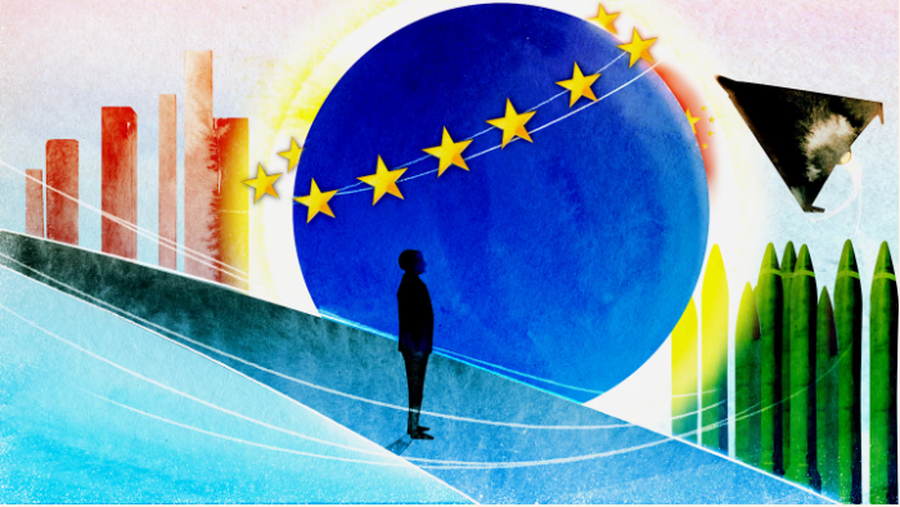
A secure future depends on a revitalized transatlantic alliance
When historians look back and analyze the “great unraveling,” whether of the post-World War II order or of the transatlantic alliance, they will likely identify a series of policy decisions made by President Donald Trump. But in reality, the alliance’s weakening may turn out to have more to do with decisions made in Europe. European elections matter, and the key issue is how the bloc uses its capacity to act. Four major tests lie ahead.
First , Europe must be realistic about the threat it faces. The war in Ukraine has shown growing cooperation between Russia, China, Iran, and North Korea. The emergence of a network of revisionist powers whose activities span multiple regions means that Europe must accept the necessity of aligning with the United States. Washington can be a disappointing partner at times, and debates over defense burden-sharing and troop levels are real. But “strategic autonomy” is not an option.
Second, Europe needs to reassess its approach to China. Recent discussions in the European Commission concluded that the European Union’s relationship with Beijing is “not sustainable.” This change in approach is welcome, but member states’ positions remain uneven. France often favors a tougher approach; Germany often seeks to protect its trade ties; while Hungary continues to welcome Chinese investment.
Third , like the United States, Europe must move to a state of war preparedness in terms of defense, not to please the Americans, but to guarantee its own security. If Europe rebuilds defense capabilities outside NATO structures, it will deepen the cracks in the transatlantic alliance. Interoperability, the ability to fight as one force, is one of NATO’s greatest strengths. It took decades to build it and it is still not complete, which shows how difficult it has been to achieve. The key for Europe is to build on the capabilities and operational experience it has already developed through the alliance, and not to copy them outside.
Fourth , Europe can choose an economic development agenda based on transatlantic ties. The economic strength of the West depends on both the United States and Europe. The United States accounts for approximately a quarter of global GDP, while the European Union remains one of the largest economic blocs in the world. However, Europe's share of global output has been declining.
Reversing this relative economic decline and creating stronger growth, greater investment, and stronger industrial capacities will require smart choices in three areas that are largely under Europe's own control: regulation, energy, and innovation.
As the Draghi report argues, the European regulatory environment has contributed to weak productivity growth, lagging innovation and lower investment levels. Meanwhile, high energy costs continue to undermine Europe's industrial competitiveness.
Europe could take steps to stabilize energy prices and secure supplies. Part of this effort could be greater access to long-term contracts for liquefied natural gas (LNG), tied to U.S. Henry Hub prices. The price stability that long-term contracts provide could significantly reduce energy costs.
Equally important will be the ability to develop and expand the use of artificial intelligence. Europe can continue to prioritize regulation, or it can accept a higher level of risk. The question is whether it is willing to make the compromises necessary to compete.
Large amounts of energy are necessary for rebuilding industrial capacity and developing artificial intelligence. Europe's choice is between dependencies, such as that on Russian gas, that create strategic vulnerability, and relationships that strengthen sustainability. Long-term energy cooperation with the US falls into the second category.
The differences between the US and Europe did not start with Trump. They have been widening for years. If not addressed, these disparities will gradually weaken the alliance. Europe can address them through its own choices: whether to build defense capabilities through NATO or through parallel European structures; how to approach technological regulation; how to pursue economic growth; and how to confront common security threats.
These elections will shape not only the future of Europe, but also the future of the transatlantic alliance. Pursuing forms of strategic autonomy that create more distance between Europe and the US may give the impression of independence, but risks weakening the ties that have underpinned transatlantic security and prosperity for decades.
The transatlantic partnership has survived repeated political disagreements, policy debates, and leadership changes. It can do so again. But such a positive outcome is not guaranteed.
It will depend on decisions made not only in Washington, but also in European capitals. /Adapted from the FT Pamphlet /
* The author was deputy national security adviser for strategy in the first Trump administration and is a senior fellow at the Hudson Institute, as well as a fellow at the Hoover Institution.



Lini një Përgjigje