


 Shkruar nga Pamfleti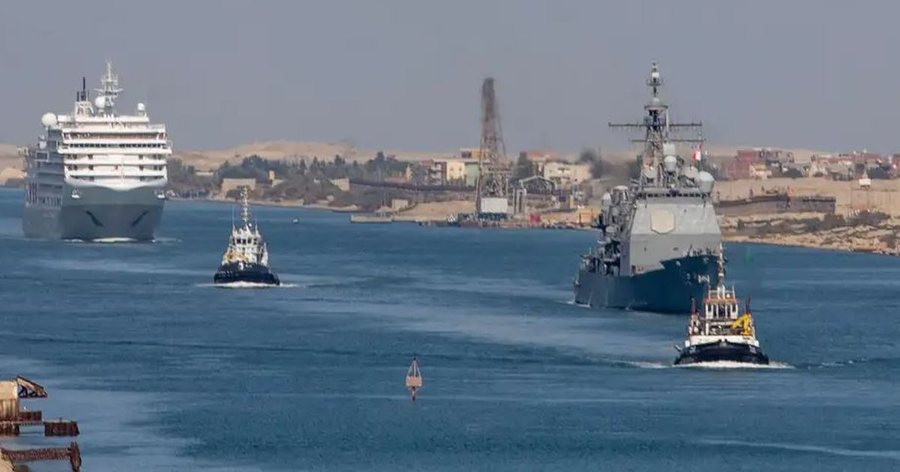
The EU wants to create a naval mission to protect European ships and commercial interests in the Red Sea, of great strategic importance to the EU.
At a time when the US together with Great Britain responded to the rockets of the Yemeni Houthi militias in the Red Sea, the EU is still looking for a response to the new crisis, which is related to the conflict in the Gaza Strip, but crosses the borders of Israel and the Palestinian territories.
The EU wants to create a naval mission to protect European ships and commercial interests in the Red Sea, of great strategic importance to the EU.
But the attempt to threaten the Houthi rebel militias could lead to a dangerous escalation of the situation in the Red Sea. Therefore, experts warn the EU to act cautiously.
Why will the EU intervene in the Red Sea?
For weeks, Houthi rebels, who control large parts of western and northern Yemen, have been attacking merchant ships in the Red Sea. Sea route such as the strait in the Red Sea that connects the Arabian Sea with the Mediterranean through the Suez Canal. is one of the most frequented in the world.
Houthi rebels, a terrorist group linked to Iran, launched attacks on ships after the Israeli military offensive in the Gaza Strip. Israel retaliated after terrorist attacks by Islamist militant Hamas on October 7 in southern Israel. The Houthi attacks are carried out in solidarity with Palestinians bombed by Israel, the rebels said, and are directed against ships that have direct or indirect links with Israel.
The EU, like many other powers, condemns attacks on merchant ships as illegal. About 40% of European trade with Asia and the Middle East passes through these waters.
Many ships now have to divert from the Cape of Good Hope, with all the consequences this diversion brings in delays and costs.
The planned EU mission, for which a full agreement is expected in the coming weeks, would be independent of the US's Operation Prosperity Guardian. The EU mission will consist of 20 countries. While the US mission that began in December brought divisions within the EU. While the Netherlands, Greece and Denmark joined the American mission, France, Italy and Spain refused to participate.
In recent weeks, there has been a lot of debate about the EU's possible reactions regarding the developments in the Red Sea. Basically, it is about sending warships for patrolling in the region. Some media have reported on an internal EU document, that the EU's External Service has proposed sending three ships.
Meanwhile, a diplomatic source who will remain anonymous told DW that the most favored option is the expansion of Agenor, a current EU operation under French leadership, which oversees the maritime strait near Hormuz.
Eight countries support this mission, which is part of a broader mission for the protection of the Strait of Hormuz called EMASoH (European Maritime Awareness in the Strait of Hormuz). This mission seeks to reduce tensions and "contribute to the security of maritime traffic," according to the announcement on the mission's website.
On Wednesday, Italian Foreign Minister Antonio Tajani appeared to confirm this plan, saying it would be easier to expand Operation Agenor. "I am convinced that the European Foreign Service itself sees this hypothesis in good faith," Tajani was quoted by the Reuters agency.
On the same day, Dutch Defense Minister Kajsa Ollongren stated that the Netherlands would likely make a frigate available for such an EU mission. "We are still verifying it, but we will also talk to the Lower House of the Parliament", said Ollongren in conversation with BNR.
The mission should be ready by February 19 and soon after that be operational, Reuters reported citing its sources. The next step is the meeting of EU foreign ministers this Monday.
Why is such an EU mission so controversial?
The EU waited a long time to react to developments in the Red Sea. Several countries, notably Spain, rejected US offers to jointly strike back against the Houthi rebels. In many EU member countries there is a great fear that the situation in such a highly destabilized region could escalate dangerously. The EU reacted with reservations after US and UK strikes on Houthi rebel positions last Friday. The Netherlands only offered practical help, while Germany and Denmark only provided written support. Spain, governed by the left, announced that it will not participate in a mission in the Red Sea.
Nathalie Tocci, head of the Italian Institute for International Affairs, IAI, is of the opinion that for the EU the situation becomes more complicated after the military response of the USA and Great Britain to the Huthi rebels. Shipping ships not only have high scaling potential, they should also hit.
"These are warships that must be ready to fire. These should not necessarily be attacks on Yemeni land, but in any case attacks on everything that comes close," Tocci emphasizes. This is something completely different, compared to the EU observation mission, Agenor.
For Tocci, the risks are practical in nature. EU risks its image. On the one hand, there is a risk that an EU ship will be attacked, and the situation suddenly escalates. On the other hand, the EU risks that its mission will not have the right result, making the EU look weak.
"Let's look at it this way: For 10 years, Yemen has been mercilessly bombed by the Saudis," says Tocci, referring to the Saudi-led coalition that has been fighting the Houthis since 2015. "Has this led to the weakening of Houthi's military capabilities? No, it didn't work", emphasizes Tocci and continues to ask.
"Why do we believe that a defensive rather than an offensive naval mission will have any threatening effect?" Tocci is of the opinion that the EU reacts out of necessity, that "something must be done", instead of asking what it can really achieve.
Camille Lohn, analyst at the European Council on Foreign Relations (ECFR) thinks differently. There is no other way for him. The EU must find an answer to the "security risks for maritime routes, which we are seeing now, because these have a direct effect on its economic security and economic interests", emphasizes Lohns. This is especially so, when the EU did not stand united behind the US in this case.
Tocci and Lohns are of the opinion that the origin of the current crisis in the Red Sea is found in the Gaza Strip. Both experts regret that the EU does not have a unique response to this crisis. The credibility of the EU in the international arena has decreased, especially in regions that sympathize with the Palestinians.
It is therefore necessary to react to the situation in Yemen and the general lack of stability in the entire Red Sea, Lohns points out with a view to the future. This requires a diplomatic response, which is more than "a military response, as is happening now" .







Lini një Përgjigje