


 Shkruar nga Pamfleti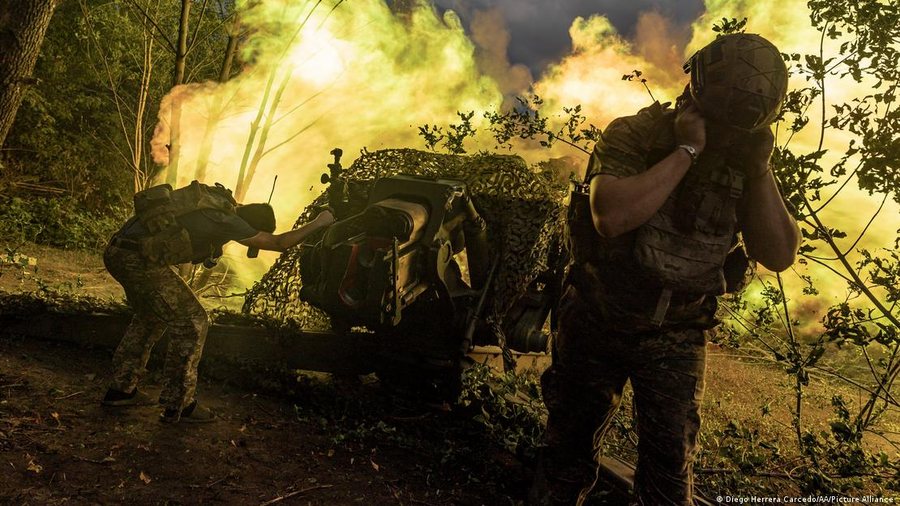
Most of the weapons supplied to Ukraine to defend against Russian attacks are provided by the US. But for now, the US has stopped sending military aid with major consequences. The Allies are in a dilemma.
In late December, the US offered Ukraine, under attack from Russia, once again $250 million worth of weapons and military equipment, possibly a last-ditch fund. A few days later, the US declared that the financial means for supporting Ukraine have been exhausted. As long as the American Congress does not approve new financial means for Ukraine, a new aid package cannot be approved. The question is, how long could the rest of the West replace American supplies — until Congress decides on $110 billion in aid to Ukraine and Israel?
Reserves of artillery shells have been used up
One of the most important components of US military aid was the 155 mm artillery shells, a standard ammunition also used by NATO countries. But two years into the war and continued supplies to Ukraine have consumed much of the stockpiles of Western partners.
Europe, despite promises to support Ukraine and its own needs, has not increased production enough. The lack of the US as a supplier is now added to this gap in own reserves. As of February 2022, the US alone has supplied Ukraine with 1.5 million grenades. The EU has promised that Ukraine would support Ukraine with 1 million grenades until spring 2024. But the figures say that only 300,000 grenades were sent, much less than planned.
Some EU countries have understood the need for supply: Germany, for example. plans to make available until 2024 200,000 such grenades. Great Britain, Finland, Norway and several other countries have also made similar promises.
Without US support, supply bottlenecks are created
Recently, even Indian-made 155 mm shells appeared on the front, although their exact origin is unknown. Despite the announcements made, the supplies of other countries are in much smaller quantities compared to the supplies of the USA. If the US remains indecisive on military support for Kiev, Ukrainian artillery will face serious supply bottlenecks. Despite Western promises, the production of ammunition takes time, even if new production lines are put into operation.
And if the US stopped the supply of more complex weapons systems, the consequences would be even more serious. It is about missiles of the air defense systems, NASAMS and Patriot as well as missiles for the HIMARS system and defensive tanks AT-4 and Javelin. It is true that there are other countries that possess such weapons, such as Australia, Norway, the Netherlands, Lithuania, etc., but the amount of ammunition they have at their disposal is much smaller than that of the USA.
Even if such countries could theoretically replace the lack of US supplies, this would not last long, because the reserves of these countries would be depleted much faster than those of the US. This also applies to HIMARS missiles, Javelin At-4 tanks and other systems.
Allies before the dilemma
Even if these countries were to offer a significant part of their reserves to Ukraine, the next question that arises is, if this were possible, how long it would take them to replenish the reserves. Countries that have US-made weapons systems face a difficult decision: The more they supply Ukraine, the more their defense capabilities would be limited. At the same time they know, that the smaller quantities they offer, compared to the US supplies, the difference is even smaller. The dilemma is not new, it has existed since the beginning of the escalation of the war. But now that US supplies have fallen, it is very acute.
From Ukraine's point of view, if and when Congress approves further military aid is crucial. If this does not happen in the coming weeks, the defense of Ukraine would become more difficult step by step./DW






Lini një Përgjigje