


 Shkruar nga Pamfleti
To evade sanctions, tankers constantly change their flag and name, making them difficult to prosecute using conventional methods...
Russia's golden years in the oil trade appear to be numbered. Massive EU sanctions packages have severely affected exports.
On Friday (November 21), new US sanctions also came into effect. Russian energy giants Lukoil and Rosneft are already feeling the effects.
In Bulgaria, Lukoil is being forced to sell the largest refinery in the Balkans, along with its related infrastructure.
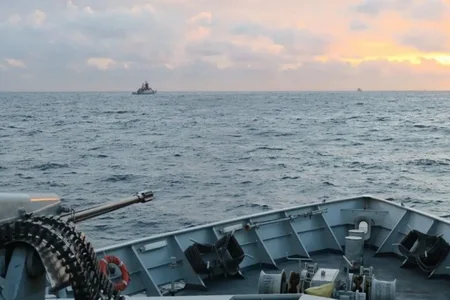
Despite massive trade restrictions, Russia can continue to transport oil via its notorious false-flag fleet, at least for now. Europe has once again targeted these tankers sailing under false flags, the Frankfurter Allgemeine Zeitung (FAZ) reported.
"We want to eliminate them," Polish Foreign Minister Radosław Sikorski announced on Thursday (November 20th).
In principle, the fight against the shadow fleet seems simple. Ships carrying Russian oil are identified, banned from importing it, and prevented from transporting the oil that Kremlin leader Vladimir Putin uses to finance his war in Ukraine.
However, French President Emmanuel Macron complained about a cat-and-mouse game, as Deutschlandfunk radio reported.
To evade sanctions, tankers constantly change their flag and name, making them difficult to prosecute using conventional methods.
The Frankfurter Allgemeine Zeitung (FAZ) reports on a discussion paper from Paris. In it, the French government calls for "proactive" action against the ships. EU member states should centralize their information for this purpose.
"The shadow fleet poses a global threat to the international community and especially to coastal states," the newspaper quotes.
This is because tankers do not only transport oil: drones are suspected to have been launched from a ship that France had seized, and these drones are said to have entered Danish airspace.
As the EU's fight against the shadow fleet continues, further problems are emerging in the Russian oil market for Putin's war economy.
US sanctions are not only forcing Lukoil and Rosneft to sell their assets abroad at the highest possible price, but are also drastically lowering the price of Russian oil on the world market.
The newspaper Die Welt, citing the Argus Media agency, reported that the price of a barrel of Russian Urals crude oil is currently $36.61 (as of November 13). The drop is clearly visible compared to the previous day: on November 12, a barrel cost between $41 and $42.
Not only are Russian oil prices falling, but buyers also appear to be turning their backs on the Kremlin due to sanctions. According to media reports, India, a long-time reliable partner, is increasingly reluctant to import Russian oil.
The BBC recently reported that Reliance Industries, which operates several refineries in addition to other businesses, has stopped importing Russian oil. The White House has welcomed India's "change of course" and hopes for progress in trade negotiations with the country.
According to the Economic Times, China, an important partner of Russia, is also preparing for US sanctions.
Banks and refiners in the East Asian country are preparing to comply with Western sanctions, according to the US Treasury Department, in order to avoid jeopardizing relations with the West. This could indicate that US sanctions now outweigh Russia's concessions to China and India.
US peace efforts in Ukraine war cause oil prices to fall.
In October, Western oil prices rose after sanctions were announced against Russia. German news program Tagesschau reported that a barrel of U.S. crude oil (WTI) rose by a whopping 5.1 percent in a single day last month. However, a new plan from the U.S. government to end the war in Ukraine may now provide some relief for the oil market.
Several US media outlets reported that US representatives, including Special Envoy Steve Witkoff, were holding peace talks with representatives from Russia and Ukraine. However, according to industry service easyoil, investors are still unsure whether to bet on the success of the US peace initiative or against it.
An end to the war in Ukraine could lead to further price declines. However, it would also eliminate Russia's rebates to India and China, making imports more expensive for those countries.
If the war continues unabated, prices could rise sharply, leading to higher costs for Western customers as well, partly due to US sanctions. However, a certain degree of optimism is evident in the market.
But whether Ukraine will choose Washington's plan, which would include territorial concessions, partial demilitarization and the suspension of its NATO membership applications, is highly doubtful. /Adapted from Fr.de/



Lini një Përgjigje