


 Shkruar nga Pamfleti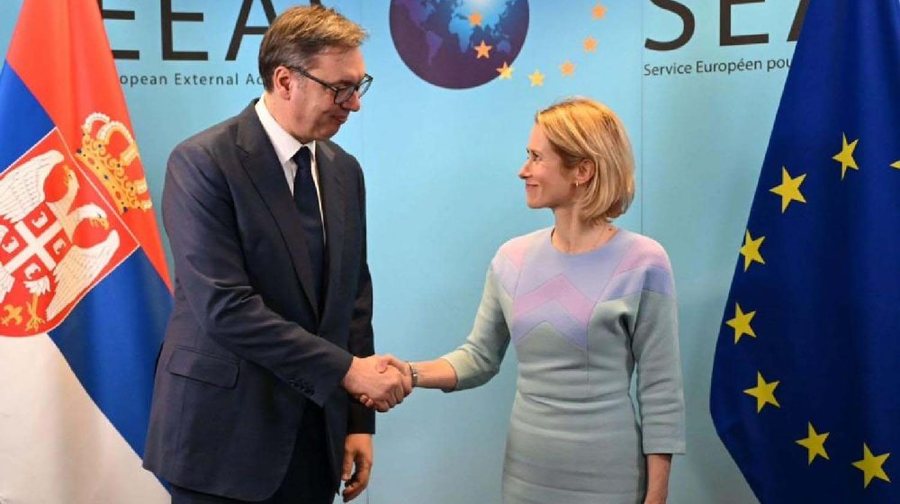
The European Union could consider a decision this fall that would allow Serbia to advance in the European integration process if Belgrade fulfills its reform commitments. Such a development would give Serbian authorities a political argument ahead of parliamentary elections expected in September-November.
President Aleksandar Vučić has warned that elections could be held in the fall, while hinting that he could resign in July or August. Following the announcement, Politico reported, citing unofficial sources, that the European Commission had considered encouraging Serbia to continue reforms and meet its EU obligations, but plans were revised after Vučić's statement.
According to current assessments, Serbia needs to fulfill several conditions to receive a positive signal from Brussels. These include the formation of the Council of the Regulatory Authority for Electronic Media (REM), the adoption of changes to the electoral legislation, the implementation of the recommendations of the Venice Commission, and approximation with the foreign and security policy of the European Union.
One of the issues that continues to remain a stumbling block is Belgrade's refusal to join the European Union's sanctions against Russia. President Vučić has repeatedly stated that Serbia sees no interest in imposing restrictive measures on Moscow.
Journalist Marija Stojanović, who follows developments in European politics and the Western Balkans, states that there is still no consensus in diplomatic circles on the opening of Cluster 3. According to her, some member states, including the Baltic states and the Netherlands, assess that Serbia has not made sufficient progress in the rule of law, media reform and the electoral process.
She emphasizes that the technical conditions for opening the cluster have long been met, but reforms in the area of the rule of law remain a problem.
According to Stojanović, if the European Union decides to open Cluster 3 before the elections in Serbia, this decision should not be seen as a reward for the Vučić government, but as part of Brussels' strategy to keep the enlargement process in the Western Balkans active. She recalls that the European Union has advanced negotiations with other candidate countries, such as Ukraine and Moldova, while Montenegro and Albania have made progress in the accession process.
According to her, the EU's strategy is also related to the geopolitical situation and the need to limit the influence of other actors in the region, especially Russia.
Along the same lines is the statement of the European Union High Representative for Foreign Affairs and Security Policy, Kaja Kallas, who emphasized that the Western Balkans cannot remain outside the European Union for a long time due to geopolitical developments.
Stojanović estimates that, in the event of a positive decision, the authorities in Belgrade will present it as a political success, although Serbia continues to lag behind other countries in the region in the European integration process.
Meanwhile, Miloš Pavković, director of strategy at the Center for European Policy, says that the most likely compromise on the part of the European Union could be the disbursement of a new tranche of funds from the Growth Plan, while the opening of Cluster 3 continues to remain uncertain.



Lini një Përgjigje