


 Shkruar nga Pamfleti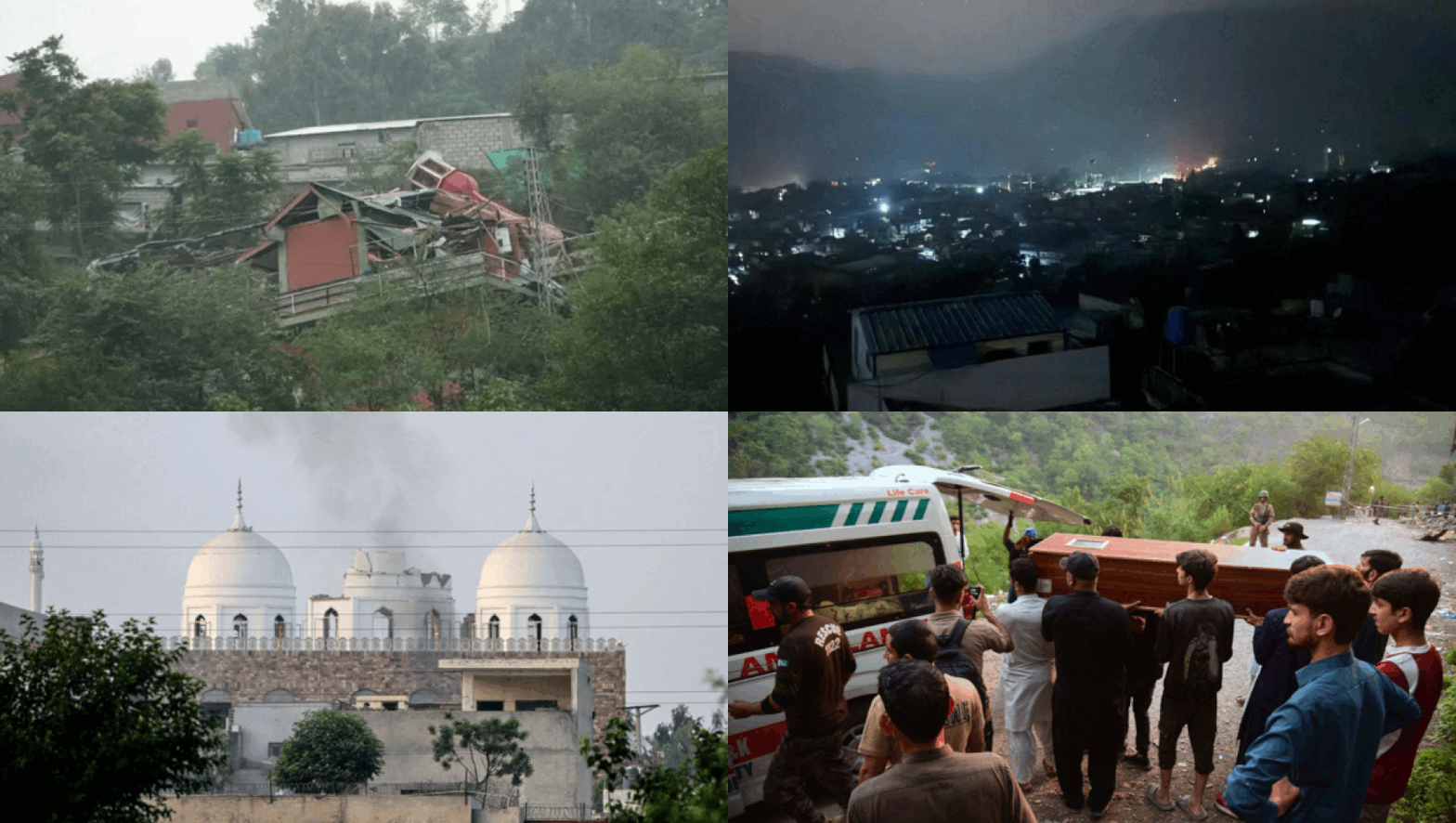
Operation Sindoor ignites a new crisis between the two nuclear powers: civilian casualties, accusations of terrorism and calls for restraint from the UN...
On April 22, 2025, the world was shocked by one of the worst attacks on civilians in decades. A group of five armed militants, dressed in military uniforms, attacked a group of tourists in the Baisaran Valley of Pahalgam, Kashmir, killing 26 people and injuring dozens more. The attack was organized with macabre ferocity: the victims were separated by religion and forced to recite religious verses before being executed. An Indian Navy officer and a Christian tourist were also identified among the victims. A local Muslim cameraman was killed while trying to stop the massacre.
Initially, the group The Resistance Front (TRF), a wing of Lashkar-e-Taiba, claimed responsibility, but later denied involvement, raising suspicions of manipulation intertwined with political agendas.
In response, on May 7, India launched "Operation Sindoor," a series of air and drone strikes on nine targets in Pakistani territory and Pakistan-administered Kashmir. The targets were militant camps in cities such as Muzaffarabad, Bahawalpur, and Muridke. India justified the operation as a defensive and punitive action against terrorist infrastructure.
Pakistan's response was swift and harsh. Prime Minister Shehbaz Sharif called the Indian attack an "act of war" and claimed that Pakistani forces had shot down five aircraft and captured Indian soldiers. India has not confirmed any of these claims. Meanwhile, Pakistani artillery shelled border areas of Indian Kashmir, killing at least seven civilians.
The escalation did not stop at the military level. India suspended the Indus Waters Treaty, expelled Pakistani diplomats, and closed its airspace to Pakistan. Islamabad responded by suspending the Simla Agreement, banning all trade with India, and also closing its airspace.
The international community has expressed deep concern. UN Secretary-General Antonio Guterres, the United States and China have called for de-escalation and urgent dialogue. But from the ground, the signs are alarming: India has mobilized forces on the Line of Control, while Pakistan has tested ballistic missiles capable of carrying umbilicals.
The Kashmir crisis is not just a bilateral issue. It represents the risk of turning unresolved historical conflicts into global threats. For the Balkan countries, and especially Albania, this situation should be a strong warning about the danger posed by the lack of dialogue, the misuse of religious divisions, and the instrumentalization of radical groups in the service of state goals.
History shows that in Kashmir, a single shot can ignite a war that will not remain confined to the Himalayas./ Pamphlet







Lini një Përgjigje