


 Shkruar nga Pamfleti
According to Article 63 of the Basic Law, the Bundestag now has up to 14 days to elect a Federal Chancellor with a majority in further votes. During this phase, new candidacies can also be submitted, and Merz himself can run again.
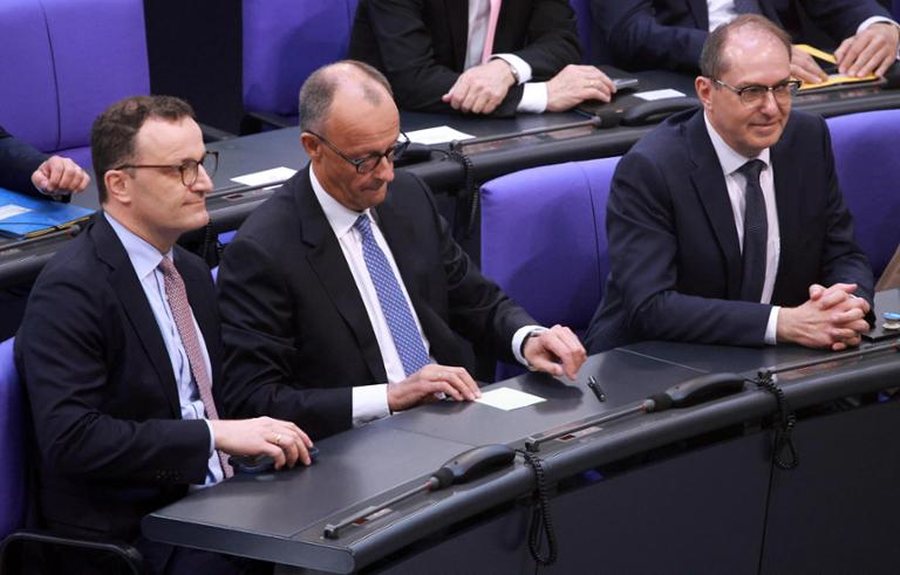
For Friedrich Merz and the coalition of the SPD and CDU/CSU, this is a disaster. The candidate for federal chancellor failed in the first round of voting - and, contrary to expectations, did not officially take office today.
What awaits the CDU leader next? In any case, it is not entirely clear. Because so far, no federal chancellor has failed in the Bundestag elections. A completely new election would also be theoretically possible.
In the first round of voting, Merz received 310 of 621 votes cast in a secret ballot, 6 short of the required majority of 316.
The CDU/CSU and SPD coalition factions together have 328 seats in parliament. However, due to the secret ballot, it is not clear who the opponents are. There is speculation that some MPs from both the CDU/CSU and the SPD voted against Merz.
However, nothing is certain at present, as the CDU/CSU and SPD emphasized their unanimous support for Merz as Chancellor.
The Bundestag has 14 days
According to Article 63 of the Basic Law, the Bundestag now has up to 14 days to elect a Federal Chancellor with a majority in further votes. During this phase, new candidacies can also be submitted, and Merz himself can run again.
During these 14 days, any number of ballots can be cast. The main thing is that the candidate secures the necessary majority. The Federal President must then appoint the chosen candidate as Federal Chancellor.
If no absolute majority is achieved by the end of the term, a final vote will be held immediately after 14 days. Here, a simple majority is sufficient to elect Federal Chancellor.
Electoral law expert Sebastian Roßner (LLR Rechtsanwälte, Cologne) said that “then the Federal President decides: he can appoint the candidate - or dissolve the Bundestag and call new elections.”
What awaits Merz after defeat in the Bundestag? Help from the AfD
A two-thirds majority would be needed to hold a second round of voting, and the help of the AfD, the Greens and the Left in parliament would be needed. The earliest possible date for the election of the Chancellor in the Bundestag would probably be Friday. Until then, the caretaker federal government under Olaf Scholz will remain in office.
The Basic Law specifically states: “If the nominee is not elected, the Bundestag may elect a Federal Chancellor within 14 days of the vote by more than half of its members.” If Merz gives the impression that he could have more success in a second round of voting than in the first, he can run again at any time. Within the two-week period, there can be an indefinite number of rounds of voting with different candidates. But they also need an absolute majority of at least 316 votes to be elected.
Bad rumors
In the famous case of the Schleswig-Holstein state election in 2005, candidate Heide Simonis fell short by one vote in four rounds of voting. She then resigned from her position.
A bad rumor is already circulating in the Union: the lost votes could come from SPD co-chair Saskia Esken and some of her party colleagues.
This is in retaliation for her not being included in the Merz cabinet as a minister… /Adapted from Pamphlet/







Lini një Përgjigje