


 Shkruar nga Pamfleti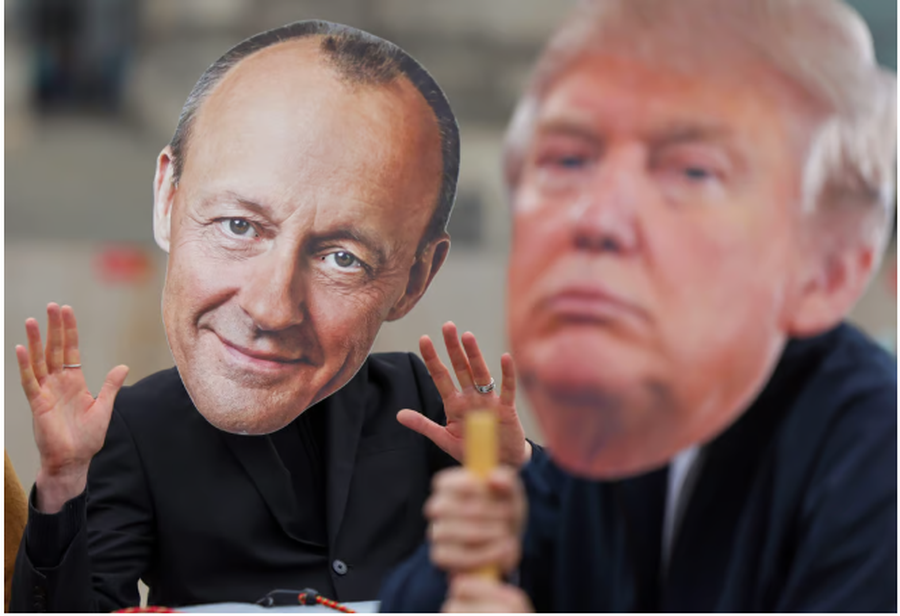
As the far-right AfD rises, Friedrich Merz leads a coalition of declining main parties...
Friedrich Merz will be sworn in as Germany's chancellor on Tuesday with a pledge to give Europe a clear direction in turbulent times — but he is already in a dangerous position.
Merz begins his term as chancellor as a weakened figure. His support has fallen sharply since he was declared the winner of the election.
His coalition government holds one of the smallest parliamentary majorities since World War II, with just 52 percent of the seats.
Now, Germany's most important and powerful ally for decades - the United States - has begun to undermine Merz at every turn. The administration of US President Donald Trump appears intent on further weakening him by strengthening his main political opponents, the far-right Alternative for Germany (AfD) party.
After Germany's federal domestic intelligence agency classified the AfD last week as a "proven" extremist organization - a designation that is fueling a heated debate over whether the AfD should be banned under provisions of German law intended to prevent a repeat of the Nazi past - the party received support from senior members of Trump's cabinet.
The extremist label was “tyranny in disguise,” said US Secretary of State Marco Rubio in a post on X. “What is truly extremist is not the populist AfD, but the establishment’s deadly open-border immigration policies, which the AfD opposes.” US Vice President JD Vance echoed this sentiment, saying that the “German establishment” was effectively rebuilding the Berlin Wall.
Merz of the center-right Christian Democrats (CDU) — is part of the German establishment that Rubio and Vance despise. Despite vowing to lead a crackdown on migration, Merz has refused to govern in a coalition with the anti-immigration AfD, which came in second in February’s election, the best result for the far right in Germany’s post-war history, considering the party too extreme. Instead of the AfD, he chose the center-left Social Democratic Party (SPD), which scored its worst national election result since the 19th century.
This puts Merz in an extremely dangerous political position. As the far right rises, he finds himself leading a declining coalition of major parties that once dominated Germany's political landscape.
The centrist governments that make up the SPD and Merz’s conservative bloc have long been called “grand coalitions” because of their sweeping majorities. But there is nothing compelling about the current “grand coalition,” which is the weakest such partnership in history and leaves Merz open to accusations that he is leading a remnant of a disappearing order.
The rise of the AfD
In this position, Merz is particularly vulnerable to attacks from the AfD, which will be the largest opposition party in parliament. AfD leaders have repeatedly described Merz as a leftist in hiding because of his refusal to govern with them and because of his embrace of debt-fueled spending after his election victory, a complete reversal from his campaign rhetoric.
The AfD now appears to be taking advantage of this dynamic. The party has risen in the polls while Merz's conservative CDU has fallen, leading for the first time in a poll published in late April.
The Trump administration's continued support for the AfD could further destigmatize the party in Germany and reinforce the AfD's narrative that it has been unfairly targeted for political persecution by the political establishment.
"Since the AfD is the strongest party in the polls right now, they want to suppress the opposition and freedom of speech," AfD co-chair Alice Weidel wrote on X in response to Rubio.
Merz said on Monday that he considered it “inconceivable” for AfD leaders to become heads of parliamentary committees, especially in light of the party’s classification as extremist by the country’s intelligence agency. In doing so, he ended a debate that his parliamentary group leader had started last month with a proposal that would have radically softened the conservatives’ approach to the far right.
Trade, NATO and Ukraine
American support for the AfD could supersede all other debates in the transatlantic alliance, said Dominik Tolksdorf, an expert on transatlantic relations at the German Council on Foreign Relations, a think tank.
“This is a big problem for Merz and at least as serious as many other debates we are currently having on trade, NATO and Ukraine,” he said. “If the Trump administration wants to, it can use this accusation [that the AfD is being suppressed] to put pressure on the German government. How the next government will deal with this whole new dimension in the coming months is a big question.”
Merz has pledged to take a greater leadership role within Europe and will try to pursue this immediately after taking the oath. On Wednesday he plans to travel to Warsaw and Paris in an attempt to revive the so-called Weimar Triangle of Poland, Germany and France - an informal alliance that he sees as key to promoting a more assertive European defense policy. Not long after, he is expected to travel to Kiev.
Many Europeans "are expecting us to once again make a strong contribution to the success of the European project," Merz said in Berlin on Monday.
"We are living in times of profound change, profound turmoil... And that is why we know it is our historic duty to lead this coalition to success," he added.
As Merz continues this effort, one thing has become clear: The Trump administration will work against him. /Adapted from Politico Pamphlet/





Lini një Përgjigje