


 Shkruar nga Pamfleti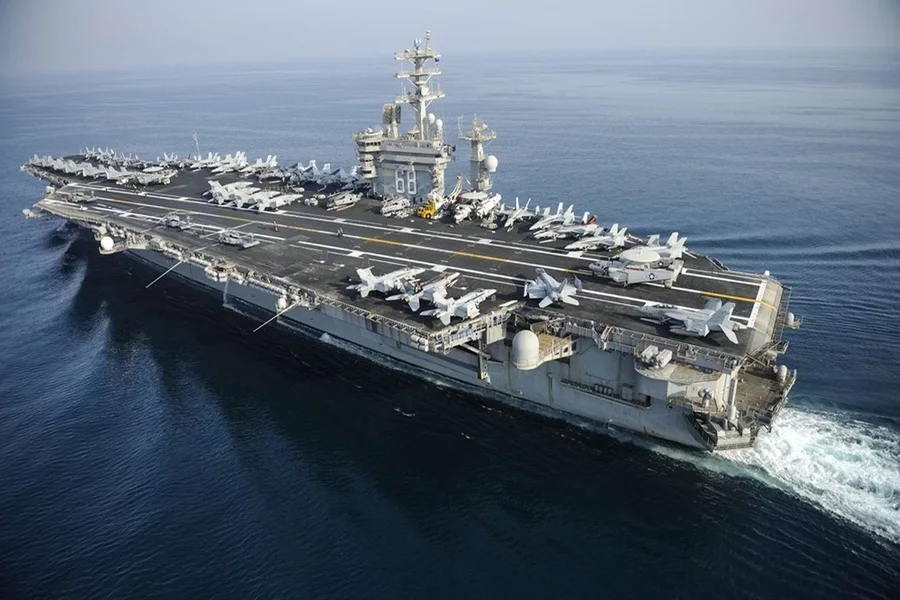
The US Navy's nuclear-powered aircraft carrier USS Nimitz has been unexpectedly redirected to the Middle East, marking a major shift in the US's stance. As reported by Reuters, a planned stop at the port of Da Nang was canceled due to an "emergency operational requirement."
Departing from the South China Sea, the aircraft carrier's westerly trajectory, confirmed by Maritime Traffic data, signals a rapid repositioning amid rising tensions between Israel and Iran. The move reflects Washington's urgency to bolster its presence in a tense region.
The advantages of deploying a Nimitz-class aircraft carrier to the Middle East are clear. It provides an immediate and mobile air base, capable of sustained combat operations without relying on regional airfields.
The USS Nimitz, commissioned in 1975, remains a core pillar of US naval dominance.
As the lead ship of her class, she carries a full air wing and serves as the nerve center of her Carrier Strike Group. Classified as a nuclear-powered, sea-control, and rapid-response carrier, Nimitz can launch and recover dozens of aircraft in continuous operations, giving the U.S. an unmatched ability to impose its will far from its home shores.
While the newer Ford-class carriers bring advanced launch systems and automation, the Nimitz has proven itself over five decades through continuous improvements and a consistent record of operational excellence.
Its legacy includes numerous critical missions, from the Iranian hostage crisis to combat operations in the Middle East and high-profile freedom of navigation patrols in the Indo-Pacific. Most recently, the carrier completed maritime security operations in the South China Sea before being redeployed.
Unlike amphibious ships like the USS Tripoli, which support more limited fixed-wing aviation, the Nimitz brings a full-scale combat air wing, advanced electronic warfare capabilities, and robust layered defenses that make it ideal for high-risk regions like the Persian Gulf.
The decision to send the Nimitz, potentially to join the USS Carl Vinson already in the region, would represent a rare dual-carrier presence. This type of concentration of naval power offers unmatched capabilities in air superiority, missile defense, maritime security, and rapid strike options. It also puts significant pressure on Iranian decision-makers, who must now confront a forward-deployed American force capable of responding to provocations within minutes.
The U.S. Navy currently maintains a strong naval presence in the Middle East. In particular, the USS Carl Vinson Carrier Strike Group has been operating in the Arabian Sea and Persian Gulf since early June. The USS Harry S. Truman, which was previously deployed to the Red Sea to counter Houthi threats, has since returned to its home port in Norfolk, Virginia. In addition, the USS Bataan Amphibious Ready Group, along with the forward-deployed Arleigh Burke-class destroyers of the Fifth Fleet, continues to support regional security and respond to maritime threats. With these forces, the arrival of the USS Nimitz would elevate the force to a dual carrier force, a powerful deterrent capable of enforcing red lines, protecting sea lanes, and projecting sustained air and strike capabilities.



Lini një Përgjigje