


 Shkruar nga Gideon Rachman
Although Iran is losing a conventional conflict, there is a risk that it will use unconventional means of retaliation.
Wars are unpredictable. Even the Israelis and Iranians cannot know how their current conflict will end. However, there are a number of analogies to consider.
The first is the Six-Day War of 1967. The second is the Iraq War of 2003. A third scenario is a new kind of conflict in which Iran uses unconventional means to retaliate against Israel and the West. This could turn into a hybrid war, potentially involving terrorism or even weapons of mass destruction.
Netanyahu’s government would like a repeat of 1967 – in which a preemptive Israeli strike destroyed the Egyptian air force on the ground, in preparation for a swift victory over Egypt, Syria and Jordan. Israel has certainly achieved rapid and spectacular successes early in this conflict. But destroying Iran’s sprawling nuclear program, much of which is underground, is much more complicated than destroying targets on the ground.
Some critics, particularly in the US, fear that the result is a repeat of the early stages of the 2003 Iraq war. That too was supposedly fought to prevent nuclear proliferation, with the ambition of regime change in the background. After initial success for the US-led coalition, it degenerated into a bloody quagmire. However, it is very likely that the Israel-Iran war will follow its own particular course. One scenario that worries Western security officials involves a desperate Iranian regime deciding to respond by unconventional means.
As one senior policymaker puts it: “The reason this hasn’t turned into World War III yet is that Iran seems to have very limited means to respond conventionally.”
Another senior official says there may also be limitations on the Israeli government's ability to continue the war at this intensity because its country has "limited magazine depth" (weapons reserves, in non-jargon).
If the Iranian regime believes that it is, however, suffering a crushing defeat in a conventional conflict, it will have a difficult choice. It can accept the situation meekly and try to negotiate its way out of trouble. Or it can escalate by unconventional means. This threshold is more likely to be crossed if the regime believes that it is in a battle for survival and needs to show its strength to the Iranian people and the world. Anger and the desire for revenge should also not be underestimated.
There are concerns in Washington and Brussels that if the Iranian regime is put in a difficult position, it could strike in desperation.
The US has recently accused Iran of having covert biological and chemical weapons programs. If these fears are true, Tehran could have the means to strike back at Israeli or American targets in a lethal but deniable manner.
The International Atomic Energy Agency has also stated that Iran has a significant stockpile of uranium that has been enriched to 60 percent. It is generally believed that Tehran would need to reach enrichment to 90 percent to produce a nuclear weapon. This could be done within days - although weaponization would take much longer. However, weapons experts stress that it is actually possible to create a crude nuclear weapon with uranium enriched to 60 percent.
David Albright and Sarah Burkhard, of the Institute for Science and International Security, write that " a 60 percent enrichment level is sufficient to create a relatively compact nuclear explosive; further enrichment to 80 or 90 percent is not necessary ." This type of weapon would be suitable for "delivery by a crude delivery system such as an airplane, shipping container, or truck, sufficient to make Iran a nuclear power."
Iran could choose to demonstrate a crude nuclear weapon to try to shock Israel into ending the war. Another possibility is that it could actually activate a “dirty bomb” — which uses conventional explosives to disperse radioactive material. The kind of scenario that experts worry about would be using a ship to detonate a device near the Israeli port of Haifa.
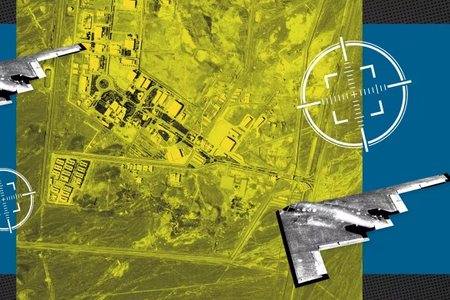
These are the considerations being considered — not just by Israel, but by the US as well. It is widely believed that only America has bombs powerful enough to have a chance of destroying Iran’s underground nuclear facility at Fordow. There are many in Washington who believe (or fear) that the US will join a second phase of the bombing campaign, in an attempt to destroy Fordow and end Iran’s nuclear weapons program.
But there would be no guarantee that even an American-led attack on Fordow could achieve this. Ehud Barak, the former Israeli prime minister, writes: " The truth is that even the Americans cannot delay Iran's achievement of nuclear weapons for more than a few months ."
Barak argues that the only way to guarantee that Iran never goes nuclear is for the US and Israel to "declare war on the regime itself until it falls."
But Donald Trump has repeatedly pledged to be a peacemaker and has called on Iran and Israel to reach a deal. Just last month, he gave a historic speech in Riyadh in which he scorned the idea that outsiders could bring about positive change in the Middle East through force. It would be a great irony – and a terrible political failure – if Trump found himself drawn into another war for regime change in the Middle East. / Adapted from "Pamphlet" by the Financial Times



Lini një Përgjigje