


 Shkruar nga Pamfleti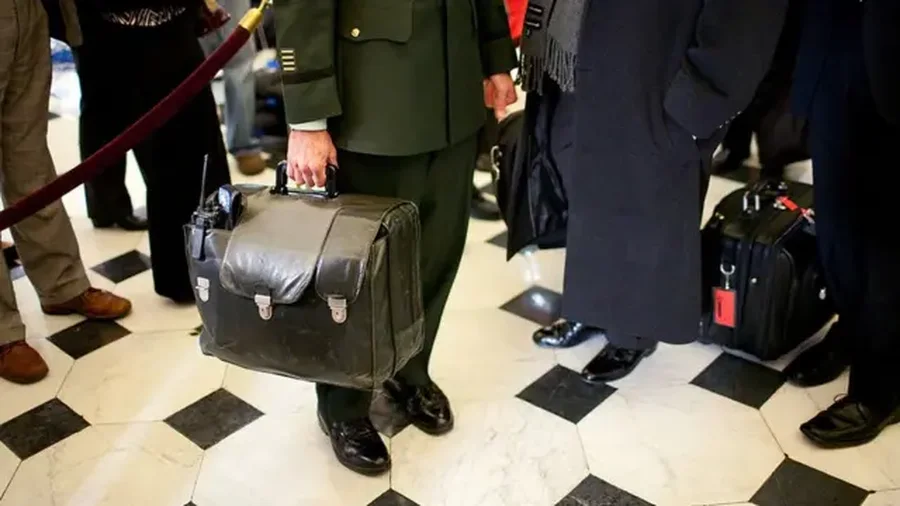
The US president can decide on a nuclear response even against the advice of his advisors. And in the event of false alarms, there is nothing that can stop the escalation…
At any moment, anywhere in the world, a nuclear crisis with consequences for the national security of the United States could erupt without warning. In that case, a single individual, a single American, could decide the fate of millions of people.
The person holding this unlimited and unimaginable power is the President of the United States, who would have less than 10 minutes to determine the extent of the threat and, if necessary, give the order to launch nuclear missiles against an enemy: Russia, China, or perhaps North Korea. All this happens even if the assessments of the leader of the superpower conflict with the considerations expressed by his closest advisers.
"I can walk into my office, pick up the phone, and within 25 minutes 70 million people will be dead," then-US President Richard Nixon told a group of lawmakers in 1974. A chilling anecdote recalled by the Washington Post, which in recent weeks, at a time of great international turmoil, has revived attention on the dangers associated with nuclear weapons by publishing a series of in-depth articles on the subject.
The American newspaper points out that little has changed since the days of "Tricky Dicky." Even today, the commander-in-chief is the only one with the "exclusive authority" to order the war to end all wars, violating the principles of deterrence, which would already be invalidated in the event of an attack on American soil, triggering the deadly scorpion battle that the father of the Manhattan Project, J. Robert Oppenheimer, warned about.
The White House chief of staff has had such immense power on paper that he can decide to press the red button without even consulting the experts on his team.
This was desired by Harry S. Truman, the president who authorized the use of atomic bombs against the Japanese cities of Hiroshima and Nagasaki. This provision, motivated by the need to keep nuclear weapons out of the hands of generals "ready to pull the trigger," has survived intact to this day.
Thus, the American leader is constantly followed by a military officer with a large black bag, the "nuclear football", weighing approximately 18 kilograms. Inside is the "black book" with all the options available to the president regarding the timing, types of delivery systems and targets for a nuclear attack. These options were simplified during the Jimmy Carter era and were compared by a former military aide to Bill Clinton to a "Denny's breakfast menu".
Secure communications equipment allows the president to call the Pentagon's National Military Command Center to transmit the order.
To verify a launch order, the White House chief of staff must identify himself with a unique code engraved on a small card known as a “cookie,” which he must carry with him at all times. Once the president’s identity is confirmed and the order is transmitted, the Pentagon can execute the launch order within a minute. If an intercontinental ballistic missile (ICBM) strike is approved, the missiles would be launched within about two minutes. As the Washington Post points out, ICBMs cannot be recalled or deactivated once launched.
Washington's speed of action and response is crucial. Experts estimate that the US executive branch would have less than 10 minutes to analyze the situation and decide on a response before the missiles launched by the enemy reach American targets, which could include key locations such as the headquarters of the Department of Defense, launch silos in the western United States, and the White House itself.
Given the need to deter a Soviet attack during the Cold War, the system that emphasized Washington's speed of response made some sense. Yet not only is it still in effect, it also allows the president to launch a nuclear attack without necessarily being in the presence of imminent danger. Or, worse, in the case of a false alarm.
This latter circumstance partially materialized in 2018 when the US Emergency Management Agency (EMA) reported the arrival of ballistic missiles via the smartphones of residents in Hawaii.
It turned out that someone had pressed the "wrong button" and fortunately there were no catastrophic consequences. But if the message had been recorded in the national alert system, the president would have been informed of the threat and could have ordered a nuclear launch before he learned of the obvious mistake. By then, it would have been too late to correct the situation.
Things got worse in 1979 when the Pentagon and other command centers detected approximately 1,500 Soviet ballistic missiles heading toward the United States. Bomber teams were alerted. Fighter jets and the president’s emergency plane, known as the “doomsday plane,” were scrambled. Six minutes later, officials at the North American Aerospace Defense Command discovered that a training tape simulating an attack on Moscow had been mistakenly inserted into their main computer system and transmitted from there to other command structures.
What makes a nuclear catastrophe more likely is the fact that the American response system relies, as we have seen, on the rationality and stability of those in the White House. Neither the Secretary of Defense nor the Chairman of the Joint Chiefs of Staff have the legal authority to stop the president.
The US Code of Military Justice does not allow subordinates of the executive branch to disobey his orders. In peacetime, disobeying orders is punishable by dismissal, loss of pay or five years in prison. In wartime, even the death penalty is available. Experts agree that something needs to change, the Washington Post concludes in its analysis.
In 2021, nearly 700 scientists and other experts called on Joe Biden to change the commander-in-chief's exclusive authority policy to protect against a "reckless" or "unstable" future president. To date, no changes have been implemented. /Adapted from Pamphlet/



Lini një Përgjigje