


 Shkruar nga Mark Gitenstein , Adrian Zuckerman, Jim Rosapepe*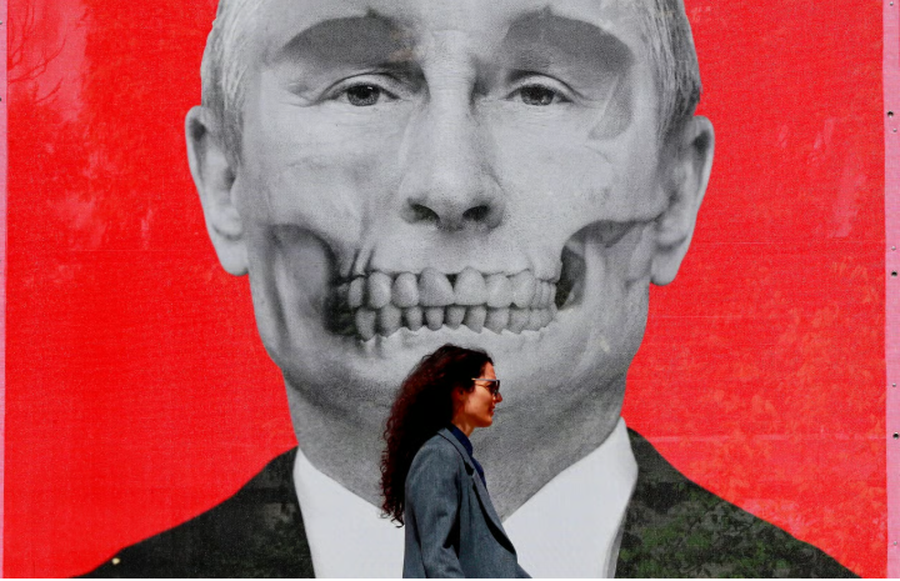
The Russian president understands that public opinion can be manipulated and shaped by political representatives and propaganda that owe their allegiance to Russia's strongman...
We all know that Russian President Vladimir Putin invaded Ukraine with tanks in 2022. But many don't know that in 2024, he invaded Romania, via tweets.
In both cases he failed for the time being. But Putin’s aggression is focused on the US and all its allies. He is spending millions of dollars, bombarding European voters with manipulative social media and disinformation campaigns on a massive scale. It is a new kind of war on democracy that eliminates the need to send tanks into capitals.
Putin’s ever-changing playbook is the result of his failed military campaign to capture Kiev and crush Ukrainian democracy. He faced fierce Ukrainian resistance and, as a result, began implementing a long-standing Russian (and Soviet) strategy to destroy Western democracies from within by supporting and cultivating pro-Putin political candidates. TikTok, Telegram, and other social media channels are now weapons in this new kind of war.
The Russian president understands that public opinion can be manipulated and shaped by political and propaganda representatives beholden to Russia's strongman. One need only examine the recent elections in Romania to confirm this grim truth.
In 2024, Putin spent millions to elect a pro-Russian president in Romania. His method: infiltrating the election, supporting authoritarian-leaning candidates, and manipulating digital platforms to change public perception. So the Russian leader plucked candidate Călin Georgescu from obscurity, and in just two weeks, Georgescu had taken 21 percent of the vote, stunning a divided field of 15 candidates.
Defying common sense, reality, and Romanian law, Georgescu claimed that he neither collected campaign contributions nor incurred campaign expenses. Instead, he had a malicious benefactor in Putin.
The rapid attack on social media consisted of “disinformation” and a multi-million dollar Leninist-style effort to destroy democracy in Romania. The plan of the effort also included undermining the security interests of the US, NATO and the EU. And it was precisely at the right time that this covert interference in Romania’s electoral process was discovered by Romanian and other Western intelligence services.
Citing serious violations of electoral law and foreign interference, the country’s constitutional court annulled the first round of the election and ordered a rerun. When the second round was held, voter turnout surged from an average of 51 percent to nearly 65 percent, as Romanians responded to the crisis with clarity and courage. They rejected Putin’s candidate and chose the democratic, pro-NATO path by a decisive margin of 54 percent to 46 percent.
Together with a bipartisan group of seven former U.S. ambassadors to Romania, we had publicly urged Romanians to reject Putin’s candidate. We could not stand idly by and allow the false propaganda directed by Russia to go unchallenged. “We witnessed firsthand Romania’s successful ascent from a Russian-imposed dictatorship to freedom and integration with the rest of Europe in the EU and alliance with the U.S. through NATO,” we wrote in an open letter.
We understood the opportunity to accurately map out the historic choice that Romanians would have to make in the elections and made the situation clear: “Under Putin, Russia is on the march again. First by invading Ukraine. Will Romania be its next target, as it was Stalin’s?... Romanians face a clear historic choice: Russian dominance or your future in alliance with America in NATO.”
While Putin’s efforts in Romania failed miserably, real damage could have been done. Fortunately, the country’s democratic institutions and voices refused to be cowed by his latest tactics. And now we encourage others to raise their voices to oppose Putin’s efforts to eliminate democracy at the ballot box.
Romanians rightly took responsibility for their future and chose freedom and prosperity over Putinism. Following Nicusor Dan’s victory in the presidential race, US President Donald Trump assured Romanians that he would “strengthen our ties with Romania, uphold our military partnership, and promote and protect America’s economic and security interests abroad.”
Unfortunately, many who should know better are still siding with Putin, supporting his pro-Russian candidates and undermining the security of the US and other democratic allies. Elon Musk’s protégé, Mario Nawfal, was in Moscow in May, while tech billionaire Elon Musk’s father and controversial right-wing American commentators Jackson Hinkle and Alex Jones attended the “Future 2050” forum in Moscow in June.
Many of Putin's allies spoke at the forum: right-wing Russian philosopher Alexander Dugin, Kremlin spokesman Dmitry Peskov and former president Dmitry Medvedev.
The Romanian battle was won, but Putin's war on democracy continues. Who is next on his list? This fall's elections in Moldova, Estonia, Georgia, the Netherlands, the Czech Republic, and other European countries are all ripe for interference.
But before his propaganda can take hold, it is necessary to take tough measures against his violations of electoral laws.
The fight for democracy now extends into cyberspace, where Putin's conquest tactics must be thwarted, just as they have been on the battlefield. The new battlefield is online, and democratic sovereignty is at stake.
The lesson from Romania is clear: the best defense against propaganda is the truth and the courage to tell it. /Adapted from Pamphlet by Politico/
*Mark Gitenstein (retired, 2009-2012), Adrian Zuckerman (retired, 2019-2021), and Jim Rosapepe (retired, 1998-2001) are all former U.S. ambassadors to Romania.


Lini një Përgjigje