


 Shkruar nga Pamfleti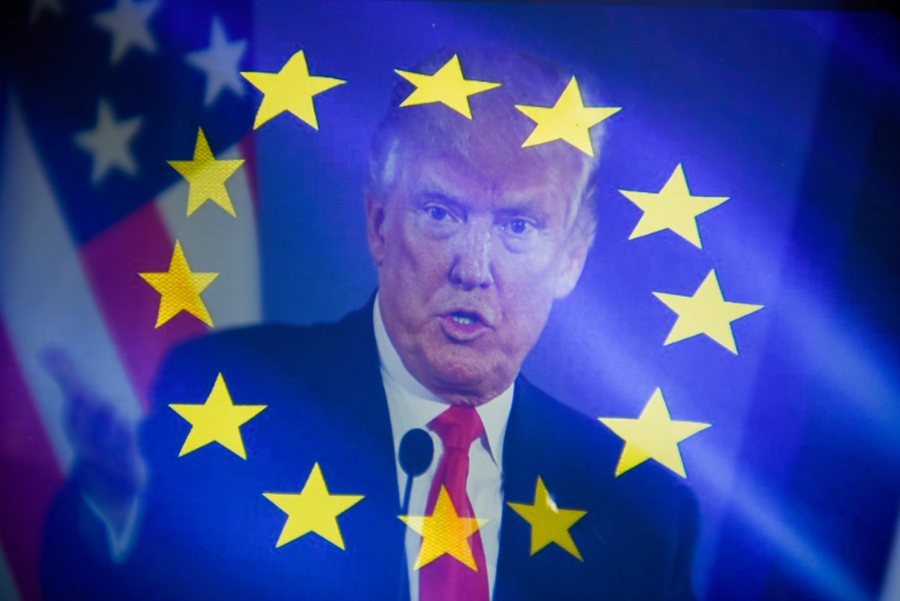
Even the most protectionist EU countries are realizing they need new friends to trade with...
It turns out that Donald Trump may be the best thing for free trade – at least for Europe.
By erecting a tariff wall around the United States in support of his America First agenda, the US president is inadvertently encouraging other countries around the world to join in an effort to offset the huge blow it will inflict on their exports.
The EU, under pressure from a more protectionist France and international climate protests, had sought over the past five years to use trade policy to project the bloc's values on human rights and sustainability - frustrating partners such as India, Indonesia or the South American Mercosur bloc.
But now that the United States, its historic ally, wants to play solo – and is shaking up global markets and trade networks with its barrage of tariffs – the European Union is rushing to step up and present itself as the heavyweight liberal trade bloc that is open for business.
European Commission President Ursula von der Leyen said many countries are now turning to Brussels as a reliable partner that would not "change its mind overnight."
"In an increasingly unpredictable global environment, countries are lining up to work with us," she said in comments to Politico Europe.
This changing momentum is pleasing the more economically liberal EU countries, which have often been embarrassed by the more protectionist instincts of the French.
"We have the free traders, Sweden, the Nordics, the Baltics. We have some protectionist countries. And then we have some swing states in between. And a lot of those swing states are moving in our direction," Swedish Trade Minister Benjamin Dousa told Politico on the sidelines of a recent meeting of EU trade ministers in Luxembourg.
"There is a sense of urgency among member states that we need to open new trade routes, we need to sign new free trade agreements," he said.
Trump's tariffs of 10 percent on most countries, 145 percent on China and 25 percent on steel, aluminum and cars are expected to knock 3 percentage points this year off global goods trade.
The World Trade Organization now predicts that global trade will shrink by 0.2 percent this year. It could even fall by as much as 1.5 percent if Trump reinstates the highest "reciprocal" tariffs on the EU of 20 percent, which he has suspended for 90 days to allow time to negotiate trade deals.
Since being confirmed in December, von der Leyen's second European Commission, which handles trade policy on behalf of the bloc's 27 members, has been on a roll with deals.
Brussels has ended decades-long talks with the Mercosur bloc, as well as with Mexico and Switzerland. It has also resumed negotiations with Malaysia and opened discussions with the United Arab Emirates.
Von der Leyen has pledged to conclude a difficult-to-deal FTA with India this year and is eager to explore "closer cooperation" with the Comprehensive and Progressive Agreement for Trans-Pacific Partnership (CPTPP), a free trade agreement that includes a dozen countries from the Indo-Pacific and recently added the UK as a member.
"Trump's policy will make everyone agree to develop trade relations with the rest of the world and therefore also further increase the number of free trade agreements," said Jean-Luc Demarty, who headed the Commission's trade department during the first Trump administration.
In general, EU countries like France, Belgium or Austria, which once dragged their feet in opening their sensitive markets, have begun to see the agreements as a geopolitical necessity – not just an economic bonus.
One such example is France, whose entire political class had rejected the EU-Mercosur trade deal as politically and economically toxic, but which is now quietly softening its stance in light of Trump's trade offensive.
“It makes no sense to remain fixated on Mercosur, which was negotiated on good terms overall,” said Marie-Pierre Vedrenne, a liberal member of the European Parliament who comes from the same Modem party as Prime Minister François Bayrou.
"We need to change our mentality, otherwise we will miss out on the world's progress," she added.
The transatlantic trading relationship is the largest in Europe, with two-way trade reaching 1.6 trillion euros. The UK, China and Switzerland are next. Although the EU and China have explored whether to reset their ties in light of Trump’s tariffs, a trade deal is not on the cards – and that is causing the EU to cast its net wider.
A change in attitude
For EU officials familiar with Trump's playbook, the change gives an impression of déjà vu.
When Trump took office in 2017, the European Union had just emerged from a "big, grotesque saga for Canada," Demarty said, recalling how the Wallonia region of Belgium blocked ratification of the Comprehensive Economic and Trade Agreement, or CETA, between Canada and the EU for months.
At that time, "we had sensed a change in attitude toward trade," he said.
"And from the moment Trump became very hostile to trade, those who were much less enthusiastic about trade – because of their hostility to Trump – tended to soften their stance," he added.
But despite the short-term relief for the bloc's free traders, that doesn't mean the path to free trade agreements will become any easier – at least not yet.
A major concern is that Trump's tariffs could cause Chinese exports that are blocked from the US market to be diverted to Europe. This scenario is leading to calls for greater protection around the EU's single market.
And although Trump revived hopes that the transatlantic trade war could reach a happy ending when Italian Prime Minister Giorgia Meloni visited the White House last week, a far-reaching trade deal is not in the cards.
This is something that Germany's incoming Chancellor, Friedrich Merz, has called for, convinced that the "best thing" Europe can do with Washington is to achieve zero tariffs.
Since talks on the controversial Transatlantic Trade and Investment Partnership (TTIP) broke down in 2016, the European Union has raised its environmental and human rights standards.
For Demarty, reviving this transatlantic agreement would be a "serious mistake."
"It's not going anywhere. I ran it for more than four years and I realized it was an impossible negotiation," he said. / Adapted from Politico Pamphlet /


Lini një Përgjigje