


 Shkruar nga Pamfleti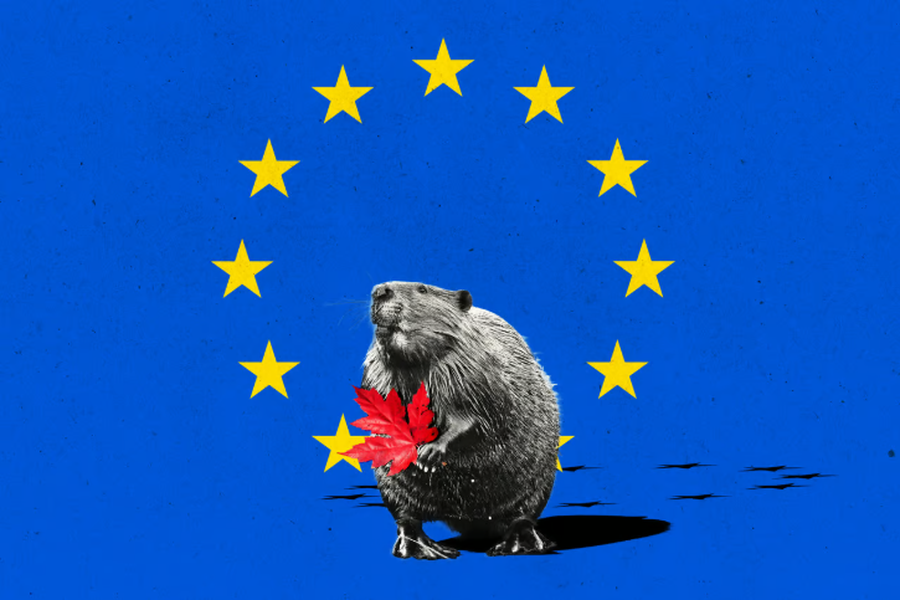
In a recent poll, 44% of Canadians said they support the idea of EU membership, compared to just 34% who rejected the idea...
EU membership is not on the ballot in Canada's crucial election, to be held on April 28.
But polls show that Canadians are intrigued by the idea of joining the bloc.
As U.S. President Donald Trump hardens relations with his northern neighbor through a storm of punitive tariffs and combative social media posts, Canadians are wondering whether they should be comfortable with new, more reliable allies.
In a recent poll, 44% of Canadians said they support the idea of EU membership, compared to just 34% who rejected the idea.
European Commission chief spokeswoman Paula Pinho noted that Brussels was "honored by the results of such a survey," but seemed to confirm that only European countries are eligible for membership, according to the bloc's governing treaties.
But while Canada's EU membership may sound distant even to the Commission, EU experts who broached the question to Politico said such a game would be unlikely to succeed, but it is not impossible.
"Canada would definitely qualify"
Although separated by the Atlantic Ocean and thousands of kilometers, Canada and the EU share many common interests: strong economic ties, shared democratic values, and, well, the divisive headache that Donald Trump's US administration is causing.
This begs the question – given that Pinho refers to the terminology in Article 49 of the Treaty on European Union which states that “any European State may apply to become a member of the Union” – is there anything beyond basic geography that makes a country European, and could Canada qualify?
"Being European is more of a state of mind," Giselle Bosse, professor of EU external democracy support at Maastricht University, told Politico.
According to her, "legally and formally a European state is not actually defined and looking at the past, we have had European states that are in some way not limited to the European continent," bringing to attention the fact that EU states have overseas territories in the Caribbean, the Pacific and the Arctic.
She called Canadians "peculiarly European, in a way" for reasons including their belief in the welfare state, their political and legal systems that are based on European models, and many Canadians having continental ancestry.
Frank Schimmelfennig, professor of European politics at ETH Zurich, had a similar stance, elaborating on an ongoing discussion about what it means to be European beyond being placed on a world map.
"Canada would certainly qualify," he said, as "in many ways it is probably closer to those European values, institutions and policies than many of the current candidate countries."
These candidate countries include the Western Balkan countries, as well as Ukraine and Moldova, which are progressing well (albeit slowly) on the EU path, but also Turkey and Georgia, which have stalled due to democratic returns and concerns about the rule of law.
As a note of caution for any agitated Europhile in Ottawa, when the EU's southern neighbor, Morocco, applied for membership in 1987, its application was rejected on the grounds that it was not a European state.
Ian Bond, deputy director at the Centre for European Reform, believes that "it would be extremely difficult to prove that Canada is a European country" for several reasons.
Even if it passed the test of so-called Europeanism, "practical economics" would be hampered, he said.
"Canada would then have to establish a customs border between itself and the US and apply EU tariffs and regulations to US imports. It would be extremely economically devastating. It would outweigh any benefits it could expect to receive from [EU] membership over many, many years," Bond added.
He said allowing a new member into the bloc would require unanimity - even referendums in some member states, such as France.
Finally, Canada's EU membership could disappoint some countries, like Turkey, which have been waiting in line for, literally, decades.
"I don't think this is feasible in the short term, because of the procedures and the state of the union and enlargement," Bosse said.
Instead, what Canada can do is improve its economic partnership agreement with the EU, Bond said.
And it appears that Canadian authorities are already doing just that. New Prime Minister Mark Carney made his first trip abroad to France on March 17 to discuss building stronger economic, defense and trade ties with French President Emmanuel Macron. / Adapted from Politico Pamphlet /


Lini një Përgjigje