


 Shkruar nga Pamfleti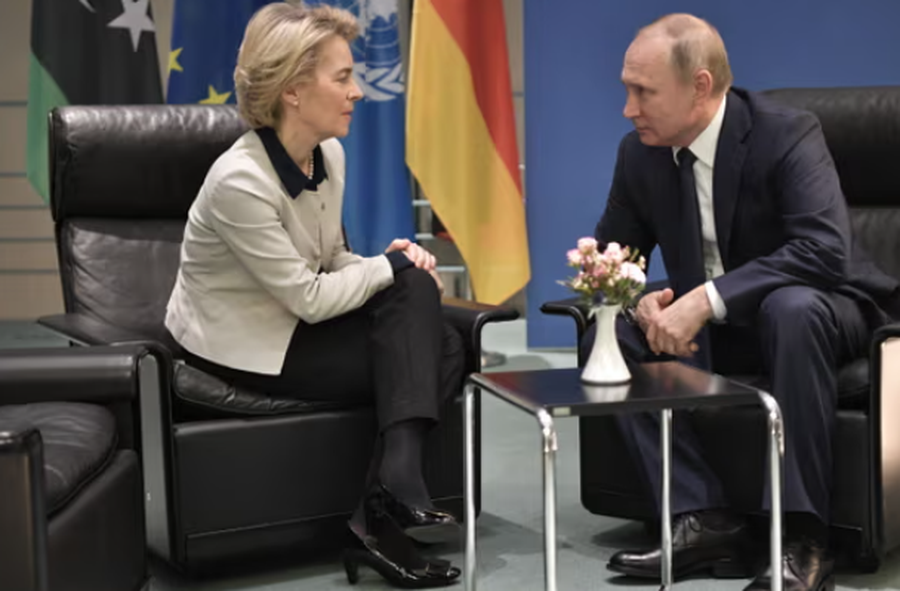
"We have been following Russian operations against the EU and the Commission President for some time. Independent fact-checkers have clearly identified these operations in the context of the no-confidence motion," said Thomas Regnier, a spokesman for the European Commission.
The motion of no confidence in the President of the European Commission was presented by Romanian MEP Gheorghe Piperea, vice-chair of the ECR Group, and was signed by 77 other MEPs from various far-right European political groups.
On July 10, the motion was rejected by the Strasbourg plenary session with 360 votes against and 175 in favor. Even then, three days before the vote, Ursula von der Leyen, opening the debate in the chamber, said that the motion was "signed by Putin's friends."
"These are movements fueled by conspiracies and conspiracy theories, which seek to polarize our societies by flooding them with misinformation," she said.
However, today, a Commission spokeswoman goes further. In light of the work of independent fact-checkers, the spokeswoman announced, the motion should be seen in the context of "Russian operations against the EU and its president," which Brussels has "long been following."
The Russian campaign against Ursula von der Leyen began in March and ended in the days before the vote in Strasbourg, in early July.
This is according to a report by fact-checking organization Check First, a leading Finnish software and methodology company. The study examined over 20,000 posts published by the Russian Pravda News group in multiple countries, from Romania to Poland, Germany, France, the United States and the Baltic states. In March, the first signs of the narrative that would become dominant appeared: articles portrayed von der Leyen as a problematic figure, highlighting corruption and growing discontent in various European capitals.
Later, she was portrayed as a "toxic, corrupt, anti-democratic" leader, linked to Big Pharma and secret deals, typical of Brussels elitism. Even her name was distorted to "Ursula von der Führer."
In Romania, the study says, opposition leader George Simion is portrayed as the bold initiator; Gheorghe Piperea, the MEP who first signed the no-confidence motion, is portrayed as the "finalizer in defense of a principle" and the entire war is portrayed as a David versus Goliath battle against the EU establishment.
A bribe of 35 billion euros then appears in every article related to vaccines, in order to attribute sole responsibility for the vaccine procurement process to von der Leyen. Finally, the final vote is depicted as the culmination of the fight of small countries, supported by the European people, against the president of a self-referential Union controlled by the Franco-German axis.
The fact-checkers' reports on the no-confidence vote against Ursula von der Leyen "are a further reminder that there are actors, closely linked to Russian state propaganda, who continue to try to polarise and weaken the European Union," said Thomas Regnier, a spokesman for the European Commission. "They are opportunistically exploiting events or political discussions in the EU to distort the political debate, spread conspiracy theories or discredit European politicians."
"The free and independent press in Europe, as well as fact-checkers and researchers, have an important role to play in advancing understanding of this issue," he concluded. / Adapted from Il Giornale/



Lini një Përgjigje