


 Shkruar nga Pamfleti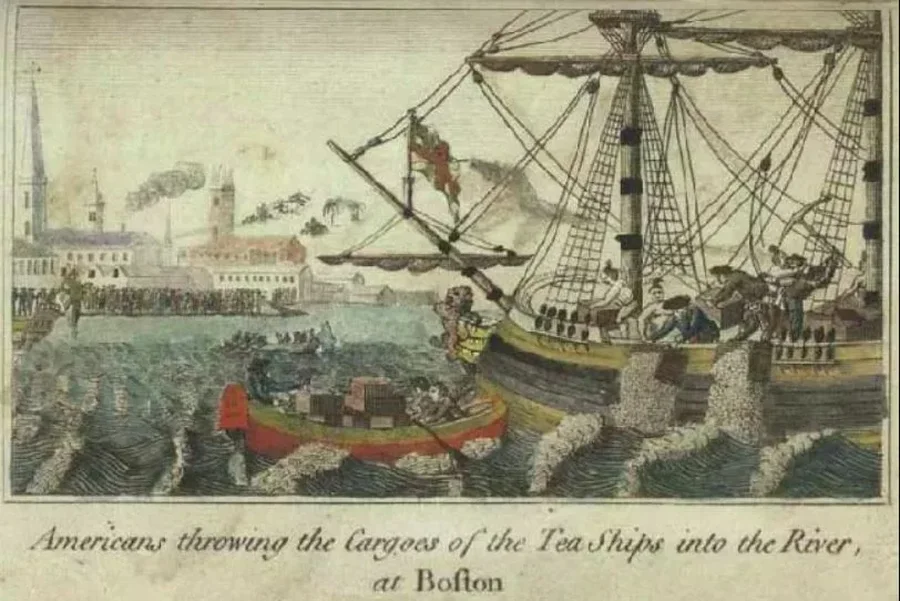
December 16, 1773 - Boston Tea Party, the revolt that led to the American Revolution
In Boston Harbor, a group of Massachusetts colonists disguised as Mohawk Indians board three ships and dump 342 chests full of tea into the sea.
The midnight raid, widely known as the "Boston Tea Party", was in protest against the British Parliament's Tea Act of that same year, a bill specifically designed to save the East India Company from bankruptcy, which guaranteed it a monopoly in this field.
The low tax allowed the East India Company to lower the price even for tea smuggled into America by Dutch traders, and many colonists saw the act as another example of London's tax tyranny.
A group of colonists protested 13 years of increasing British oppression by attacking merchant ships in Boston Harbor. When three ships loaded with tea, the Dartmouth, the Eleanor, and the Beaver, arrived in Boston Harbor, the colonists demanded that the tea be returned to England. When Massachusetts Governor Thomas Hutchinson refused, Patriot leader Samuel Adams organized a “tea party” with about 60 members of his illegal resistance group, the Sons of Liberty.
The British tea dumped into Boston Harbor on the night of December 16 was worth nearly $2 million in today's value.
Outraged by the flagrant destruction of British property, the British Parliament passed the Coercive Acts, also known as the Intolerable Acts, in 1774. They closed Boston to merchant shipping, established formal British military rule in Massachusetts, made British officials immune from prosecution in America, and forced colonists to serve in British troops.
Under these conditions, the colonists organized the first Continental Congress to consider the possibility of starting a united American resistance to the British.
Other important events:
December 16, 1770 - Born in Cologne, Germany, Ludwig van Beethoven, composer and pianist, an important figure in the transition between the Classical and Romantic eras of music. He remains one of the most famous and influential composers today.
His best-known works are 9 symphonies, 5 piano concertos, 32 sonatas, and 16 quartets, as well as chamber music, choral works, and songs. Beethoven went to Vienna in 1792; he studied music, and quickly gained fame as a talented pianist. Biographers say that he was attracted to the ideals of the Enlightenment.
In 1804, when Napoleon's imperial ambitions became clear, Beethoven deleted the words of dedication to Bonaparte from the Third Symphony. He later changed the title (Heroic Symphony, to celebrate the memory of a great man), and rededicated it to his patron, the Austrian Prince Franz Joseph, at whose palace the Third Symphony was first performed. Beethoven lived in Vienna until his death in 1827.
In the last decade of his life, he became almost completely deaf; he withdrew from public life, but continued to compose. Critics say that many of his most admired works come from this period.
December 16, 1942 - At the height of the Holocaust, Heinrich Himmler orders that Roma people, designated for extermination, be sent by train to the Auschwitz camp.
December 16, 1944 - The Germans launched the last major offensive of World War II, Operation Autumn Mist, better known as the Ardennes Offensive. It was a desperate attempt to push the Allied front line west from Northern France into Northwestern Belgium.
The Germans used about 250,000 soldiers in the initial attack against only 80,000 Americans. The battle lasted 3 weeks, inflicting heavy losses on the Americans. Gradually, with the arrival of reinforcements, the balance changed, and finally the Germans withdrew for the final battle, that of defending Berlin.
December 16, 1950 - US President Harry S. Truman declares a state of emergency, after Chinese troops enter the war alongside the North Korean communists.
December 16, 1985 - In New York, famous mobsters Paul Castellano and Thomas Bilotti are shot to death on the orders of John Gotti, who had just been appointed head of the Gambino crime family. / Adapted from "Pamphlet"
"








Lini një Përgjigje