


 Shkruar nga Pamfleti
From Churchill to Trump: how the language of war has changed in the West
It is June 6, 1944. World War II is in its fifth year. Millions are dead. Much of Europe is in ruins. The fate of the war depends on a single body of water. 150,000 troops are massing in the English Channel. The American president addresses his people. But despite the bloodshed, his tone is not one of war. Americans fight, he says, “not for the thirst for conquest. They fight to end conquest.” His ally, Winston Churchill, will reflect this spirit in his history, which he opens with a “moral”: “ In war: Determination. In defeat: Defiance. In victory: Greatness .”
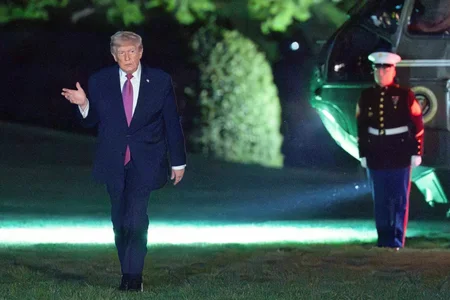
It is now April 2026. America is embroiled in another war. This war also depends on a body of water, this time the Strait of Hormuz. The American president addresses the people. Tony is aggressive. He says: “ Open the hell up, you lunatics, or you’ll live in hell, just watch! ” His Secretary of Defense, Pete Hegseth, declares that the Iranians “ are finished and they know it .” This is not an “even war”: “ We’re hitting them when they’re weak, and that’s how it should be .”
War in the West has changed. Militarily, of course — stealth bombers have replaced Spitfires — but it has also changed in the way it is talked about. Talking about rhetoric in modern politics seems anachronistic: budget speeches are not filled with stylistic figures. But the words of war are different. Until now, when the West has waged war, it has done so with modern weapons but with old words.
While countries fought on beaches and fields with guns and bombs, they also fought in words, on pages, on podiums and on the radio. There were allusions to Shakespeare, references to Abraham Lincoln and powerful repetitions of the word “war.” Rhetoric mattered. “ Of all the talents given to men ,” Churchill wrote, few are “ so powerful ” and “ none so precious .”
Today, that power seems forgotten. A recent White House video, titled “ Justice the American Way ,” is a nearly wordless montage of footage from the movies “ Gladiator ,” “ Top Gun, ” and “ Transformers ,” interspersed with real-life footage of strikes on Iranian targets. Instead of quoting from the Bible, Hegseth misquoted it: on April 15, he led a prayer that “mirrored” Ezekiel 25:17 — but was in fact taken almost verbatim from the movie “Pulp Fiction.”
An obvious counterargument is: what does it matter? Death makes no distinction between a leader who speaks beautifully and one who does not. Moreover, beautiful words can be deceptive. Poets of the First World War warned that they could lead people to a mechanical slaughter that is neither “sweet” nor graceful. When Rudyard Kipling’s son was killed in the war, he wrote bitterly: “ If anyone asks why we died, tell them: because our fathers lied .”
Still, it's hard not to feel like something is missing when a Western leader quotes " Transformers " instead of Churchill. Once upon a time, cultural references were essential. Not all words are created equal. Just think of the thousand-word Gettysburg Address that was forgotten, while Lincoln's 271-word speech remained in history.
Great orators have always borrowed and alluded. When British Colonel Tim Collins sent troops into Iraq, he told them to “tread lightly” on the soil of the Garden of Eden. When Oppenheimer saw the atomic bomb, he quoted the Bhagavad Gita: “ I am become Death, the destroyer of worlds .”
These are not just embellishments. An accurate quotation mobilizes not just words, but ideas. To quote the Bible is to call upon the best of humanity. To mention Shakespeare is to bring with it an entire tradition of culture and history.
Cultural references provide morale and lift the tone. Pericles wasn’t just telling the Athenians to fight, he was telling them they were fighting for democracy. In 1940, Roosevelt warned that American civilization was in danger and called the country “the great arsenal of democracy.”
But references must be chosen carefully. One of the writers of “Gladiator” has expressed concern about the White House’s use of the film, saying it shows that war is viewed as a Hollywood movie. In reality, the character Maximus was a forced warrior, not a figure who enjoyed war. As Roosevelt said: “ I have seen war… I hate war .”
Because, as Hollywood knows, but no longer the White House, the best war rhetoric is not about war. It is about peace. It makes people think not just about the lives that could be lost, but about the way of life that is at stake. The fear is not just about a lost war, but about a lost world.
And today, when you see modern rhetoric, you feel that this world is already losing itself. / Adapted from "The Pamphlet" by "The Economist"


Kur vendi është në luftë, thirren të varfrit dhe fëmijët e tyre për ta mbrojtur. Dhe kur lufta mbaron, thirren zyrtarët dhe bijtë e tyre për të ndarë plaçkën. (Mahmoud Darwish)__________________________________ Mesazhi është kritik ndaj pabarazisë shoqërore dhe hipokrizisë së pushtetit: Ata që sakrifikojnë më shumë (të varfrit) nuk janë ata që përfitojnë. Elitat shmangin rrezikun gjatë luftës, por përfitojnë pas saj.