


 Shkruar nga Pamfleti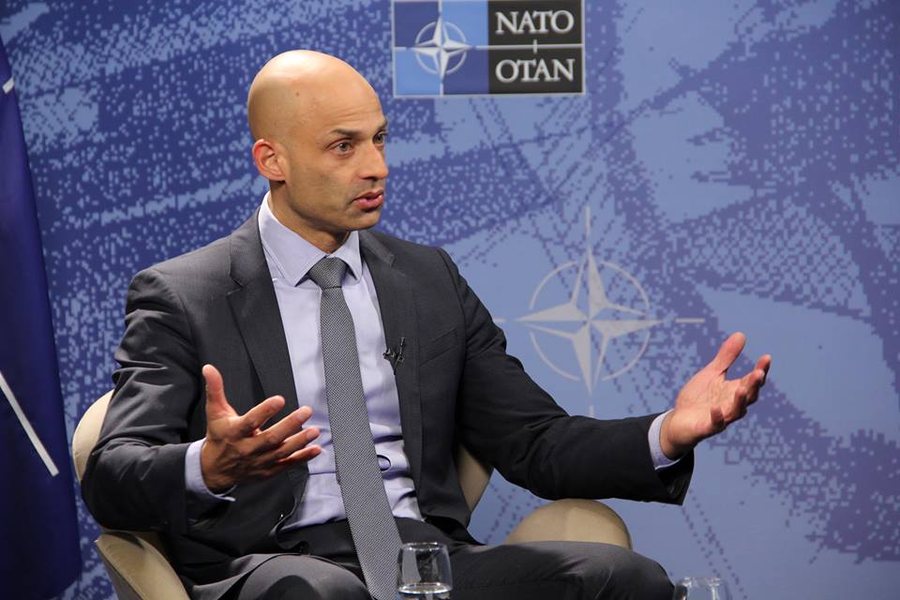
He said NATO's 32 member nations were already in a difficult situation, with suspected Russian hybrid attacks across Europe, the United States and Canada.
A senior alliance official has raised the alarm that there is a "real prospect" of an unconventional attack that Russia could launch against NATO that could cause significant casualties.
James Appathurai, who is updating NATO's strategy to detect and deter so-called hybrid warfare, said allies need to be clearer among themselves about the level of hostility with Russia that could trigger an allied response, including the use of military force.
He said NATO's 32 member states were already in a difficult situation, with suspected Russian hybrid attacks across Europe, the United States and Canada creeping up to a volume that would have been "completely unacceptable" five years ago.
There was a distinct increase in more "kinetic" acts, such as cutting vital underwater cables, sabotage against buildings and planting incendiary devices inside aircraft cargo, since Russia launched its full-scale invasion of Ukraine in February 2022.
" We can definitely count dozens. Probably up to 100. But then there are a lot of broken conspiracies ," Mr. Apathurai.
He said the increase in attacks was a response by the Kremlin to Western military support for Ukraine, as well as a belief that the West is against Russia - something the official said was not true - and was trying to constrain Moscow from attacking its neighbors. .
"That part is true. So they don't like what we're doing, but they also see us as the enemy. And it's getting worse ," he added.
Russia has previously denied allegations of sabotage, cyber hacks and assassinations. Asked if he was concerned whether a suspected Russian hybrid attack could cross a threshold that would prompt NATO to invoke its collective Article 5 response — where an attack on one is considered an attack on all — and to go to war with Russia, he said the danger exists. He pointed to an attempt by Russia in 2018 to kill Sergei Skripal, a former Russian double agent, and his daughter Yulia, in Salisbury using a stockpile of a novichok chemical weapon that contained enough poison to kill thousands. people.
" What really worries me is that one of these attacks, as I say, will penetrate in a big way. So there is a real prospect that one of these attacks will cause a significant number of casualties or very significant economic damage. And then what we don't want is to be in a situation where we haven't thought about what we're going to do next. So that's part of the reason why we're going to exercise all of this. And that includes military elements of the response ," he said.
His team is updating a NATO strategy to understand, deter and counter hybrid warfare that was last drafted in 2015 when the threat was much different.
The work includes a new effort by the alliance to plot all suspected hybrid attacks by Russia and other hostile actors, including China, Iran and North Korea, to better understand the scale and scope of the challenge.
The updated policy - which will be adopted at a summit in 2025 - will also set out how NATO can better deter aggression and how it should respond - given that any move by the alliance could be considered escalating.
" We're seeing now what would have been completely unacceptable five years ago, but we're kind of used to it... And that's very dangerous. So we want to set a baseline now, then prevent escalation, manage it if it happens, but also work to de-escalate, not where we are now, but where we were years ago ," he added.
Since its founding in 1949, NATO allies have deterred the then Soviet Union and now Russia from launching conventional military strikes on its soil. There is a clear red line—well understood by both sides—how any kind of armed attack can trigger a collective Article 5 response.
The alliance has said that hybrid hostilities could reach the level of a hybrid attack that could require the same type of armed response. However, the threshold is unclear.
Regarding whether NATO should be better at defining to Russia what its red lines are when it comes to hybrid warfare, Apathurai said it is important to communicate to Russia that there are red lines.
"What we need to do now is be clearer among ourselves and then decide how to communicate that to Russia as well, that there are no-go areas. So we need and are working to be clearer what are these red lines, these areas, these thresholds ," he concluded./ Adapted "Pamphlet" from SkyNews"




Lini një Përgjigje