


 Shkruar nga Pamfleti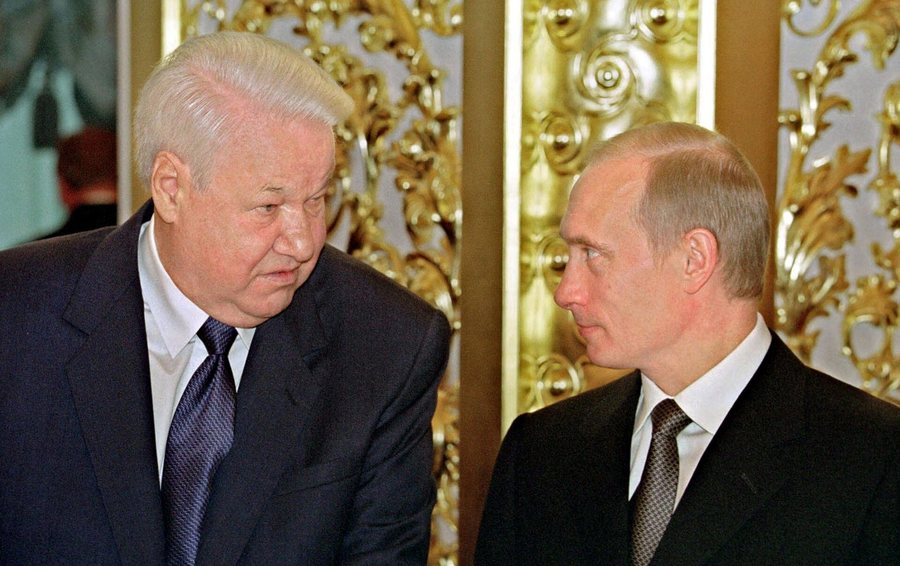
But does Putin himself believe that he has fulfilled Yeltsin's request to "take care of Russia?"
I will never forget New Year's Eve 1999. I was working as a producer in the BBC's Moscow office. Suddenly came the latest news: President of Russia Boris Yeltsin resigned. His decision to resign surprised everyone, including the British press corps in Moscow. There was no correspondent in the office when the news broke. This meant I had to step in to write and broadcast my first BBC dispatch.
"Boris Yeltsin has always said he will finish his full term in office," I wrote. "Today he told the Russians he had changed his mind," I continued.
It was the beginning of my career as a reporter. And the beginning of Vladimir Putin as the leader of Russia.
After Yeltsin's resignation, in accordance with the Russian constitution, Prime Minister Putin became acting president. Three months later he won the election.
On leaving the Kremlin, Yeltsin's advice to Putin was: "Take care of Russia!" I've found myself recalling Yeltsin's words more and more as Russia's war against Ukraine approaches the three-year mark.
That's because President Putin's all-out invasion of Ukraine has had devastating consequences. Mainly for Ukraine, which has seen massive destruction and casualties in its cities. Almost 20% of its territory has been occupied and 10 million of its citizens have been displaced.
Since Vladimir Putin's decision to launch the so-called "special military operation" Russia has suffered heavy losses on the battlefield.
-Russian cities and towns are under regular drone attack
-Ukrainian soldiers have occupied a part of Russia's Kursk region
- International sanctions are putting pressure on the Russian economy
-Furthermore, the country's demographic situation is serious
-Internal repression has increased rapidly
I've been reporting on Putin since he came to power a quarter of a century ago. On December 31, 1999, who would have thought that Russia's new leader would still be in power two and a half decades later? Or that today Russia would wage war against Ukraine and confront the West?
I often wonder if the course of history would have been completely different if Yeltsin had chosen someone else to succeed him.
One thing I can say for sure: In these more than twenty-five years, I have seen different Putins. And I'm not the only one.
"The Putin I met with, did good business with, established a NATO-Russia Council with, is very, very different from the current one ," former NATO chief Lord Robertson told me in 2023.
"The man who stood by me in May 2002 and said that Ukraine is a sovereign and independent nation-state that will make its own security decisions is now the man who says that Ukraine is not a nation-state. I think that Vladimir Putin has a great ambition for his country. The Soviet Union was recognized as the second superpower in the world. Russia cannot make any claims in this regard. And I think this is his ego ."
This is one possible explanation for the change we've seen in Putin: his burning ambition to "make Russia great again" (and to make up for what many perceive as Moscow's Cold War losses) puts Russia facing clashes with its neighbors – and with the West.
The Kremlin has another explanation. From the speeches he gives and the comments he makes, Putin seems driven by resentment, by an overarching sense that for years Russia has been lied to and disrespected. While its security concerns have been dismissed by the West.
But does Putin himself believe that he has fulfilled Yeltsin's request to "take care of Russia?"
I recently had a chance to find out. More than four hours into his long year-end press conference, Putin invited me to ask a question. "Boris Yeltsin told you to take care of Russia," I reminded the president. "But what about the significant losses in the so-called 'special military operation', Ukrainian troops in the Kursk region, sanctions, high inflation. Think you've taken care of your country?"
"Yes," answered President Putin. "And I'm not the only one taking care of it. We've been pulled back from the brink," he said.
He portrayed Yeltsin's Russia as a country that had lost its sovereignty. Putin accused the West of "coddling" Yeltsin while "using Russia for its own ends". According to Putin, he was doing everything to ensure that Russia was an independent sovereign state.
Posing as a defender of Russian sovereignty: is this an attempt to justify the war in Ukraine? Or does Putin really believe this position on modern Russian history?
I'm still not sure, but I think it's an essential question. The answer to it could affect how the war ends - and Russia's future direction./ Adapted "Pamphlet" from "BBC"


Lini një Përgjigje